News for hackers. Stuff that matters.
Re:Busting Modern Hardware Myths (2013) by yvdriess on Friday June 27, 2014 @03:56PM (#7956001)
Are any of these a surprise to anyone here?

I am not asking this rhetorically.

Re:Busting Modern Hardware Myths (2013) by t1m on Friday June 27, 2014 @07:09PM (#7956694)
I found the SSD discussion very useful. Bottom line is that deleting (or rewriting) data causes unpredictable and degraged write performance due to "write amplification". Sticking to appends-only writes keeps things fast.

I certainly wouldn't discourage anyone from watching the video. At least read the slides!

http://gotocon.com/dl/goto-aar-2012/slides/MartinThompson_My...

Re:Busting Modern Hardware Myths (2013) by p1esk on Friday June 27, 2014 @05:50PM (#7956446)
For me, the surprise was to learn that access time for L1 cache is 3 cycles. I thought it should be 1 cycle.
Re:Busting Modern Hardware Myths (2013) by Tuna-Fish on Friday June 27, 2014 @06:35PM (#7956582)
Actually 4 cycles for modern cpus. The access time of a cache depends mostly on it's size (wire delay and switching time for the access tree). This means that cache sizes are always tradeoffs between hit rate and access time. As cpus get better at hiding latency, the access latency is loosened.
Re:Busting Modern Hardware Myths (2013) by mtdewcmu on Friday June 27, 2014 @09:24PM (#7957114)
I was a little surprised that it was called a myth that CPUs are not getting faster. CPUs may still be getting a little faster, but they are way off the exponential curve that they were on at one time. They look like they're asymptotically approaching some constant now. It certainly wouldn't hurt your code at all if you make the assumption that CPUs are no longer getting faster. Your code would probably be better.
Re:Busting Modern Hardware Myths (2013) by InclinedPlane on Saturday June 28, 2014 @05:29AM (#7957831)
CPUs are still getting a lot faster, at a geometric rate. But they are doing so at a different rate than they did in the '90s, where CPUS were getting enormously faster year over year.

Here's a chart (note that the vertical scale is logarithmic): http://preshing.com/images/integer-perf.png
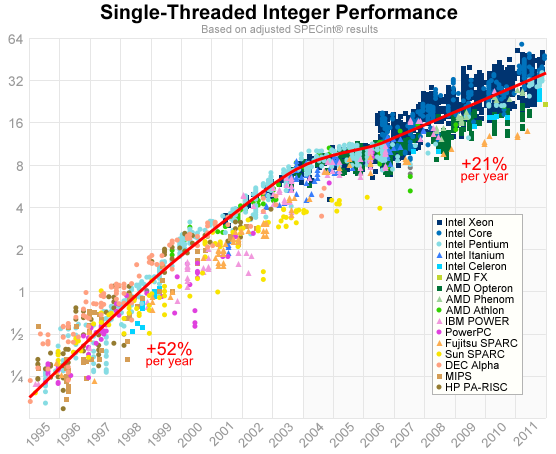
In the '90s processors were doubling in performance every 20 months or so (i.e. a factor of 64x per decade). Since about 2005 processors have been doubling in performance about every 43 months. This is much slower than the insanely fast rate during the '90s but it is still very fast and still on an exponential curve.

Re:Busting Modern Hardware Myths (2013) by lloeki on Saturday June 28, 2014 @05:55AM (#7957872)
> Here's a chart

Interesting that in order to compare apples to apples it's single threaded. That means for a back of the envelope estimation of ideally parallel loads performance, the graph goes "through the roof" since it's exactly twice on my laptop or four times on my desktop.

Re:Busting Modern Hardware Myths (2013) by cma on Saturday June 28, 2014 @11:21AM (#7958397)
The graph is logarithmic, so it might not go entirely through the roof.
Re:Busting Modern Hardware Myths (2013) by mtdewcmu on Saturday June 28, 2014 @04:36PM (#7959253)
Why does it stop at 2011? The last that I've heard of Haswell was that it was a paltry improvement, and that core will be around for the next couple years.
Re:Busting Modern Hardware Myths (2013) by InclinedPlane on Monday June 30, 2014 @12:38AM (#7963722)
That was just the most thorough chart I'd found. Rest assured, the trends have continued since then.
Re:Busting Modern Hardware Myths (2013) by gizmo686 on Friday June 27, 2014 @08:15PM (#7956899)
Network cards write directly into cache
Re:Busting Modern Hardware Myths (2013) by hhw on Friday June 27, 2014 @08:34PM (#7956943)
This feature, known as DDIO, is only on Intel's Xeon E5 and E7 v2 family CPUs. So, it's not quite ubiquitous yet, nor have there been any announcements on when it will become available (if ever) on the lower Xeon E3 or any of the desktop lines, despite a good amount of information already having been revealed on the next 2-3 generations of processors.
Re:Busting Modern Hardware Myths (2013) by neckbeard on Saturday June 28, 2014 @01:55AM (#7957559)
DCA (Direct Cache Access) has been around for a while - DDIO is its replacement on higher end Xeons.
Re:Busting Modern Hardware Myths (2013) by wtracy on Friday June 27, 2014 @06:56PM (#7956648)
The idea that mutating files in place is actually very expensive is new to me.
Re:Busting Modern Hardware Myths (2013) by ohashi on Friday June 27, 2014 @05:37PM (#7956407)
It was definitely interesting to learn a few little things like 1 divide being slower than +-