Re:Introducing Swift
by creativeembassy on Monday June 02, 2014 @03:06PM
(#7835294)
I spent a lot of time trying to do stuff with ObjectiveC, but just hated the syntax. That's been the biggest thing keeping me from developing Mac OSX apps; I just prefer Ruby's simplicity. I'm going to seriously give Swift a try.
[ Parent
| on HN ]
Re:Introducing Swift
by will_work4tears on Monday June 02, 2014 @03:12PM
(#7835363)
Yep, same here. It looks pretty JavaScript-y, which is familiar at least. I think this is a good move on Apple's part.
Re:Introducing Swift
by stcredzero on Monday June 02, 2014 @03:25PM
(#7835527)
It's probably a wise decision to have an "Algol patterned" language. No non Algol patterned language has ever become a mainstream programming language to my knowledge.
I am not a programming language wonk; so I imagine most languages I am familiar-with/know-of are necessarily Algol patterned. What are some non-Algol patterned languages?
Lisp, Forth, Prolog (and Erlang), Smalltalk, Haskell, and Tcl all come to mind.
Re:Introducing Swift
by stcredzero on Monday June 02, 2014 @04:19PM
(#7836050)
In particular, Obj-C = Smalltalk + C. If you subtract C from Obj-C, you'd most easily just end up with Smalltalk. But that's not the right move for mass adoption.
I agree with the first, but disagree with the second part:
COBOL, Fortran, JCL (not Turing complete, AFAIK), SQL, Excel, DOS batch files all were (fairly) mainstream at some time.
Fortran came before Algol and arguably influenced it[1]. I agree with COBOL and SQL in particular, though.
[1] http://www.digibarn.com/collections/posters/tongues/Computer...
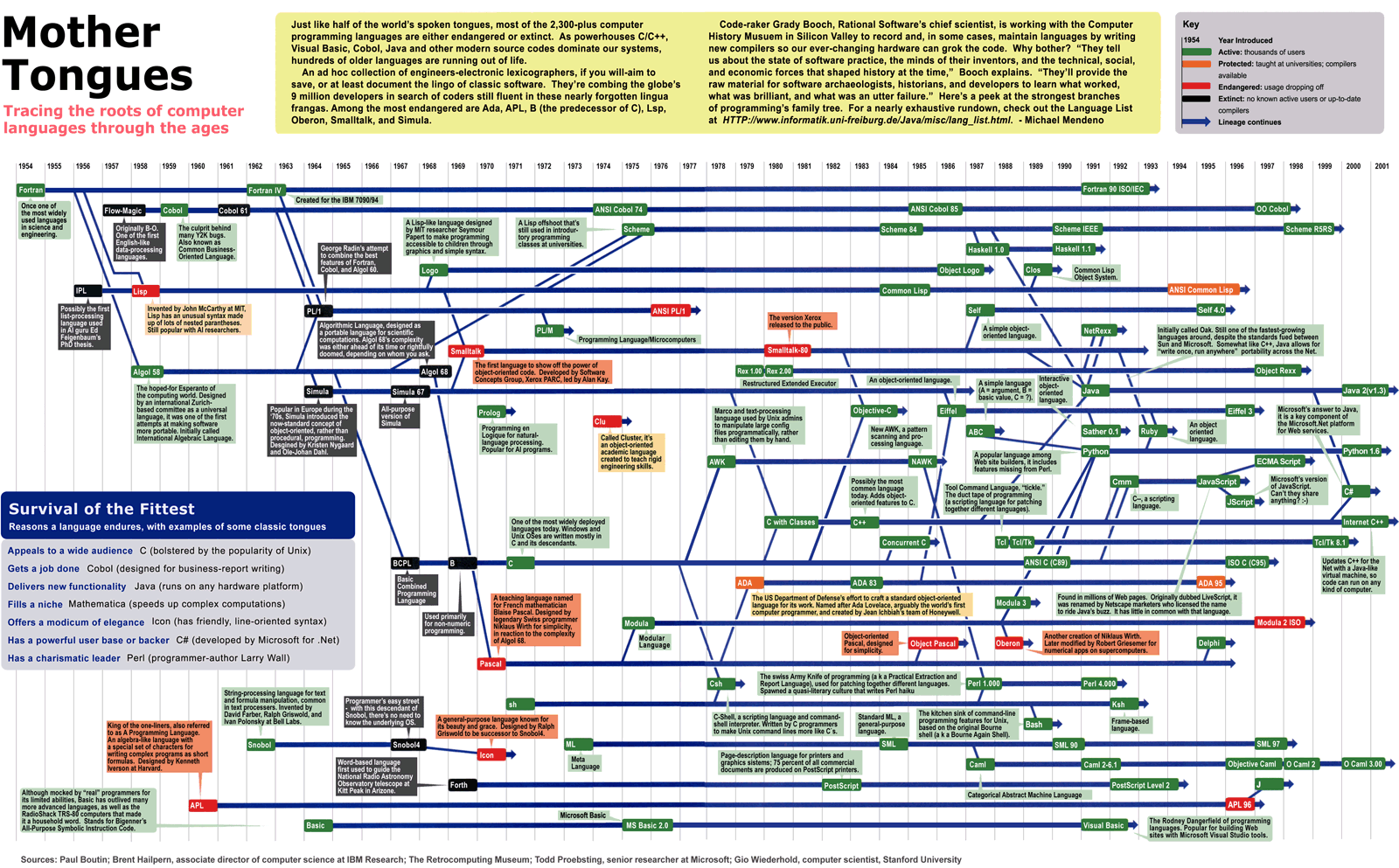
The correctness of that image can be discussed. Fortran was specified in 1954, but the first compiler shipped in April 1957 (http://en.wikipedia.org/wiki/Fortran#History). That is earlier than Algol 58 (first two implementations in 1958 (http://en.wikipedia.org/wiki/ALGOL_58#Time_line_of_implement...), but close.
More importantly, "inspired by" does not imply that Fortran 58 is Algol-like (that same picture would declare Fortran Lisp-like, too)
For me, http://en.wikipedia.org/wiki/Fortran#Simple_FORTRAN_II_progr... certainly is nothing like Algol.
Re:Introducing Swift
by VeejayRampay on Monday June 02, 2014 @06:45PM
(#7836984)
Ruby is simple and beautiful, isn't it? Too bad it never got the shower of money from big backers Javascript, PHP and now Swift got blessed with.
Beauty is in the eye of the beholder, but Ruby is anything but simple. It has one of the most complicated syntaxes of any programming language in common use.
Perl and C++ are still in the lead, but with stuff like the gratuitous introduction of alternate hash syntax, new-style lambdas, etc., Ruby is catching up.
Re:Introducing Swift
by steveklabnik on Monday June 02, 2014 @09:43PM
(#7837685)
Ruby's grammar is complex, but it's object model is incredibly simple.
Re:Introducing Swift
by VeejayRampay on Tuesday June 03, 2014 @04:15AM
(#7838681)
Introduction of a new hash syntax wasn't gratuitous really. I think the point was to make up for the lack of proper keyword arguments. Now that they're available, it's true that it doesn't have a reason to stand on its own, but it does make the code more readable and concise, as does the stabby lambda syntax. Though I do agree with your point on simplicity really, the language does offer way too many ways to do the same thing sometimes.
Re:Introducing Swift
by alecthomas on Monday June 02, 2014 @09:52PM
(#7837705)
It'll never catch C++ [1]
[1] http://stackoverflow.com/questions/23980929/what-changes-int...
Tried http://macruby.org/ ?