Re:Why Chinese Is So Damn Hard (1992)
by daphneokeefe on Monday April 21, 2014 @03:59PM
(#7623340)
English must be pretty damn hard, too. When I studied conversational Mandarin a few years ago, it gave me a real sympathy for native Chinese speakers learning English. Basically, in Mandarin, there are no verb tenses or cases or persons. I go, you go, he go, they go, or I is, you is, he is, they is. You don't know when it happened. Today, yesterday, tomorrow. You get the timing from the context. How hard it must be to understand that it's a different word if I went yesterday, we are going tomorrow, he might have gone, if we could have gone....I can't do more than basic conversation in Mandarin, but studying it really helped me to understand the challenges some of my friends and coworkers have faced.
[ Parent
| on HN ]
Also, things like articles (the, a, an). My Chinese father, an academic biologist, sometimes asked me to help him copy-edit papers. It was difficult for me to explain when to use the definite article, the indefinite article, or no article at all. For me, as a native speaker of English, there wasn't a hard-and-fast rule. One way just "felt right".
Even something as trivial-seeming as gender causes trouble. I know a lot of Chinese speakers who I'd happily describe as fluent in English, and just about all of them routinely mix up he/she, him/her, and the like.
It's like the trouble that English speakers have with noun genders in Romance languages, but taken to an extreme.
Chinese also mix up "last" and "next", just as English-speakers learning Chinese mix up 上 and 下 for time words. The English metaphor for time is climbing a mountain, whereas the Chinese one is script written top to bottom.
Wait, really? That's surprising, since pronouns in Chinese are gendered. However, they are all homophones, so that might be the reason for confusion.
It's not that surprising when you consider that native English speakers routinely mix up "your" and "you're". Native Chinese just aren't used to thinking about pronoun gender when speaking.
It's not quite the same, though. Native English speakers don't mix up 你的 and 你是 when speaking Chinese. Although "your" and "you're" sound the same, it seems that we still inherently consider them to be different words, and the mixup when writing is more of a spelling problem.
I can't think of a better equivalent, though. Fiancé and fiancée come close, but most English speakers don't even know that there are different ways to write that for male and female.
You're right, it is kind of surprising. I guess the spoken takes precedence over the written somehow. There's even occasionally an incorrect "it" thrown in for good measure.
Tell me about it. I still do not understand why you need to put am after I but is after he. Isn't it clear 'I is' is different from 'he is'? Another thing troubling me is whether to reply yes or no on questions like "didn't you agree?". I also think it would be nice for English to have more compound words like "sunflower". I am not even starting on the cultural part yet, since I am still studying the evolvement from illegal to undocumented.
> Another thing troubling me is whether to reply yes or no on questions like "didn't you agree?"
Native English speakers often get confused by this one too. You can respond either yes or no in those situations as long as you specify the one you wanted afterwards.
    e.g. "Don't you agree?"

"Yes, I agree" and "No, I agree" would both be acceptable.I've heard of many situations where East Asian students of English cause confusion by answering "Yes. Yes, I don't agree." — which doesn't sound natural in English.
All of the different forms of "to be" come from different words in old languages. We get "am" and "is" from Latin, but I am not sure about the other tenses. Google says that all of the others are a collection of words "Indo-European," which indicates that it is some language from ancient times.
As for answering questions with a presumed answer, one of the best things to do is to restate the verb when you answer. "Didn't you agree with him?" "Yes, I agreed with him." This way, it is clear to everyone.
Re:Why Chinese Is So Damn Hard (1992)
by crazychrome on Monday April 21, 2014 @04:16PM
(#7623479)
Exactly. Even after 10 years living in UK I still make mistakes with verb. Consider this: http://www.verbix.com/webverbix/English/have.html, a table just for "have"!
Dude, that's nothing. Romance languages are much worse. Check out Italian: http://italian.about.com/library/verb/blverb_avere.htm
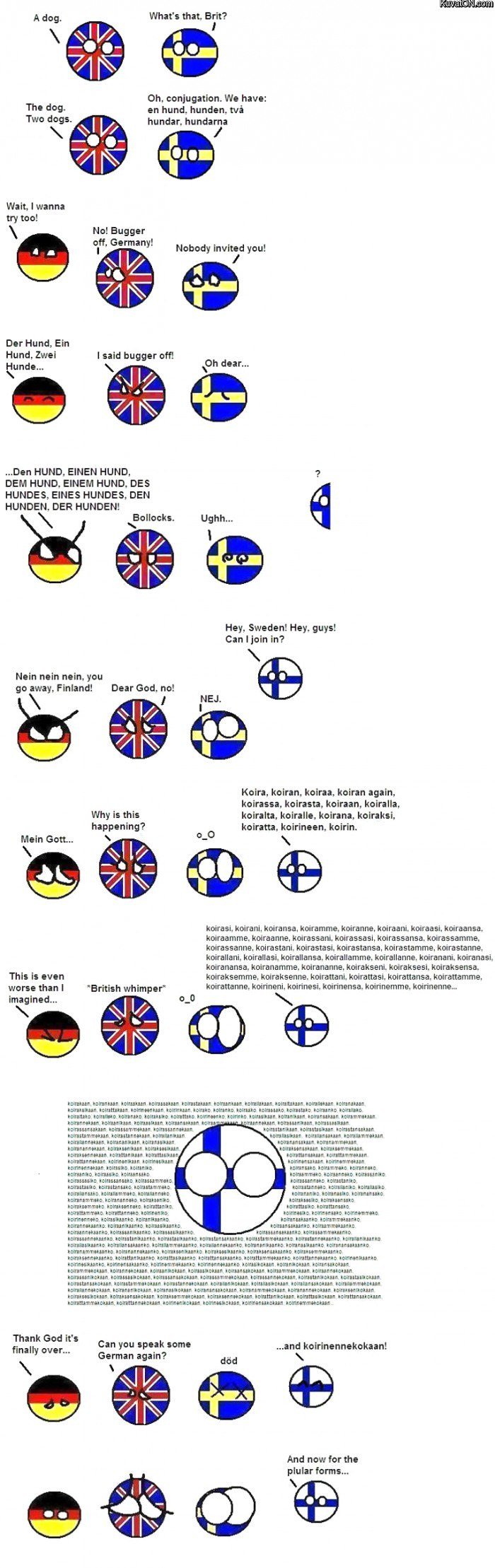
Well, then there's Finnish with its noun cases, etc:
http://static.fjcdn.com/pictures/Perkele_ddd3f7_5063375.jpg
What's so complicated about that? It's far from the most irregular verb in the language. The participle is really the only curve ball.