You've obviously never done any serious electrical or electronics work then. The reason they're so expensive is four reasons:
1. Mains and high voltage work. If you're working with high voltages or massively different potentials, Fluke actually design the boards and isolation circuitry properly. You're not going to get electrocuted by a Fluke meter. It doesn't even take a high voltage, just a bad earth to kill you. Cheap multimeters and even mid range ones tend to ignore this fact in favour of cost.
2. Explosion resistance. If you stick your cheap multimeter in resistance mode and whack ot across a 400v 30A supply its going to blow your hand off. No joke. Fluke - dead meter by design or absolutely nothing and it still carries on working.
3. Reliability. I have a 1989 Fluke 87 that cost me a small fortune. It works fine today, still handles calibration perfectly and is pin sharp and accurate. Other vendors fall to bits, drop out of calibration ranges and pack in completely. I know because I have three meters at any time and the only ones that survive are flukes.
4. They have lesser effect on the circuit you are measuring because the input stage is better designed.
So you're merely putting your life in the hands of a $10 meter.
My current fluke cost me £435 and it was worth every damn penny
Edit: adding some more as I'm not posting this from my phone now:
5. Cheap meters can't do true RMS measurements.
6. Cheap meters have probes without correct insulation.
7. Cheap meters have probes which fall to bits and expose the conductors.
8. Cheap meters have less probe/connection options which are required for more than just passive metering.
9. Cheap meters can't be calibrated at all by calibration services as there is nothing other than a single master voltage reference inside which is usually not a constant current or voltage source but a resistor/voltage divider across the reference voltage. This can drift as batteries drain for example.
10. Decent meters have a better count i.e. 0.00000 vs 0.00 on the displays.
I could go on forever at why a $10 meter is a joke.
My first Fluke multimeter was a hand-me-down from my father, and he had made it clear how it was a better instrument. At the time, there were no "Fluke yellow" instruments on the market. They were generally considered ugly.
Fast forward through the 1990s and I'm in a builders supply shop looking at meters. I grab what I thought was a Fluke, got home, and only then realised I had a cheap knockoff. Yes, my fault for not reading, but a large number of second generation tool users have been raised to invest in the products of a few companies that have maintained solid reputations.
From what I can tell, in the time period you're talking about even Fluke meters weren't "Fluke yellow" though - e.g. http://www.stevenjohnson.com/pics/why-i-buy-flukessm.jpg
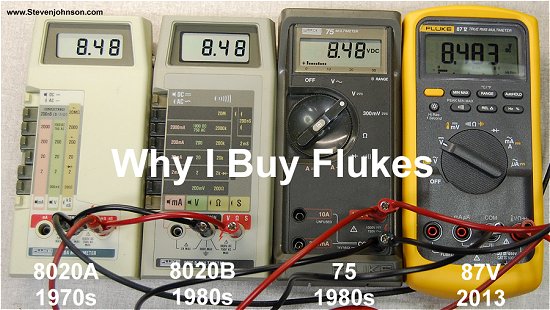
They definitely used yellow and black in the mid-to-late 1980s, primarily on "ruggedized" field gear. Bench gear tended to look pretty much like most bench gear, as far as I can recall.
For some reason it was that detail and sensitivity that made me realize just how precisely made meters like that are. Thankfully it was just a $7 fuse to fix it.
Depends what you mean "dominate the market", I guess: go to Amazon or Radio Shack, and most of the multimeters are the cheap and non-Fluke.
Also: Fluke does certainly charge a premium, but they are also not equivalent to the $10 meter. Fluke uses higher-quality (and thus more expensive) components, and it definitely costs them more than $15 to manufacture. This affects the actual electronics to the case to the probes to the buttons.
If you use your meter to measure your batteries and the occasional resistor, you probably don't care. But if you use the meter often, you may start to notice the difference, and that's why people are willing to pay that higher price--it really is worth it to some.
The fact that Fluke can sell $150 multi-meters when they can be made for $15 is because of the substantial value people attach to branding. $100 Ralph Lauren jeans are made for $10 in Vietnam or wherever, and the only piece of that product protected by trademark is the little RL label (fashion designs cannot be protected). But that's all it takes.
I've been through any number of cheap multimeters over the years and finally broke down and bought a Fluke. It's been absolutely solid. Worth it.
Lets imagine the outcome of two theoretically unrelated possibilities:
1) For safety reasons someone (who?) has purchased an OSHA regulation which now requires that all electricians use high contrast yellow multimeters, yellow indicating their, uh, safety-ness or something.
2) Fluke has paid the .gov to be the only legal yellow multimeter supplier.
I know #2 is true. I suspect but have no evidence #1 is true.
What a pointless thing to enter into your widely connected information appliance. If you think it is true and has some merit as an idea, spend the couple minutes to actually inform us, alternatively just don't bother telling us what you think might be true.
Is it then impossible to sell a product because it would always interfere with someone else's color?
BTW, I agree with other EEs, the Sparkfun meter is not "really great high-quality" as they claim. It will suffice for hobby use, but Fluke's markup is based on having additional quality, not brand recognition.
1) You can't just apply to protect an arbitrary color. You need to show secondary meaning (i.e. the market associates the color in a certain context with your brand). It is unlikely for that to happen with more than one brand in a particular space.
2) The color can't be functional and can't affect the quality or value of the product. So Apple can't trademark aluminum-colored laptops, nor can you trademark yellow or orange traffic cones.
3) With respect to running out of colors, that issue is addressed on pages 168-169. The gist of the argument is that if people "use up" the high-contrast color schemes, than not being able to use some mark will put competitors at a functional disadvantage, which will invoke the functionality bar mentioned in (2), invalidating the other color marks.
That's a totally different "crime" if you want to call it that. Has nothing to do with whether a company has the right to trademark a particular design which in this case they apparently do.
Also maybe there are some other issues at play with precision, calibration and/or taking higher voltages/amperage? Or just not blowing up if you try to measure the wrong circuit with way too much power?
1) Multimeters can be made for $10 or $15, but Fluke continues to dominate the market with equivalent meters costing 10x more. And don't tell me that these basic multimeters incur significant R&D costs.
"Guilt should be determined in retrospect based on material gain." -- The gold standard for judging extremely powerful companies.