I'd go beyond that: they're complimentary to non-resistance training, and can even help address some of the negative effects of them.
Running's actually pretty good all-around, though it does little for your upper body. Strength training can help there.
For swimming and cycling, a problem is actually the non-weight-bearing nature of the activities. For cyclists, combined with the electrolyte imbalances from sweating and insufficient food intake, bones can actually weaken. Again, whole-body strength training will make up for this.
But surely up to a point? I find it hard to believe that guys growing so much meat on themselves that they can't clap their hands over their head get only largely positive health effects.
How's having hand, that when shaken by somebody feels like kaiser roll for them, improves health?
> I feel silly that I'm even bothering to justify myself to an internet stranger.
Sorry. No offence meant. I can respect bodybuilding as a hobby (part of life that has self contained meaning and brings pleasure by itself). I just see people doing it as if it was a mean to something and that's what eludes me (apart from, growing muscles to attract some girls, I get that).
Muscles don't make you inflexible. Inflexibility is what makes you inflexible. Olympic weightlifters and gymnasts are both heavily muscled with high mobility. Try overhead squatting some time. It's harder than it looks.
A common cause of difficulties is in benching heavily without working the shoulder through external rotation. You see it a lot in powerlifters and in the general "bench bro" population.
> I just see people doing it as if it was a mean to something and that's what eludes me
I lift weights for a number of reasons. Primarily to get better my sport, which is ... lifting weights.
First off: even some really big guys can be amazingly flexible: http://1.bp.blogspot.com/-mO3twKxKpqc/UfaQxvShokI/AAAAAAAAV0...
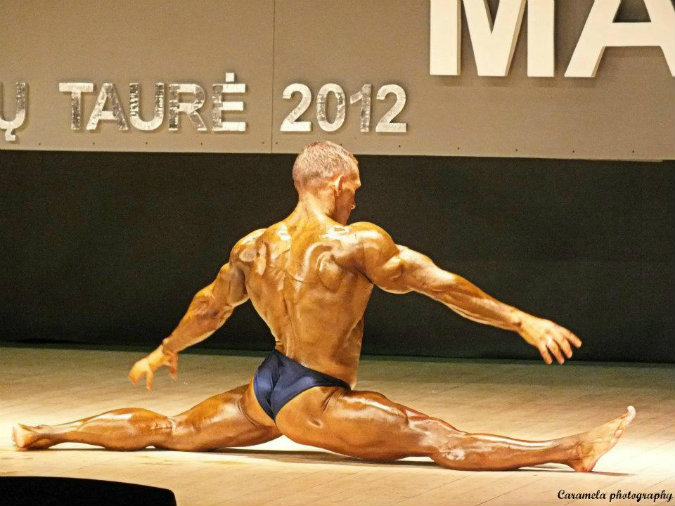
It's really got more to do with tendon and ligament mobility than anything else.
The other: you're simply not going to get that big without drugs. A really good natural bodybuilder will look more like this:
http://mybodyhealth.net/wp-content/uploads/2013/01/tumblr_md...

That's defined, but not huge. And he's doing better than most.
You can get the positive results of strength training at or below these levels.
To extent you get improved flexibility from lifting with proper form, but if you don't get flexible enough, you've got no choice than to work on it in other ways: Staying inflexible while lifting is a surefire way of getting hurt badly.
Body builders can "get away" with less flexibility, but as your pic shows they certainly don't have to be less flexible.
Building muscle is not equivalent to body building. Body building is a distinct sub-culture within the strength sports. Not everyone who lifts is interested in getting as big as possible.
When people take steroids to gain muscle beyond that it's not healthy. Also a beginner in a plateau who can only bench 160 has no business taking steroids, he's not the target audience.
Also weird hypertrophy routines dependent on machines, ignoring the core free-weight lifts aren't healthy. Many bodybuilders have muscle in unnatural places, which screws up their flexibility, mobility, and make them look disproportionate. Freakishly big bodybuilders spend hours stretching to avoid becoming muscle bound.
These practices give weightlifting a bad reputation but are easily avoided by not practicing them.
If it helps put things into perspective - it's a rare person who wakes up and wishes that they were weaker than they were the day before. However, that's precisely what happens to you if you don't engage in resistance training; this is especially true the older one gets.
However:
> It's like getting fat on purpose.
The downstream health effects of developing muscle tissue (and increased bone density) are largely positive; of fat, largely negative.
Weight training improves insulin sensitivity, improves various cardiovascular markers, strengthens the heart and improves bone density. People who train with weights live longer, with fewer health problems, with shorter senescence, than people who don't.
These health effects are distinct from the health effects of non-resistance training such as running, cycling or swimming.