a) A higher standard? Sure. I suppose I'm extremely naive, but if you spend your day punishing people for doing X, I think you should have an appreciation for why you shouldn't be doing X or at least be a role model for not doing X.
b) I actually wouldn't guess that, among the general populace, the majority of people regularly speed at 90-130. Again, that's probably naive. I drive like an elderly person, so I may be biased.
Regarding speeding, I don't see how the current system can hold up under technological advances. There are a dozen trivial ways to tell if someone is speeding, from the toll booth data of the original article to cell phone GPS to computer vision to road sensors to smart cars. It doesn't make sense for the police to perform inefficient, dangerous traffic stops when all this data is available, but the system would collapse if everyone received 10 traffic tickets a day.
I agree with your sentiment. But please bear in mind, that the profit per radar gun would probably go down, if enforcement was less sporadic.
But it does provide a way to pick-and-choose when enforcing laws.
That said, while people may complain about particular speed limits, I don't think very many would call a cap somewhere below 120mph "unjust".
Plus there's the issue of driver's ability as well. Can you look in your side mirror and successfully gauge the speed of the car that's a good distance behind you to know whether you can safely change lanes? If the car is going at a known max speed, of which you are probably aware of as you are likely at that speed yourself, then you can change but if the car is going two to three times faster than you I would imagine changing lanes would be a bad idea.
Also, how would the police be able to judge the things you describe looking at your car driving by at 120 MPH while everyone else is driving in the 80s? The officer would have to constantly be pulling these people over to check their "licensed to speed" status. How would the officer be able to judge the conditions of your car as you breeze by? Sticker on the bumper? Better be a huge freaking sticker when you are flying through traffic.
Speed limits are decided upon on the safety of most cars for the general area and expectations of traffic conditions, not the capabilities of the cars or drivers on the road.
However, there is one common case where the speeding law seems unnecessary at best. I live in Texas. Florida is similar in that there can be large stretches of empty highway. When I travel outside the city there is often very little traffic and very open country. If I can see for a mile and I am the only one out there, why shouldn't I travel at the fastest speed I can manage safely? In the city speeding rarely pays off, what with traffic and traffic controls. On a trip of 200 miles (Austin to Dallas for example) the difference between an average speed of 60 m/hr and 90 m/hr is an hour of travel. It seems wrong that I should be limited in this situation because an 18-wheeler cannot handle more than 60 or 70 safely. Worse is when you have small towns that drop the speed limit to 55 or 45 for a tiny stretch of road when the road does not even go through the town. That kind of speed trap is what angers people, especially when you see an officer blow through with impunity.
There are examples of US interstates with no speed limits within, to some people, reasonable limits:
http://www.motorists.org/press/montana-no-speed-limit-safety...
They even discuss how in some cases fatalities go up with new road laws and speed limits.
I have driven that stretch of road between Austin and Dallas as I live in the Dallas area. I have also lived in Florida with it's stretches of long, boring roads. Plus, I've lived in Vegas with that incredibly boring route into Los Angeles. In every case I would agree with you that the idea of being able to go a bit faster would have been nice.
But the question that will come up is how do you determine the maximum speed that you can safely manage? What if your assessment of your max speed differs with that of the police officer who witnesses what he feels is a dangerous amount of speed? What about other people on the road that you will eventually come across that can't handle the situation that you present if you decide that the person can handle a speed that in truth they cannot? I'm sure you're thinking you'll just slow down when you see someone but you cannot foresee the possibilities plus your reaction time dwindles quite effectively the faster you go. A mile at 60 MPH is one thing, a mile at 120 MPH is another.
My example against this, which is interesting considering the topic of this thread, is when I was in Vegas an off-duty cop was speeding (I forget how much but in excess of 100 MPH) on one of the interstates outside of the main part of town and rear-ended a family in their car. The resulting accident killed a number of them including children. Therefore, I personally don't like the idea of a free-for-all on the interstate where different cars can drive at different speeds based on criteria that will be different for each individual driver and car. I would rather we all agree on a maximum speed that makes sense for the conditions of the road and expected traffic. Now if a road has too slow of a speed limit for the typical conditions of that road, then that is a different discussion.
http://cbsdallas.files.wordpress.com/2010/10/i-35-texas_6713...

(Ok, that's downtown Austin; how about this one:
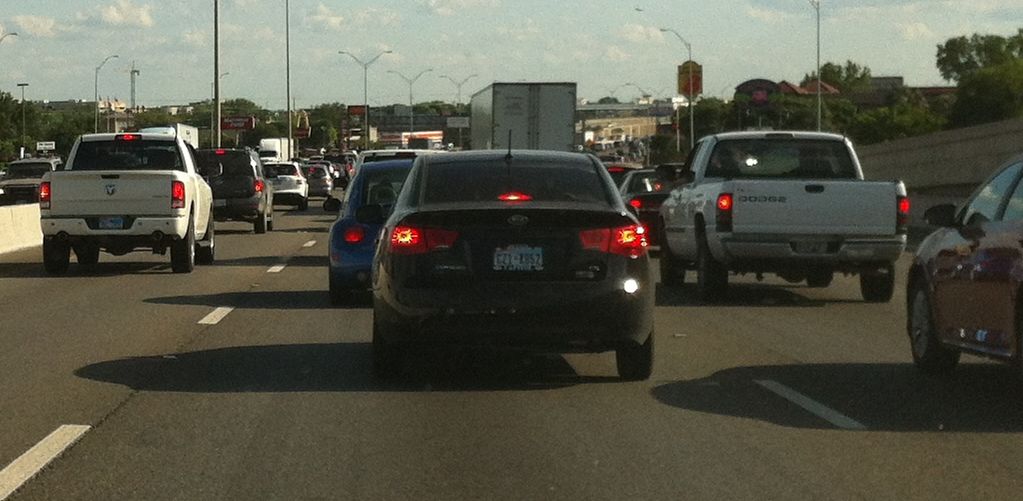
How can we expect them to investigate abuse of position if they are abusing their position?
Yes! Of course! Being an officer may be 'just a job', but in practice the hat doesn't come off. Which is the entire point - police officers occupy a particular position in society regardless of whether or not they're wearing a badge at the moment.
That's not the same thing as saying that I'm surprised that they're still human, though.
> Unless you wanna have robots do it instead
Not really. It's been shown time and again that greedy authorities will compromise on public safety to optimize profit. And, machines tend to have no discretion. Nor is any applied by the authorities. If you show up to an intersection at two am, with nobody in sight, stop, look and proceed safely through a red light, you get the same citation that some jerk gets who blows through on a busy day.
This a feature, that protects and racism and classism.
You've got a point.
>and classism.
Meh, I'm not so sure about that one, and really, in both cases it depends where the machines are sited.
This. If we believe that people will tend to behave in accordance with their incentives (and we all do, because we're all good capitalists here) then this is a virtual certainty.
Cops get paid X per year. So, all things being equal, some number of people who think it is worthwhile to do the job for X per year will sign up. A few will take the job because they want to help people, so they are willing to work for less than they would at some other job. At the same time, and in the same vein, a few will take the job because it allows them "perks" like hurting people and generally breaking the law without consequence. This is why it is so, so important to hold police to a higher standard, because in the long run we want more of the "want to help people" type and fewer of the "want to break the law" type.
Do you hold them to a higher level of moral responsibility during their off time because of what they do for a living?
Only if they get "professional courtesy" every time they get pulled over, unlike the rest of us that get traffic tickets.
In a word, yes! I expect a judge to engage in ethical behaviour when not behind the bench, a politician to tell the truth (as laughable as that is) and so on. Sure, cops are human but they should also know that by virtue of their position they are much more visible than the ordinary citizen and act accordingly. Surely you can see the hypocrisy of a cop giving tickets for speeding when they get away with the very same behaviour. Maybe I'm old fashioned, I think cops should not be able to say "Do as I say, not as I do."
If you can't tell the difference between cause and condition, you may keep silent. No one is forcing you to participate in the discussion.
My point was, that in a large proportion of the accidents where people are killed and where drivers are speeding, people state that that it was the drivers inattention that caused the accident, and not the speed they were going. They use this to suggest that we should not prosecute speeding.
While this is technically true, (one of) the reason that we impose speed limits is that an accident caused by, e.g., inattention or mistake is turned from a fender-bender into a fatal accident by high speed.
Even the best drivers make mistakes from time to time, we have a right not to have that mistake turn into a fatal accident by someone speeding.
A particular crosswalk in my city was a dark spot, accident wise. A common accident spot, resulting in deaths. Speed traps were, for years, commonly placed in the street, treating, I assume, the perceived cause of the accidents. Speed bumps followed. Years go by, accident rates don't go down. Then, finally specific street lighting is setup on the crosswalk: problem solved. The cause was not excess speed, but night visibility of the crosswalk.
One of the worst mountain roads in Portugal, IP4, was for years considered plagued by speeding. Lots of police cruisers, both marked and stealth, patrolled the road, enforcing limits. Static speed traps the ensued. Accident rates stubbornly wouldn't go down. Then, finally, a brilliant mind decided to place plastic lane barriers preventing overtaking in prohibited zones. Problem solved! Speed was not the cause, dangerous overtake maneuvers were.
Speed is an easy target. As such, it's a dangerous default as accident cause.
That's how the number on the sign relates.
I have talked to a lot of state patrolmen in CA and WA (USA) and they were cured of using their awesome driving schools for personal advantage after coming up on their first gruesome accident. Especially if said involved children.
People tend to think they're "exceptional" in some way, though, and will dismiss the risk by thinking that they are better trained and more aware of the factors that lead to accidents.
Did anyone really believe that taking a job as a police officer somehow suppressed these people's natural desire to drive fast? Hell, that's probably what make them join the force in the first place. Sure, it's irresponsible and illegal for off-duty officers to speed, but it's also irresponsible and illegal for regular citizens to speed, and yet that doesn't seem to stop them from doing it. Why would you expect the cops to be any different? Do you hold them to a higher level of moral responsibility during their off time because of what they do for a living?
Being a police officer is a job. Unless you wanna have robots do it instead, people are going to do what people are going to do.