News for hackers. Stuff that matters.
Re:Data journalism busts speeding cops, wins Pulitzer by samolang on Tuesday April 16, 2013 @10:09PM (#5562230)
Regarding a (at least in the US) I think a big part of the problem is a system of laws that people generally agree is unjust (i.e. the drug laws)
Re:Data journalism busts speeding cops, wins Pulitzer by nonce42 on Wednesday April 17, 2013 @12:01AM (#5562619)
I find it strange that the US has laws that many people break and the law is only enforced sporadically. Some examples in California are speeding, missing front license plate, age of consent laws, use tax on out-of-state/internet purchases, and illegal immigration. Having a bunch of laws that people break with impunity has a "broken window" effect, leading to less respect for the law overall. (Whether or not these laws are just is an orthogonal issue, which I won't get in to.)

Regarding speeding, I don't see how the current system can hold up under technological advances. There are a dozen trivial ways to tell if someone is speeding, from the toll booth data of the original article to cell phone GPS to computer vision to road sensors to smart cars. It doesn't make sense for the police to perform inefficient, dangerous traffic stops when all this data is available, but the system would collapse if everyone received 10 traffic tickets a day.

Re:Data journalism busts speeding cops, wins Pulitzer by lesterbuck on Wednesday April 17, 2013 @12:33AM (#5562699)
There is absolutely nothing new in tech advances that makes it easier to enforce speeding laws. In the 80s I read some book about beating speeding tickets, and they did the math about the profit margin on a radar gun. It turned out that the average radar gun generated a net profit on the order of $1000/day/gun. The obvious question is why aren't there radar guns on every police car? The answer is obvious: local politicians don't like to get tickets, either.
Re:Data journalism busts speeding cops, wins Pulitzer by eru on Wednesday April 17, 2013 @01:55AM (#5562918)
> It turned out that the average radar gun generated a net profit on the order of $1000/day/gun. The obvious question is why aren't there radar guns on every police car?

I agree with your sentiment. But please bear in mind, that the profit per radar gun would probably go down, if enforcement was less sporadic.

Re:Data journalism busts speeding cops, wins Pulitzer by talmand on Wednesday April 17, 2013 @11:06AM (#5564875)
One of the problems is that the US has so many laws on the books that law enforcement has no choice but to enforce it sporadically. If every law was enforced as written then I would imagine about 80% of the US population would be in the justice system in one form or another at any given moment.

But it does provide a way to pick-and-choose when enforcing laws.

Re:Data journalism busts speeding cops, wins Pulitzer by redblacktree on Wednesday April 17, 2013 @01:40PM (#5565833)
This makes it easier to target enemies.
Re:Data journalism busts speeding cops, wins Pulitzer by jamesaguilar on Wednesday April 17, 2013 @01:53PM (#5565904)
Not all cars are required to have a front license plate, just FYI. For example, when I got the license for my MINI, they only sent me one, and said that I didn't need to have one on the front.
Re:Data journalism busts speeding cops, wins Pulitzer by corwinstephen on Wednesday April 17, 2013 @03:01PM (#5566348)
Sort of ironic. When I bought my mini, it only had one license plate, and I've since received several tickets for that reason. #california
Re:Data journalism busts speeding cops, wins Pulitzer by jamesaguilar on Wednesday April 17, 2013 @04:49PM (#5567127)
Hmm. I might be wrong! Everything I'm looking at online seems to suggest I should have one. But they only sent me one!? I dunno.
Re:Data journalism busts speeding cops, wins Pulitzer by sampsonjs on Wednesday April 17, 2013 @03:27AM (#5563202)
Regarding CA, the vehicle code says something to the effect that the ticket a). must be given by an officer b). must no have financial incentive attached. Just ask the court that dismissed my red light camera ticket for "lack of prosecution". On that note: http://www.utsandiego.com/news/2013/feb/01/san-diego-red-lig....
Re:Data journalism busts speeding cops, wins Pulitzer by dllthomas on Tuesday April 16, 2013 @10:23PM (#5562270)
In my mostly uninformed opinion, drug laws are a huge part of the problem in terms of public interfacing with the police.

That said, while people may complain about particular speed limits, I don't think very many would call a cap somewhere below 120mph "unjust".

Re:Data journalism busts speeding cops, wins Pulitzer by nitrogen on Wednesday April 17, 2013 @03:10AM (#5563141)
The maximum safe speed really depends on the road, current traffic, weather, and the capabilities of the car. I could imagine some locations permitting safe travel at 120+. Maybe the revenue currently earned from speeding tickets can be gained by offering a "license to speed" instead, with increased driver training, insurance, and vehicle inspection requirements.
Re:Data journalism busts speeding cops, wins Pulitzer by talmand on Wednesday April 17, 2013 @10:57AM (#5564824)
You can't go by the capabilities of the individual car. You have to also account for the capabilities of the other cars on the road. If a Ferrari is speeding along at 120 MPH, which might be easily within its capabilities, there will be problems when it encounters the small Hyundai that can only achieve 90 comfortably.

Plus there's the issue of driver's ability as well. Can you look in your side mirror and successfully gauge the speed of the car that's a good distance behind you to know whether you can safely change lanes? If the car is going at a known max speed, of which you are probably aware of as you are likely at that speed yourself, then you can change but if the car is going two to three times faster than you I would imagine changing lanes would be a bad idea.

Also, how would the police be able to judge the things you describe looking at your car driving by at 120 MPH while everyone else is driving in the 80s? The officer would have to constantly be pulling these people over to check their "licensed to speed" status. How would the officer be able to judge the conditions of your car as you breeze by? Sticker on the bumper? Better be a huge freaking sticker when you are flying through traffic.

Speed limits are decided upon on the safety of most cars for the general area and expectations of traffic conditions, not the capabilities of the cars or drivers on the road.

Re:Data journalism busts speeding cops, wins Pulitzer by jdbernard on Wednesday April 17, 2013 @12:45PM (#5565463)
I agree with you in general. There needs to be a common speed for all cars because difference in speed is, I believe, the real cause of danger.

However, there is one common case where the speeding law seems unnecessary at best. I live in Texas. Florida is similar in that there can be large stretches of empty highway. When I travel outside the city there is often very little traffic and very open country. If I can see for a mile and I am the only one out there, why shouldn't I travel at the fastest speed I can manage safely? In the city speeding rarely pays off, what with traffic and traffic controls. On a trip of 200 miles (Austin to Dallas for example) the difference between an average speed of 60 m/hr and 90 m/hr is an hour of travel. It seems wrong that I should be limited in this situation because an 18-wheeler cannot handle more than 60 or 70 safely. Worse is when you have small towns that drop the speed limit to 55 or 45 for a tiny stretch of road when the road does not even go through the town. That kind of speed trap is what angers people, especially when you see an officer blow through with impunity.

Re:Data journalism busts speeding cops, wins Pulitzer by talmand on Wednesday April 17, 2013 @06:12PM (#5567674)
You make good points, but I'll say first your example of the obvious speed trap is a different problem of which I agree with you.

There are examples of US interstates with no speed limits within, to some people, reasonable limits:

http://www.motorists.org/press/montana-no-speed-limit-safety...

They even discuss how in some cases fatalities go up with new road laws and speed limits.

I have driven that stretch of road between Austin and Dallas as I live in the Dallas area. I have also lived in Florida with it's stretches of long, boring roads. Plus, I've lived in Vegas with that incredibly boring route into Los Angeles. In every case I would agree with you that the idea of being able to go a bit faster would have been nice.

But the question that will come up is how do you determine the maximum speed that you can safely manage? What if your assessment of your max speed differs with that of the police officer who witnesses what he feels is a dangerous amount of speed? What about other people on the road that you will eventually come across that can't handle the situation that you present if you decide that the person can handle a speed that in truth they cannot? I'm sure you're thinking you'll just slow down when you see someone but you cannot foresee the possibilities plus your reaction time dwindles quite effectively the faster you go. A mile at 60 MPH is one thing, a mile at 120 MPH is another.

My example against this, which is interesting considering the topic of this thread, is when I was in Vegas an off-duty cop was speeding (I forget how much but in excess of 100 MPH) on one of the interstates outside of the main part of town and rear-ended a family in their car. The resulting accident killed a number of them including children. Therefore, I personally don't like the idea of a free-for-all on the interstate where different cars can drive at different speeds based on criteria that will be different for each individual driver and car. I would rather we all agree on a maximum speed that makes sense for the conditions of the road and expected traffic. Now if a road has too slow of a speed limit for the typical conditions of that road, then that is a different discussion.

Re:Data journalism busts speeding cops, wins Pulitzer by mcguire on Wednesday April 17, 2013 @04:58PM (#5567195)
I-35 between Austin and Dallas is a spectacularly bad example, give that the traffic is routinely congested.

http://cbsdallas.files.wordpress.com/2010/10/i-35-texas_6713...

(Ok, that's downtown Austin; how about this one:
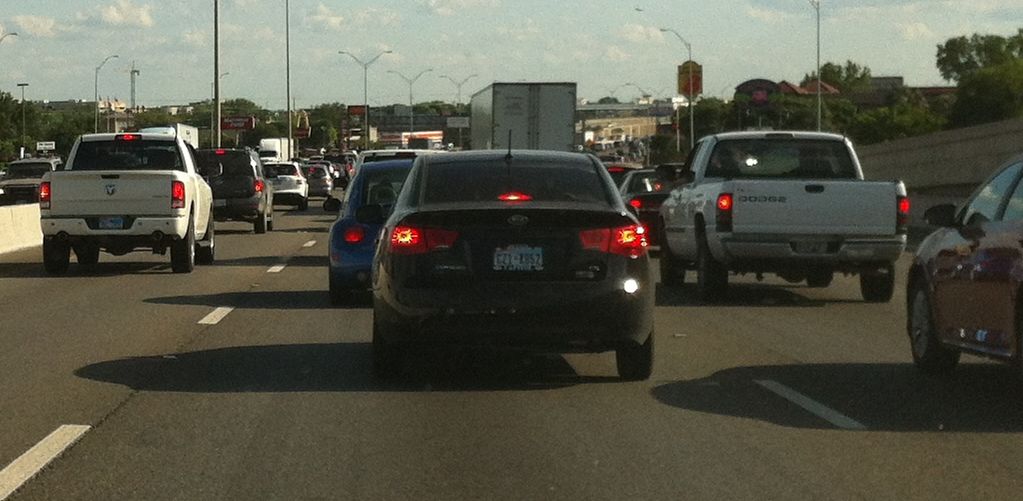
http://www.bartcop.com/Austin-Garbage-09.jpg )