Or point me in the right direction in terms of what to read.
By distilling, you are training a model via Reinforcement Learning (RL) to mimic the answer of a bigger model. To do that, you need all the steps that contributed to generating an answer.
To give you a better idea, imagine teaching a student how to solve math problem:
1. You give it the problem and the answer only (no thinking trace) 2. You give it the problem, the intermediary steps and the answer (full transcript)
I think you can agree that the second method is more likely to give a well-informed student.
It has an event sourced architecture in SQLite and it resolves queries using recursive CTEs (and sneaky projections to speed things up) to deliver exactly that. Identical, stable message chains to AI and complete introspection.
Bonus points include a constraint-satisfaction solver for the tiling window manager so windows never shrink too small to read. And many other keyboard-friendly features.
[0] https://www.dreamcoder.ai/ [1] https://www.dreamcoder.ai/assets/graph.webp
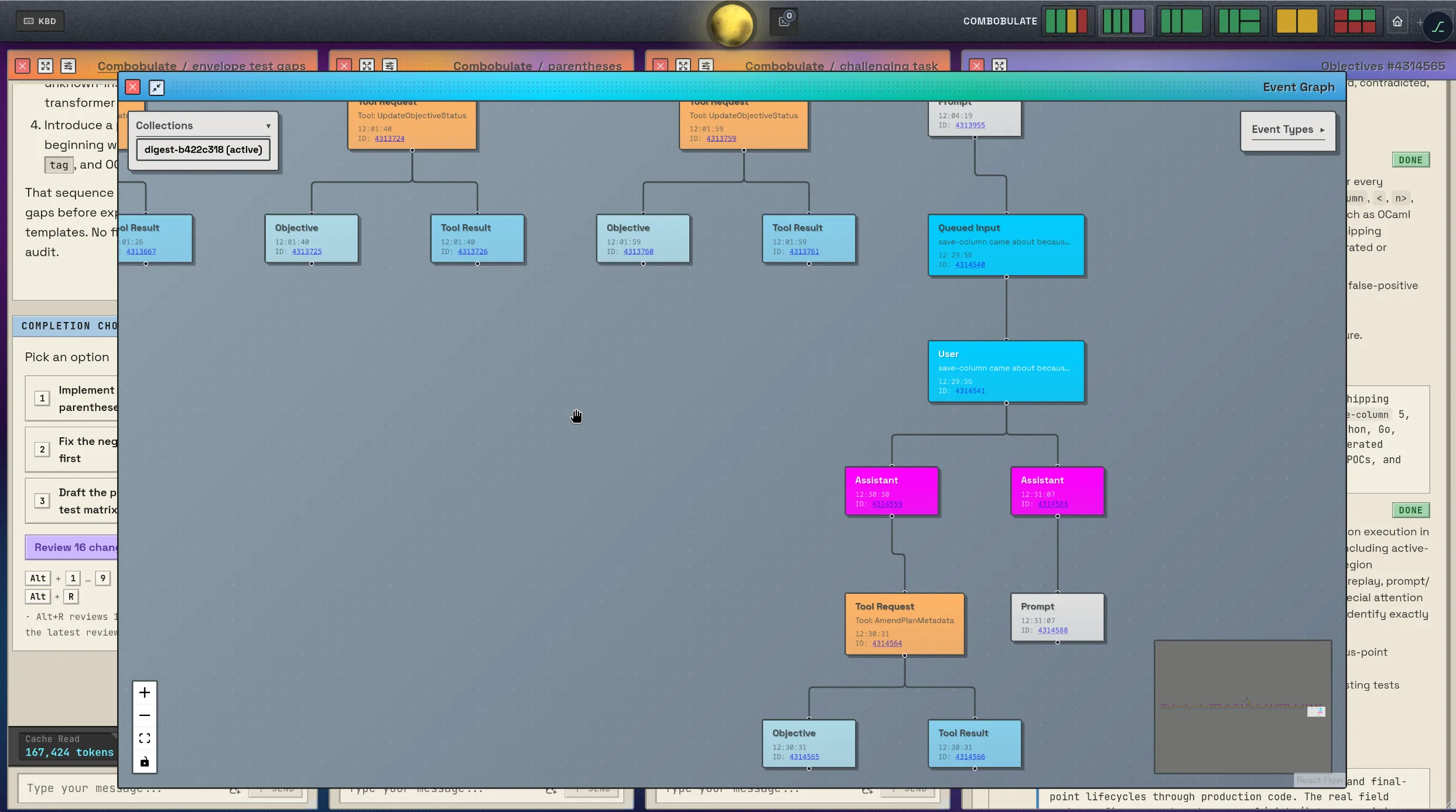
to swelljoe below
Anyway, this particular harness isn't doing anything unique, but the combination of an official agent intentionally keeping the data and making it accessible to the user and a model API that provides all the information is unusual and worth calling out. It used to be common, most APIs and models and agents showed the reasoning, or could be configured to do so. Most no longer offer it.
In short, there are workarounds, but they're not guaranteed to work forever and they're likely to bump into terms of service.
Everything the model sees is recorded in an append-only session log: system prompts, reasoning, tool calls and results, subagent scheduling, and every context injection. In the Trajectory view, you can inspect these records by source. Resume, fork, search, and replay all operate on the same event stream."
That's a killer feature, IMHO, and one that US models won't allow you to do, as their traces are encrypted, obfuscated, etc. and have to be extracted via various workarounds (that violate the terms of service).
If you want to be able to improve your tools that work with models, you have to be able to assess what the models think is happening, how they think about and interact with the data you give them. And, the US models won't let you see that.