> usually on device prompts are very short
Sure, but that might change with better NPU support, making time-to-first-token quicker with larger prompts.
NPUs are racing stripes, nothing more. No killer features or utility, they probably just had stock and a good deal they could market and tap into the AI wave with.
OK, but where can I find demo applications of these that will blow my mind (and make me want to buy a PC with an NPU)?
This is normal, standard, expected behavior, not blow your midn stuff. Everyone is used to having it. But where do you think the computation is happening? There's a reason that a few years back Apple pushed to deprecate older systems that didn't have the NPU.
Are they more performant? Hell no. But if you're going to do the calculation, and if you don't care about latency or throughput (e.g. batched processing of vector encodings), why not use the NPU?
Especially on mobile/edge consumer devices -- laptops or phones.
Maybe because they sleep all the time. To be able to use an NPU you need at least a compiler which generates code for this particular NPU and a CPU scheduler which can dispatch instructions to this NPU.
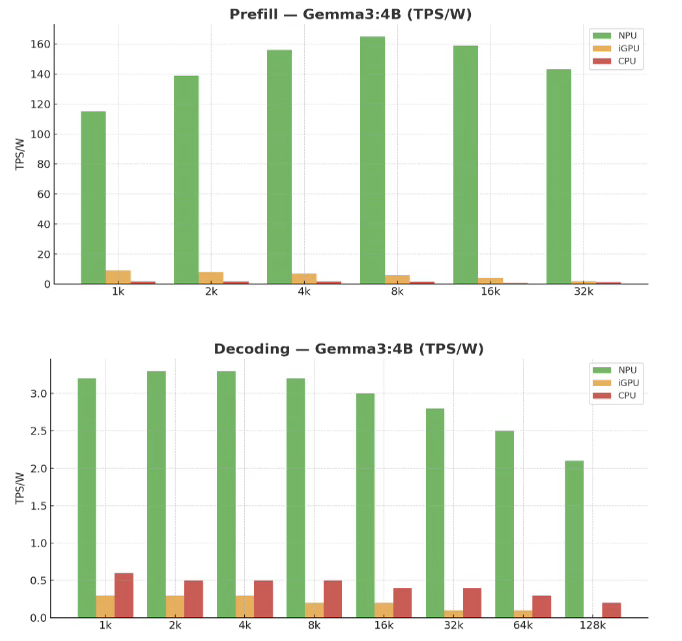
Obviously in the future this might change. But as we stand now dedicated silicon for _just_ LLM prefill doesn't make a lot of sense imo.
And LLM inference is heavily memory bandwidth bound (reading input tokens isn't though - so it _could_ be useful for this in theory, but usually on device prompts are very short).
So if you are memory bandwidth bound anyway and the NPU doesn't provide any speedup on that front, it's going to be no faster. But has loads of other gotchas so no real "SDK" format for them.
Note the idea isn't bad per se, it has real efficiencies when you do start getting compute bound (eg doing multiple parallel batches of inference at once), this is basically what TPUs do (but with far higher memory bandwidth).