A PhD student once mentioned to me that when people envisage themselves in history, they always assume they'd be upper class. No one ever thinks that they'll be poor :-)
<https://en.wikipedia.org/wiki/A_Farewell_to_Alms>
Cities simply could not grow without net in-migration until the development of sewerage, municipal waste removal, fresh-water systems, and public health in general.
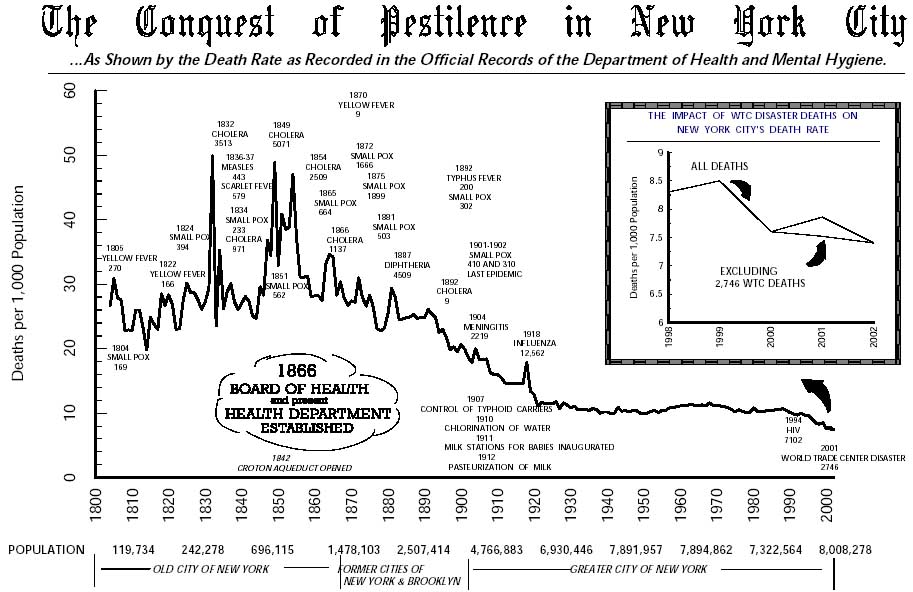
Another favourite illustration, "The Conquest of Pestilence in New York City", showing the overall decline in mortality from 1800 to present:
<https://1.bp.blogspot.com/-uTWEATUzgxk/TXQoTibILtI/AAAAAAAAA...>
From: <https://economicspsychologypolicy.blogspot.com/2011/03/conqu...>
Note that for all the vaunted advances of 20th century medicine, the needle hardly moved at all from 1920 through 1990, and mortality increased from 1950 -- 1970. There has been substantial improvement from 1990 through 2000.
But rural Europe was no picnic either - you would still be likely to die in all sorts of painful ways, from sepsis, diseases, accidents, childbirth, etc. And my god, it would have been dull.
Honestly, if you forced me to go back to the 17th century, I would probably take the risk and live in London. At least there is the possibility of crossing paths with Samuel Pepys, Christopher Wren, the early Royal Society etc. while you sit in your coffeehouse reading a freshly-printed news sheet.