I was about 8 years old, and convinced a local video store in my small town that I could repair Nintendo games. I brought them home, and if they were indeed not working, I would get a Q-tip, apply some rubbing alcohol, and swab/scrub the contacts. This nearly worked every time.
I got slightly called out when a customer brought in an actual Nintendo that was broken. I ended up taking it home, opening it up, turning it on (probably not the best idea), and went through each component on the board to see if anything looked out of place. I ended up finding a capacitor that was a bit bent, so I straightened it out with my fingers and, viola! It worked! I returned the Nintendo back to the shop in working order and felt like quite the little man.
I had free game and movie rentals for life, as well as being able to pick out what Nintendo games the store was to order next. I was in gaming heaven.
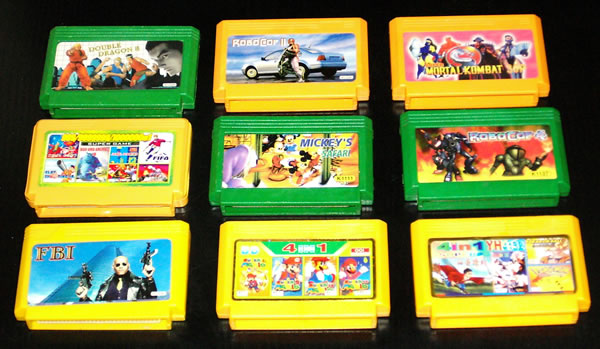
[1] Actually, history of game consoles in Russia in early 1990s is quite curious. Nintendo themselves weren't interested in our market, so Russian-Chinese manufacturers promoted their clone quite freely. I believe it was even better than original famicom, since original controllers were detachable and easily replaced and also it came with a lightgun. Cartridges were cheap and abundant, about $2-4 each. Also there was a lot of 10-in-1 (100-in-1 even) catridges. After SEGA released their mega drive 2 console in Russia, dendy business started to decline. Look at this pic: http://upload.wikimedia.org/wikipedia/commons/6/67/Dendy%27s... Ridiculous bottom-left cartridge with the picture of Morpheus from the Matrix and hilariously named FBI was clearly released in 1999 or later. Anyways, all our favorites were the same with the rest of the world: mario, contra, battle city (this one was a real hit! everyone had it). Ah, sweet times.
How do you know it was the blowing, and not the act of removing and reseating the cart? That's rather the point of the article.
The PacMan series were the worst and the single data and power connector would always fail, often scorching the PCB causing the traces to lift and come loose. The legs on the EEPROMs on Ms PacMan I worked on fell off I think they were just pressed on, they were a weird gold colour. That was a bad day.
The contacts were never the issue. the CIC lockout chip is the culprit everyone's ignoring.
I'm really asking a mechanical question. Basically, if you're going to build an insert-and-press-down device, it would make sense to have a mechanical system to handle all of that separately from the electrical contacts. Basically, you'd have the cartridge slide into some kind of device which captures it and has the springs and latches to make the system work as desired. Within that device, you'd also have the electrical contacts with the cartridge, but set up so that the fragile electrical contacts don't actually transmit the spring's force, which goes through the outer frame instead. You made it sound like the force got transmitted directly through the electrical contacts without any separate spring-loaded device, which seems like a pretty obvious failure point.
Blowing on the cart sometimes worked, if there was errant dust or fluff in the way. But in the long run the salty moist air would cause a corrosive layer of gunk on the contacts. Normal procedure was to open each cart and clean them with a good eraser then an alcohol wash.
The bigger problem was bad design in the original NES. The cart plugged into a component that looked like a harmonica and then pressed downwards, levering against a pretty heavy spring. This perpendicular stress caused the contacts to break, first causing contact flakiness, then failure. The SuperNES and GameBoy fixed this problem with a vertical insertion that carried over into the N64 and others.