"For the pre-Fed period (1790-1913), the average annual inflation was 0.4 percent with a coefficient of variation of 13.2. During the period 1941-2016, these figures changed to 3.5 percent and 0.8, respectively. If we look at the post-Volcker era (1988-2016), annual inflation was 2.2 percent on average with a coefficient of variation of 0.4." -
Source: https://www.stlouisfed.org/publications/regional-economist/s...
Also recommend Debt: The First 5000 Years (David Graeber) and Capital in the Twenty-First Century (Thomas Piketty) which cover this and more on how current concepts of finance and capital post-1914 are incredibly different from the majority of human civilization.
I think a broader historical/anthropological approach is helpful here to understand why those tradeoffs were made.
Citing an average number is misleading since the chart of the value of a dollar during that time looks like a zig-zag with some massive swings in both directions. This means periods of severe deflation, too, which can be very bad for people.
It definitely was not flat or consistently near zero, though citing an average number is a great way to give that impression.
Not when you are also citing the coefficient of variation it isn’t.
> since the chart of the value of a dollar during that time looks like a zig-zag with some massive swings in both directions.
Uh, exactly the claim made, “we have accepted higher inflation in order to achieve stable inflation that is predictable.” (emphasis added)
Characterizing this as a bad thing is, IMO, quite bonkers, but so is denying that it is exactly what has happened.
Why not look at 1000-1500? That's a much longer time period.
https://upload.wikimedia.org/wikipedia/commons/c/c7/Dollar_v...
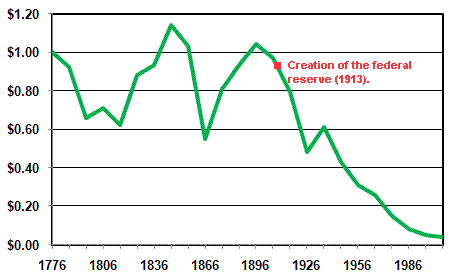
The point is that even after the central bank was introduced, the US remained on a literal or defacto gold standard, of varying sorts, until 1971. That's when Bretton Woods ended and the value of the USD became based on absolutely nothing and the government granted themselves the power to 'print' arbitrary amounts at their discretion.
> As the market becomes more efficient at producing goods and services, we should expect prices to decrease, not inflate.
Yes, that’s why the cost of clothes has decreased in real terms.
In the first 130 years of the US, the value of the dollar didn't change, as far as I can tell, more than 50% from the starting point.
From 1913 to 2025, the dollar lost 96+% of its value. The difference between a ratio of 2:1 and a ratio of more like 30:1.
I'm not arguing it didn't. But I think in kind the US's global economic position didn't change substantially between full independence in 1783 and 1913. It grew during that period, but the idea of the US as a peer (and then dominant) economic world power is a distinctly post-WWI one.
No, it was much less stable (higher volatility), but the long term trend was neutral.
If currency halves in purchasing power in 25 yrs, that means inflation is 100% in 25 years, so
    (1 + r)^25 = 2
r = 2^(1/25) - 1 ~ 2.8%I agree 100% with your thought.
However, I've come with an explanation: people save $100k and the amount in itself will not budge unless they use that money. This, of course, is a flawed argument as the amount doesn't matter; what you can buy with it does. With stocks—I prefer ETFs but I digress—you do not know the amount you will have in 40 years (even if, historically, you would have made money in absolutely all cases).
This uncertainty, coupled with lack of economics knowledge, is why people qualify stocks as "risky". However, instead of "risky", I think they mean "volatile". Cash is absolutely the riskiest of assets as it loses value in 100% of cases despite being more stable than stocks.
And my cynic mind tells me that the banking industry has all to gain from telling people that "stocks are very risky", instilling fear and, instead, selling them over-complicated products where the bank is guaranteed to make a profit on the back of their clients. Of course, they tell them it's "100% safe".
And to be more precise, 25 years to halve is actually less inflation than the historical average of 3.29% from 1914-2025. At that rate it would take 21-22 years to halve.
Actually there is a surprisingly good trick to be able to calculate this called the rule of 72. Take the inflation percentage (2, 3 %) and divide 72 by it. Thats how many years it will take to halve. Not completing accurate but actually very close.
But yeah, inflation is a bitch over long time horizons. It makes me laugh when people say stocks are risky. Say you are 20 years old and want to save $2M USD for your retirement by 65. Expect that to be more like $470k.