But when you're insecure the feelings you get from the latter are more comforting in the short term.
HN's insistence on decorum is just really poorly suited to the moment.
The immigration system should be designed to block retired parents from moving country to live with their working age adult children who have migrated.
One reason to have immigration is to improve a country's dependency ratio: the ratio of working age population to children and retirees.
The ideal immigrants are young well-educated parents that can stay in the workforce for 40+ years with healthy children that are just about to enter the school system.
That way the receiving country didn't need to invest in educating the parents originally, don't need to pay the healthcare costs of very young infants, and it provides the best possible addition to the the receiving country's demographic structure so the host country benefits from a whole working life of tax payments and all the value created by their work output.
The economic case for even skilled immigration is far less compelling for a receiving nation without such restrictions on immigrating retirees.
Should the country receiving the immigrants let elderly grandparents be cared for by their own country's pension and aged-care and healthcare industry, instead of burdening the receiving countries?
Absolutely unequivocally yes.
The grandparents can always come visit on tourist visas and the immigrants can visit their original country too.
I seem to recall the notion that elderly people are normally isolated, atomized wards of the “aged-care industry” as a relatively recent innovation, no? Versus people seeking to bring elderly relatives to reproduce the sort of multigenerational households that more traditionally handled aging care, and that do that today in other parts of the world?
Nations are able to afford it with a healthy dependency ratio, but with the Baby Boom generation leaving the workforce, it will no longer be possible.
A young family who have recently migrated are saving for a house and college, to make them pay for a decade of end-to-life treatment (cancer treatment, dialysis) at United States price ranges is unaffordable even for very high income earners.
Remember the two parents have four grandparents, and two children (the receiving country would love for them to have a third).
That said, I am open to a special visa with a million dollar escrowed deposit per elderly parent to cover their healthcare. Without extreme restrictions they are bound to become a healthcare burden on the system.
I was of the impression that, in the US at least, such immigrants might be allowed to purchase Medicare if they’d been here for a long time and worked/paid payroll taxes for many years—but that they certainly wouldn’t qualify to get it for free in the way native-born people do. Native-born people with 10 years of formal employment, anyway.
Not sure how that works with Medicaid—it sounds like [1] some states have chosen to implement that in ways immigrants can access if they come in on green cards and spend their working lives in the US, paying in to the system—but that seems to me more like a local policy choice than a primary feature of the immigration system.
For that matter, in your formulation, should the working-age immigrants themselves, who permanently resettle and work their whole life in the US, be denied access to old-age benefits when the time comes?
[0] https://www.kff.org/faqs/medicare-open-enrollment-faqs/enrol...
[1] [PDF] https://www.health.ny.gov/health_care/medicaid/publications/...
Oh, I wasn't familiar with the 'public charge' requirement of the US immigration system. That's excellent in principle, and wonderful if enforced adequately.
> Not sure how that works with Medicaid—it sounds like [1] some states have chosen to implement that in ways immigrants can access if they come in on green cards and spend their working lives in the US, paying in to the system—but that seems to me more like a local policy choice than a primary feature of the immigration system.
Yes, agree that's not a feature of the immigration itself but a local policy choice. Some states are very lax with Medicaid qualification rules eg, California recently expanding coverage to illegal immigrants with loosened criteria that legal immigrants won't qualify. I recall changes were made in response to federal tightening of rules. It's still a bad policy, but a local one.
> For that matter, in your formulation, should the working-age immigrants themselves, who permanently resettle and work their whole life in the US, be denied access to old-age benefits when the time comes?
No, one principle is they have paid into the system for a long period of time then they should of course be able to access benefits.
The other principle is by that time they are ready to retire they will certainly permanent residents but hopefully citizens, so not seen differently than other citizens.
Even moreso with arbitrary rule changes with zero deadlines meaning they can't even necessarily fly back in emergencies without risking losing their status in the US?
Based on my reading of the law, you can overstay a tourist visa and receive Medicaid coverage in California relatively quickly.
(But that's a different discussion)
Are those the people Europe and the US are look to immigrate?
GP mentioned “abandoning your parents” when you immigrate as if that’s absurd. In reality it’s the most normal thing imaginable.
I know hundreds of people who live outside their home country and I can’t thing of a single one of them who took their parents with them. When does that ever happen?
My wife "abandoned" her entire family to come to America at 18, didn't speak a word of english, had a suitcase and barely enough money to survive a week.
She doesn't regret it and her family doesn't think they were abandoned.
This "abandoned" idea is great example of a poor idea that goes into policy that doesn't match reality.
That's what I'm responding to. That the first immigrants to America came under very different circumstances. Circumstances that wouldn't get them into America today.
Abandoning your parents isn't absurd when you don't have other good options. It's also not the most normal thing imaginable. Would you abandon your parents and go to another country if they can't join you at all?
We want the "best and brightest" but we also want them to have to abandon their parents to do it? Many of the best and brightest have other options.
For the most part it was companies looking for gold, furs etc, with the support of their governments. Companies founded the colonies and trading posts for the benefit of the stockholders and the governments. The consideration of colonists was a distant third. When the supply of easy marks dried up they turned to indentured labour and then slavery.
The Migration Observatory at Oxford publishes excellent summaries about migration trends, e.g. https://migrationobservatory.ox.ac.uk/resources/briefings/lo...
> a record-high 79% of U.S. adults say immigration is a good thing for the country.
It’s hard to separate what’s supported by the public and what are random hobby horses of the far right once they get in power.
Because the US has historically been relatively more positive to immigration I am skeptical that we would see the same reaction as in the UK or other countries in the long run (in the short term, it’s all a sht show)
https://news.gallup.com/poll/692522/surge-concern-immigratio...
Don't forget to quote the parts that contradict your statement:
> After climbing to 55% in 2024, the percentage of Americans who say immigration should be reduced has dropped by nearly half to 30%. Sentiment is thus back to the level measured in 2021, before the desire for less immigration started to mount. Meanwhile, 38% now want immigration kept at its current level, and 26% say it should be increased.
Overall, this poll paints a picture of moderation from a period of anti-immigrant sentiment, not of a population that has "swung in favor of immigration", as you assert.
(It also has nothing to do with H1B visas specifically. As far as I can tell, it's almost entirely about illegal immigration.)
It would also be nice if the poll probed as to the reasons for why people hold certain opinions. My guess would be the numbers are changing partly due to political backlash and not due to some economical or social insight.
The good thing about this poll is that the same questions are asked over time. So likely the trends are real. It's just hard to get a more nuanced understanding.
Almost every question was about illegal immigration. They ask some top-level questions about overall immigration, then ask a series of other questions about illegal immigration, border enforcement, etc.
There are questions about people present in the US illegally but not about people being allowed to come to the US illegally.
When I say illegal immigration I'm mostly thinking of the question of whether people should be allowed to come into a country illegally and generally immigration laws that govern people immigrating to the country. The question of how to deal with people who are present, maybe for a long time, in the country illegally is a different one. But I can see how in the US those are sort of mashed together. There's an obvious relationship, e.g. if you say that someone present in a country illegally should be allowed to stay and become a citizen that basically means new people arriving (let's say as tourists or not entering via official entry points) can just stay and become citizens. But I think in the US it's generally debated as two separate questions, i.e. people that are present (especially for a long time, families, etc.) should have a path to become legal immigrants. I'm not here to really debate this but more to point out those are somewhat different questions.
Let's review everything just to make sure we're not missing anything:
"Thinking now about immigrants — that is, people who come from other countries to live here in the United States — in your view, should immigration be kept at its present level, increased or decreased?" -> legal immigration (presumably, or at least ambiguous)
"On the whole, do you think immigration is a good thing or a bad thing for this country today?" -> legal immigration (again, presumably)
"Please tell me whether you strongly favor, favor, oppose or strongly oppose each of the following proposals. " -> This one is more of a mix but the question of whether people support illegal immigration isn't really addressed. There are questions about how people who are present in the US illegally should be treated and about things like border security which has some tangents to illegal immigration (presumably a border is there to stop illegal immigration, but also to stop smuggling and other reasons, but why not just ask if people want open borders?)
"Figures represent percentages who favor or strongly favor each policy." -> similar to the above, dealing with the question of those present in the US illegally not the question of more people coming into the US and whether that should be via current legal means or "open border everyone is welcome with no process".
"Do you strongly approve, approve, disapprove or strongly disapprove of the way Donald Trump is handling the immigration issue?" -> not really clear enough but feels like another permutation of the above. dealing with people present illegally and not general immigration policy questions (who should be able to come and who shouldn't).
Much has been said about Trump, but his main quality is this: he's a foot-gun artist.
Could only find 2019 data:
https://www.uscis.gov/sites/default/files/document/data/h-1b...
Of course, nothing has changed for the illegal ones: they haven't (and won't) see the increased burden of legal migration of which they are oblivious. Overall things are only getting worse, and I hate that there's no attempt to having a honest and transparent debate and discourse on the matter.
The UK has had a "brain drain", but it's as much UK citizens as migrants. Economic migrants migrate.
> But also highly paid people have spouses, children, parents and other relatives. Once you are told you barely cleared (very high) criteria, you can be pretty sure your retired parents won't, if ever you need them to move in with you.
Skilled immigration is sold in almost all of the West as a necessary demographic cure. The classic "we're getting older and there is a labour shortage of working age people". The retired parents were never a part of the deal, and are of no interest to almost any Western country. Obvious given that it completely annihilates the justification for bringing people in in the first place.
So if these skilled workers aren't moving to the UK because they can't bring their retired parents, then presumably they aren't also choosing the US, Canada, Germany, etc., given the same situation.
Canada does have a family reunification program but it is not only spectacularly unpopular among the Canadian public and likely to fade away, it allows for a tiny number per year.
They are, certainly at least in Germany there are special provisions for that.
Chain migration is an anti-immigration argument in the US - even if some particular immigrant is highly-skilled and would benefit the US from being a legal resident, that immigrant's family is probably not as impressive. Nonetheless, once the government gives legal residency to the highly-skilled immigrant, they will be highly motivated to try to get the rest of their family to the US as well. So the US should be careful about granting legal residency even to prospective immigrants whose credentials make them individually look good.
You have no idea what you're talking about.
You are wrong. For the Skilled Worker route, the minimum salary threshold is 41k per year, with some special jobs at 33.4k.
> "homeopaths" and "reiki healers"
You are wrong. There are SOC codes for things like "Therapy professionals". They give examples like acupuncturists, art/drama/music therapists, chiropractors/osteopaths, nutritionists, sports therapists/massage therapists. No "reiki healers", though.
> The skilled worker visa only requires B1 English
You are technically right, but are ignoring the larger context. Jobs open for Skilled Worker migrants have to be RQF 6+, which usually means the worker has to perform at the level of a university graduate. So, while the language requirement is B1, the skill requirement is non-trivial.
> You have no idea what you're talking about.
Ironic.
https://www.gov.uk/government/publications/skilled-worker-vi...
And I only picked those two because they were particularly egregious. The list is full of jobs for which it's absurd to suggest we need to fill from abroad: are we really suffering for a lack of recruitment consultants? Human resources officers? Can no-one can find a homegrown Brit who's able to work as a restaurant manager?
As for the salary threshold, you're right: the basic threshold is £41k, although it can be as low as £25k (not £33.4k) in some circumstances: https://www.gov.uk/government/publications/skilled-worker-vi...
I'd argue that £41k is still too low. It's barely above the median UK salary - we can't find anyone in the top ~50% of people who can do these jobs? And it doesn't even make you a net contributor (from what I can tell that threshold is around £50-55k, although for many of these "skilled" workers it's much higher as they bring dependents.) Nevertheless I'll accept a partial L.
Regarding English, maybe I'm wrong about the precise requirements, but I've worked with software professionals in London, here on a skilled worker visa, with whom I was barely able to communicate, so clearly we're doing something wrong.
In any case, my thesis still stands: there have not been "very high" criteria to migrate to the UK recently, in fact quite the opposite, and if you don't believe this then I suggest you go outside and look around.
Foreign students were also encouraged to study here and remain after studying. Initially even family reunion immigration was encouraged, although that's changed now.
https://ichef.bbci.co.uk/news/1536/cpsprodpb/5579/live/8ea3a...
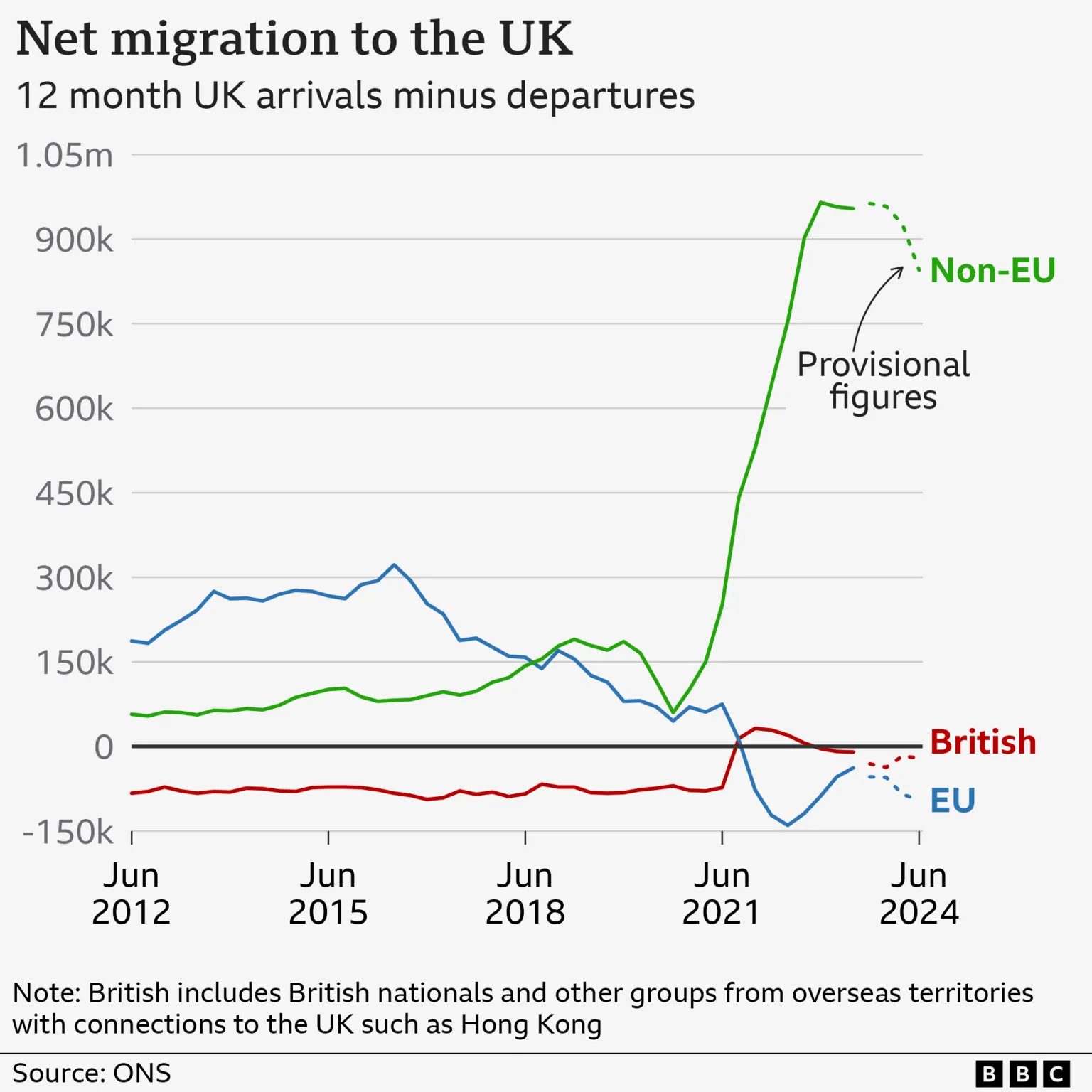
The UK has been playing this game for centuries - bringing in cheap foreign labour on the quiet, then using that as political leverage with "We will protect you from the foreign invasion" messaging.
They were the most pro-immigration government in British history, by far.
High-skilled immigration - not so sure about this.
The UK was 94% white as recently as 1991 and was 99% white in 1951. What cheap labor was being imported in the centuries prior?
-
Smart professional people desire non-hostile space where they can build a life. When a Russian scientist or Iranian doctor left their countries for London or Paris, they were't calculating for a net income increase, they were running away from an environment that didn't show a promise to allow them realize themselves. Lot's of white collar people are paid well below what they will make if they learn a JS library or do construction work because of their desire to fulfill themselves in a peaceful life and be respected. It is kind of similar to game devs being paid very little in respect to the complexity of the programming they do. If you break that magic, they aren't going to stay.
But a lot of skilled labour left anyway. Partly because the general atmosphere got unpleasant. But also highly paid people have spouses, children, parents and other relatives. Once you are told you barely cleared (very high) criteria, you can be pretty sure your retired parents won't, if ever you need them to move in with you.
So the effect may well be that the kind of people whose productivity and tax bracket makes a 100k fee justifiable simply choose to go elsewhere.
Especially when the administration makes their contempt for any rights they have so obvious.