When I go to a clothing store, all the jeans and dress shirts and folded the same way and look nearly identical, same goes for the milk and eggs at the grocery store.
In spite of all this I always manage to come home with the brand I set out to buy in the first place.
Jeans are somewhat less complex. There are fewer ways to differentiate, so those differentiators become more signficant. And the makers try to differentiate across as many of them as they can.
Meanwhile, Samsung's own market feedback shows customers were coming home with the wrong box:
http://www.bgr.com/2012/07/27/samsung-tablet-returns-best-bu...
EDIT (ADDED): If you think this is "customer stupidity", you haven't been paying much attention to normals' interactions with technology, or to Samsung's deliberate packaging and presentation.
See the "What did you do with my Facebook?" incident:
http://www.readwriteweb.com/archives/how_google_failed_inter...
Recapped here, "These are your users, read and be horrified":
http://uxmag.com/articles/these-are-your-users-read-and-be-h...
In both images, the boxes clearly state in large lettering "Samsung Galaxy Tab."
Also, like I related above, I'm a normal with regard to clothes and food, not a fashionista or a chef yet I have no problem distinguishing between any number of all but identical products.
Stop grasping.
That was not a single anecdote, that was a rollup of return reasons. Quoting Samsung's own document:
"The most common pattern is that a customer returns the product which was purchased because the customer thought it was an Apple iPad 2."
Also, places like BestBuy often display things out of the box, and parents often buy the things their kids showed them.
Consider:
"Mom, buy me this," showing Mom an iPad.
Mom gets to the store, and sees these on display:
http://cdn.redmondpie.com/wp-content/uploads/2011/10/default...
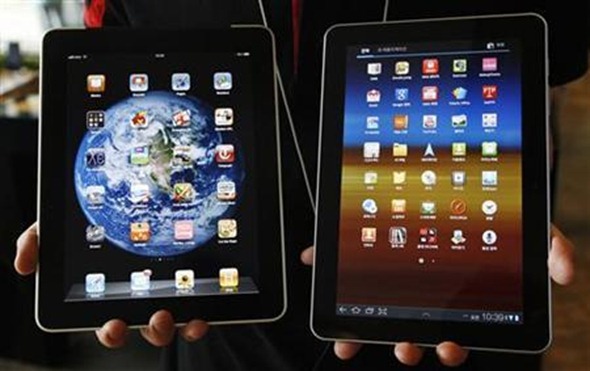
Mom buys the one on the right. If you really think that confusion is so far fetched, you are not the typical Best Buy customer.
As this article[1] says, "There’s little doubt those of us familiar with techie gadgets aren’t going to mistake a Galaxy Tab for an iPad, it’s of little surprise plenty of customers have been fooled, and although Samsung claims to have shipped many millions of units of the slate, it’s currently unknown just how many of those were sold."
1. http://www.redmondpie.com/best-buy-galaxy-tab-buyers-thought...
Just because it was the most common reason for a return doesn't tell us how significant it was. What was the overall return rate? Of the devices returned, what fraction cited confusion with an iPad? Depending on the range of possible return reasons that might be large or small.
Beyond that, there's the question of how many customers are telling the truth why they're returning something. Plenty of people don't, for all sorts of reasons. Especially if they'd had any exposure to Apple's lawsuits, I'd expect the easiest way to return a Galaxy Tab would be to say "I thought it was an iPad", even if you had known the difference and just decided to spend the money on something else or whatever. Sadly, we can't figure that out from Best Buy's data, but is a possibility worth noting.
Big. It was a huge fiasco at the time.
For a "huge fiasco" there's a distinct lack of coverage (that didn't occur in the last week as a direct result of the discovery in this case) to be found via Google.
Apple has already done this with the iPhone 4/4s - namely the antenna array composed of segments of high tensile stainless steel that can only be machined with very expensive, very limited availability hardware.
Apple already understands how to beat the copycats, they simply want to spite Samsung/Google.
Another point is that copying is good for Apple. Johanna Blakley again makes an excellent point: "One of the magical side effects of having a culture of copying is the establishment of trends." Apple needs the copycats in order to drive smartphone adoption, with Apple remaining the top tier innovator akin to high-end fashion labels.
[1] http://www.ted.com/talks/johanna_blakley_lessons_from_fashio...
Samsung was dangerously close to the line.
It's not just the boxes either. See the cabling and power adaptor.
This whole trial has been enormously educational. Stuff like this rarely sees the light of day.
Absolutely. And now they're diverging again. But it took courts to force that shift.
- the 'before' shows more in the iphone-like category and less in the other category of phones than the 'after'. Also the iphone-like cateogy has heaps of phones compared to other categories. This plays with your sense of weighting and importance because automatically you assume that you can compare numbers of phones on this chart, which you can't (mostly because iphone-like pre-iphone devices are all prototypes, whilst others are just a fraction of produced phones.)
- many of the 'before' phones in the iphone-like category are '2006', probably after Samsung would have known what apple is producing.
that being said apart from the package printing the rest of the package design is not apples design or idea, I think the benefon Q had a similar set up, (first thing you see it the phone).
10.1v http://www.techspot.com/images/products/tablets/org/96609971... 10.1 http://cdn.androidcommunity.com/wp-content/uploads/2012/01/g...


disclosure: I own a 10.1v
The argument isn't about the devices on that poster. It's about Samsung's a posteriori "design" and marketing process. Their product guy's "can't design patent a black rectangle" comments are a bit disingenuous:
http://copyrightcommerceandculture.com/wp-content/uploads/20...
Also worth noting their tablet PR screenshots, like their boxes, have stopped using the iPad's portrait icon array and started featuring landscape TouchWiz widgets instead.
They were fully aware of what they were doing:
Boxes before: http://www.thegalaxytab.com/wp-content/uploads/2010/10/galax...
Boxes after: http://forums.appleinsider.com/content/type/61/id/9172/width...