News for hackers. Stuff that matters.
Re:Polychromatic Pixels by GrantMoyer on Thursday July 18, 2024 @02:33PM (#40998444)
A single wavelength can't reproduce all visible colors. These pixels are variable wavelength, but can only produce one at a time, so you'd still need at least 2 of these pixels to reproduce any visible color.

The fundamental problem is that color space is 2D[1] (color + brightness is 3D, hence 3 subpixel on traditional displays), but monochromatic light has only 1 dimension to vary for color.

[1]: https://en.wikipedia.org/wiki/Chromaticity

Re:Polychromatic Pixels by jessriedel on Thursday July 18, 2024 @02:44PM (#40998542)
Ha, yea, in particular these monochromatic pixels can't simply be white. Notably ctrl-f'ing for "white" gives zero results on this page.

Relatedly, the page talks a lot about pixel density, but this confused me: if you swap each R, G, or B LED with an adjustable LED, you naively get a one-time 3x boost in pixel area density, which is a one-time sqrt(3)=1.73x boost in linear resolution. So I think density is really a red herring.

But they also mention mass transfer ("positioning of the red, green and blue chips to form a full-colour pixel") which plausibly is a much bigger effect: If you replace a process that needs to delicately interweave 3 distinct parts with one that lays down a grid of identical (but individually controllable) parts, you potentially get a much bigger manufacturing efficiency improvement that could go way beyond 3x. I think that's probably the better sales pitch.

Re:Polychromatic Pixels by etrautmann on Thursday July 18, 2024 @03:35PM (#40998975)
It would be interesting to plot all of the achievable colors of this LED on the chromaticity diagram. Presumably it'd be some sort of circle/ellipse around white but might have some dropouts in certain parts of the spectrum?
Re:Polychromatic Pixels by formerly_proven on Thursday July 18, 2024 @04:07PM (#40999228)
Pure wavelengths are on the horseshoe-shaped outline of the CIE 1931 space. The straight line connecting the ends of the horseshoe is the line of purples, which also isn't monochromatic.

https://en.wikipedia.org/wiki/Chromaticity#/media/File:Planc...

Re:Polychromatic Pixels by Y_Y on Thursday July 18, 2024 @04:40PM (#40999528)
Presumably they wouldn't need to do a pixel-to-pixel mapping, but could account for the wavelengths of neighbouring pixels to produce a more faithful colour reproduction at an effectively lower resolution.
Re:Polychromatic Pixels by meindnoch on Friday July 19, 2024 @10:38AM (#41007014)
It's going to be the spectral locus.
Re:Polychromatic Pixels by daniel_reetz on Thursday July 18, 2024 @05:27PM (#40999929)
Don't forget about bond wires that need to be run to each die and/or connected to a backplane.
Re:Polychromatic Pixels by ricardobeat on Thursday July 18, 2024 @06:00PM (#41000168)
Doesn't the fact they have successfully demonstrated displays at 2000, 5000 and 10000 DPI alleviate those concerns a little bit?
Re:Polychromatic Pixels by creshal on Friday July 19, 2024 @07:37AM (#41005218)
It's not really meant as a concern, more a supporting argument: If every subpixel is identical, you can use simpler wiring patterns.
Re:Polychromatic Pixels by mark-r on Saturday July 20, 2024 @10:04AM (#41016588)
The subpixels don't need bonding wires, they have dedicated connections just like any transistor on a regular IC.
Re:Polychromatic Pixels by mark-r on Saturday July 20, 2024 @10:00AM (#41016557)
The key to this is using the same process to get all the colors. For separate R,G,B pixels you need 3 different processes and can't build them on the same chip, you need to assemble them - that's what allows the vast improvement in pixel density.
Re:Polychromatic Pixels by ddingus on Saturday July 20, 2024 @09:06PM (#41021581)
Would one not just use a few pixels to create white?

That does mean a variable resolution scenario.

Re:Polychromatic Pixels by TJSomething on Thursday July 18, 2024 @03:31PM (#40998951)
One thing I noticed is that they were talking about demoing 12,000 ppi displays, which is way more resolution than you're going to resolve with your eye. So using 2 pixels is still probably a win.
Re:Polychromatic Pixels by mensetmanusman on Thursday July 18, 2024 @04:24PM (#40999377)
Those are the densities needed for near eye displays. The best displays can still show pixelization to the human eye up close.
Re:Polychromatic Pixels by FriedPickles on Thursday July 18, 2024 @02:41PM (#40998505)
It can produce all the colors of the rainbow. But no magenta. Perhaps they can quickly pulse the LED enough between multiple wavelengths.
Re:Polychromatic Pixels by jessriedel on Thursday July 18, 2024 @02:47PM (#40998565)
It also can't produce white or anything else in the interior of this diagram (as well as, as you mention, shades of magenta and purple that lie on the flat lower edge):

https://upload.wikimedia.org/wikipedia/commons/b/ba/Planckia...

Re:Polychromatic Pixels by mensetmanusman on Thursday July 18, 2024 @04:25PM (#40999385)
The human eye will see white when a pixel flashes through all of the colors quickly in time.
Re:Polychromatic Pixels by ajuc on Friday July 19, 2024 @03:33AM (#41002916)
But that means it has reduced refresh rate.
Re:Polychromatic Pixels by wmertens on Saturday July 20, 2024 @03:31AM (#41014779)
The two are not related at all. Refresh rate is how fast it can accept input, whereas this is how fast it can do TDM of colors and intensities
Re:Polychromatic Pixels by Etherlord87 on Friday July 19, 2024 @11:06AM (#41007264)
How quickly? Surely well above 1 kHz (1000 FPS). Otherwise you will see flickering.
Re:Polychromatic Pixels by jessriedel on Friday July 19, 2024 @01:50PM (#41009107)
According to this, humans can't see flicker above 100 Hz for most smooth images, but if the image has high frequency spatial edges then they can see flicker up to 500-1000 Hz. It has to do with saccades.

https://www.nature.com/articles/srep07861

Re:Polychromatic Pixels by mastax on Friday July 19, 2024 @08:14PM (#41012851)
Single chip DLP projectors strobe red, green, blue, white sequentially. Modern DLPs use separate light sources (LED/Laser) and pulse them at a high frequency - kilohertz I assume. Before we had high-power LEDs DLP projectors used a xenon lamp and a color wheel (https://www.projectorjunkies.com/color-wheel-dlp/) spinning at as little as 60 revolutions per second. This caused a "rainbow effect" which was very annoying to some people, but apparently enough people didn't notice it that those products got sold anyway. So somewhere around 180Hz is the bare minimum.
Re:Polychromatic Pixels by mark-r on Saturday July 20, 2024 @10:07AM (#41016612)
You don't need all the colors. As every household white LED bulb proves, you can get it with just a combination of blue and yellow.
Re:Polychromatic Pixels by rini17 on Sunday July 21, 2024 @02:59PM (#41027277)
You'll get atrocious CRI/sick skin tones that way. There's much more fleshed out spectrum in nowadays LEDs, especially warm white variants.
Re:Polychromatic Pixels by PaulHoule on Thursday July 18, 2024 @02:47PM (#40998562)
See also https://en.wikipedia.org/wiki/Spectral_color

This reminds me of the observation I had in high school that I could immerse LEDs in liquid nitrogen and run them at higher than usual voltage and watch the color change.

I got a PhD in condensed matter physics later on but never got a really good understanding of the phenomenon but I think it has something to do with

https://www.digikey.com/en/articles/identifying-the-causes-o...

Here is a video of people doing it

https://www.youtube.com/watch?v=5PquJdIK_z8

Re:Polychromatic Pixels by duskwuff on Thursday July 18, 2024 @04:28PM (#40999423)
> I got a PhD in condensed matter physics later on but never got a really good understanding of the phenomenon but I think it has something to do with

The color of most* LEDs is controlled by the band gap of the semiconductor they're using. Reducing the temperature of the material widens the band gap, so the forward voltage of the diode increases and the wavelength of the emitted light gets shorter

https://www.sciencedirect.com/science/article/abs/pii/003189...

*: With the exception of phosphor-converted LEDs, which are uncommon.

Re:Polychromatic Pixels by exmadscientist on Friday July 19, 2024 @01:20AM (#41002178)
> phosphor-converted LEDs, which are uncommon

No, they're extremely common. Every white LED in the market is phosphor-converted: they're blue LEDs, usually ~450nm royal blue, with yellow-emitting phosphors on top. Different phosphors and concentrations give different color temperatures for the final LED, from about 7500K through 2000K. (Last I looked, anything below about 2000K didn't look right at all, no matter what its manufacturer claimed.)

Bigger LEDs are often phosphor-converted as well. Most industrial grow lamps use this type of LED. So they're around! You're probably looking at some right now!

Re:Polychromatic Pixels by Remnant44 on Thursday July 18, 2024 @03:07PM (#40998753)
This is definitely a problem; if the control circuitry is up for it you could PWM the pixel color, basically dithering in time instead of space to achieve white or arbitrary non-spectral colors.
Re:Polychromatic Pixels by brookst on Thursday July 18, 2024 @10:41PM (#41001657)
Yep. DLP color wheels come to mind.
Re:Polychromatic Pixels by jmu1234567890 on Thursday July 18, 2024 @02:56PM (#40998646)
However, you would have more flexibility to do tricks sub-pixel to improve resolution?
Re:Polychromatic Pixels by thomassmith65 on Thursday July 18, 2024 @04:56PM (#40999667)
Surely the 'tricks' we have for RGB displays would be more effective when every element has the same color range as every other. For example, the subpixel rendering of typography for RGB displays had an unavoidable rainbow halo that would no longer be an issue for most colors of text with polychromatic pixels.
Re:Polychromatic Pixels by golergka on Thursday July 18, 2024 @03:59PM (#40999148)
> color space is 2D

Human eyes have three different color receptors, each tuned for it's own frequency, so it's already 3d. However, apart from human perception, color, just like sound, can have any combinations of frequencies (when you split the signal with Fourier transform), and may animals do have more receptors than us.

Re:Polychromatic Pixels by paipa on Thursday July 18, 2024 @04:28PM (#40999420)
You only need to mix two different wavelengths to render any human perceptible color. They give you four parameters to work with (wavelength1, brightness1, wavelength2, brightness2) which makes it an underdetermined system with an infinite number of solutions for all but the pure, spectral boundary of the gamut.
Re:Polychromatic Pixels by GrantMoyer on Thursday July 18, 2024 @04:34PM (#40999475)
Humans perceive all stimulation in the same raito of the L, M, and S cones to be the same color, but with different brightnesses. So only two dimensions are nessesary to represent human visible colors, hence HSV or L*a*b* space.
Re:Polychromatic Pixels by a-priori on Friday July 19, 2024 @10:30AM (#41006939)
According the opponent process model of colour perception you need three axes to represent all colours: luminosity [L+M+S+rods], red-green [L-M] and blue-yellow [S - (L+M)].
Re:Polychromatic Pixels by dahart on Friday July 19, 2024 @10:44AM (#41007063)
There is a fair point there, but a few things - HSV and Lab are only models, they don’t necessarily capture all visible colors (esp. when it comes to tetrachromats). Brightness is a dimension, and can affect the perception of a color, esp. as you get very bright - HSV and Lab are 3D spaces. Arguing that brightness should be ignored or factored out is problematic and only a small step from arguing that saturation should be factored out too and that color is mostly one dimensional.
Re:Polychromatic Pixels by BurningFrog on Thursday July 18, 2024 @08:48PM (#41001133)
In this sense our hearing is much better than our color vision.

We can distinguish the combination a huge number of frequencies between 20-20000Hz.

But we can only distinguish 3 independent colors of light.

Of course our vision is vastly better than hearing for determining where the sound/light comes from.

Re:Polychromatic Pixels by 6gvONxR4sf7o on Friday July 19, 2024 @03:36PM (#41010248)
Total tangent, but is that because of the wavelengths involved? I imagine a “sound camera” would have to be huge to avoid diffraction (but that’s just intuition), requiring impracticality large ears. Likewise i imagine that perceiving “chords” of light requires sensing on really tiny scales, requiring impractically small complex structure in the eyes?

Anybody know the answer?

Re:Polychromatic Pixels by cubefox on Thursday July 18, 2024 @05:53PM (#41000117)
> These pixels are variable wavelength, but can only produce one at a time

Citation needed. The article doesn't say anything about how the colors are generated, and whether they can only produce one wavelength at a time.

Assuming they are indeed restricted to spectral colors, dithering could be used to increase the number of colors further. However, dithering needs at least 8 colors to cover the entire color space: red, green, blue, cyan, magenta, yellow, white, black. And two of those can't be produced using monochromatic light -- magenta and white. This would be a major problem.

Re:Polychromatic Pixels by jiggawatts on Thursday July 18, 2024 @08:03PM (#41000894)
Dithering just black, red, green, and blue is sufficient to produce a full-colour image. Everything else is a combination of those. That's effectively how normal LCD or OLED monitors work!
Re:Polychromatic Pixels by cubefox on Thursday July 18, 2024 @09:03PM (#41001222)
No, normal monitors use additive color mixing, but dithering isn't additive, it's averaging. With just red, green, blue, black you couldn't dither cyan, magenta, yellow, white, just some much darker versions of them. E.g. you get grey instead of white.

You can check this by trying to dither a full color image in a program like Photoshop. It doesn't work unless you use at least the 8 colors.

In fact, ink jet printers do something similar: They use subtractive color mixing to create red, green and blue dots (in addition to cyan, magenta, yellow and black ink and white paper), then all the remaining shades are dithered from those eight colors. It looks something like that: https://as2.ftcdn.net/v2/jpg/01/88/80/47/1000_F_188804787_u1... (though there black is also created with subtractive color mixing).
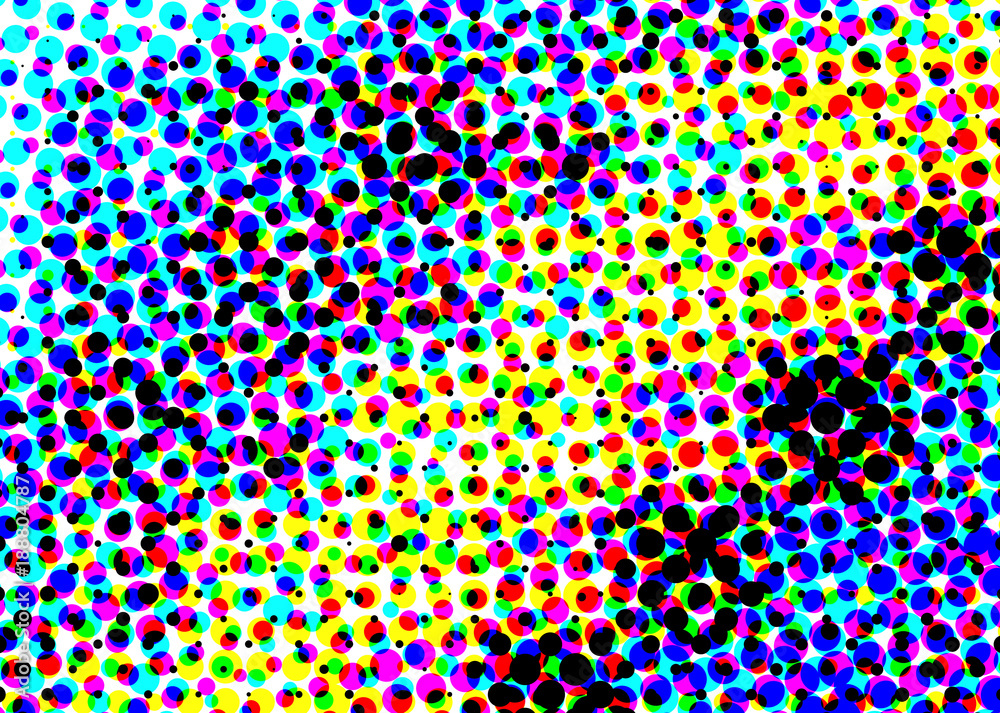
The color mixing type used by dithering is sometimes called "color blending". Apart from dithering it's also used when simulating partial transparency (alpha).

Re:Polychromatic Pixels by jiggawatts on Thursday July 18, 2024 @10:36PM (#41001636)
The article is talking about microLEDs, which are an emissive light source.
Re:Polychromatic Pixels by cubefox on Thursday July 18, 2024 @11:27PM (#41001820)
You can dither not just in print but also on illuminated screens. For example:

http://caca.zoy.org/study/out/lena6-1-2.png

This picture has only pixels of the aforementioned eight colors.

Re:Polychromatic Pixels by incrudible on Friday July 19, 2024 @06:30AM (#41004592)
Emissive means additive, not averaging. Cyan, magenta and yellow are not primaries here. Red and green light adds up to perceptual yellow. Red, green and blue adds up to perceptual white (or grey, at very low luminance). Treating each of these pixels like subpixels (which is arguably a form of dithering) will produce a full color image (at a lower resolution), but given that they did not demonstrate it, color reproduction and/or luminance likely is far from competitive at this point.
Re:Polychromatic Pixels by cubefox on Friday July 19, 2024 @09:43AM (#41006511)
That's not true. Dithering can be used in emissive screens, but dithering is not additive. If you mix red and green with color blending (e.g. by dithering), you get less red and less green in your mix, and therefore the resulting mix (a sort of ochre) is different from additive color mixing (yellow), where the amount of red and green stays the same. Or when you mix black and white, you get white with additive color mixing, but grey with blending. You also get grey when blending (dithering) red, green and blue. You can test this in software like Gimp, you won't be able to dither a full color image without at least the eight colors I mentioned.
Re:Polychromatic Pixels by incrudible on Friday July 19, 2024 @12:00PM (#41007807)
I am not saying you can use the exact same math as in an image manipulation program, these work with different assumptions. Mixing colors in those is usually not correct anyway.

https://www.youtube.com/watch?v=LKnqECcg6Gw

I am saying you can think of subpixels, which already exist, as a form of dithering. Most displays use just three primaries for subpixels - red, green and blue. Their arrangement is fixed, but that is not a limitation of this new technology.

Re:Polychromatic Pixels by cubefox on Saturday July 20, 2024 @02:09AM (#41014456)
Well I disagree with that. It's two different ways of mixing colors (additive vs blending), with different results and different requirements.
Re:Polychromatic Pixels by pfg_ on Thursday July 18, 2024 @06:48PM (#41000467)
This seems like a non-problem, cut the display resolution in half on one axis and reserve two 'subpixels' for each pixel. Then you have a full color display with only one physical pixel type and that needs one less subpixel. These displays could even produce some saturated colors with specific wavelengths that can't be represented on regular rgb displays.
Re:Polychromatic Pixels by ajuc on Friday July 19, 2024 @03:35AM (#41002929)
You'd still be unable to produce different brightness pixels. You'd get white but no grayscale.

I guess you could cheat it by moving the wavelength outside the visible spectrum?

Re:Polychromatic Pixels by mark-r on Saturday July 20, 2024 @10:11AM (#41016635)
I hate to think of the damage large amounts of IR or especially UV would do to the eye.
Re:Polychromatic Pixels by enragedcacti on Friday July 19, 2024 @11:58AM (#41007790)
Assuming they can PWM the brightness while getting consistent color (seems reasonable since microLEDs have extremely fast response time) then I think what you're saying would work great. It would be akin to 4:2:2 chroma subsampling where luminance (which we have higher acuity for) gets more fidelity and the resulting image quality is closer to full-res than half-res.
Re:Polychromatic Pixels by Bumblonono on Friday July 19, 2024 @06:53AM (#41004797)
There are plenty of monochromatic cases. Right now hw has a lot of orange.

Dynamic resolution / subpixel rendering. Retina looks really good already, not sure if the effect would be relevant or interesting but it might open up something new

Re:Polychromatic Pixels by creshal on Friday July 19, 2024 @07:39AM (#41005237)
What Apple sells as "retina" still doesn't match common print densities, there's definitely room for improvement.
Re:Polychromatic Pixels by Bumblonono on Monday July 22, 2024 @08:29AM (#41033630)
You make it sound like there is still an easy to spot difference. When i look at the print quality of pictures on a news paper, its the opposite and at least for me, i don't need more than retina and i was very eager to switch to 4k to have higher dpi.

But 14' with retina im very happy.

I'm actually more surprised by hdr on my lg oled 4k. Its actually quite nice when done well.

Re:Polychromatic Pixels by creshal on Monday July 22, 2024 @09:27AM (#41034125)
Newspapers are famously printed on the lowest quality recycled paper and cheapest print process available, because they're disposable. Compare a retina screen to a coffee table style reference book with high resolution photos – the kinds you can use a magnifying glass on - and you'll still notice differences.

Or just look at what companies do when manufacturing technologies allow them to push for higher densities: iPhones now exceed 450 dpi, and the 8" iPads exceed 300; if the technology allowed it, Apple would most likely introduce higher densities on larger iPads and Macbooks as well.

Re:Polychromatic Pixels by meatmanek on Friday July 19, 2024 @03:07PM (#41009945)
I'm assuming that in most cases they'll just make these act as RGB displays, either by sequentially tuning the wavelength of each pixel to red, green, blue in a loop, or by assigning each pixel to be red, green, or blue and just having them act as subpixels.