By the way, 8 year old me loved Glider! Nice work.
https://farm6.staticflickr.com/5749/23487975024_13a1504a6b_c...
https://farm2.staticflickr.com/1584/24008226682_5f6c6d1f6c_c...
https://farm2.staticflickr.com/1570/23820565720_559b380eb2_c...
("Stormtrooper!")
As opposed to cyberpunk, because yes on that: spend money on wiring, computers and noodles, not on wall paint.
Some glimpses of it in the movie Subway I think? It's not the main station in that movie, which is Chatelet Les Halles - vast spaces where it's hard to keep track of orientation yes, but seemingly very simple vertically: flat. Which is misleading: most Paris subway stations are complex vertically because of the need to straddle and connect different sides of rail tracks crossing at different levels, while leaving intact different sides of other tunnels, sewers, etc.
First how people think of subway stations: https://www.gettyimages.com/detail/news-photo/illustration-o...
And then how they are. Except these diagrams do not show the businesses...
https://old.reddit.com/r/interestingasfuck/comments/v6v4no/3...
https://preview.redd.it/axr7x8yi9x391.png?width=960&crop=sma...

https://old.reddit.com/r/InfrastructurePorn/comments/v6axqk/...
https://old.reddit.com/r/transit/comments/1aw7ht7/why_are_so...
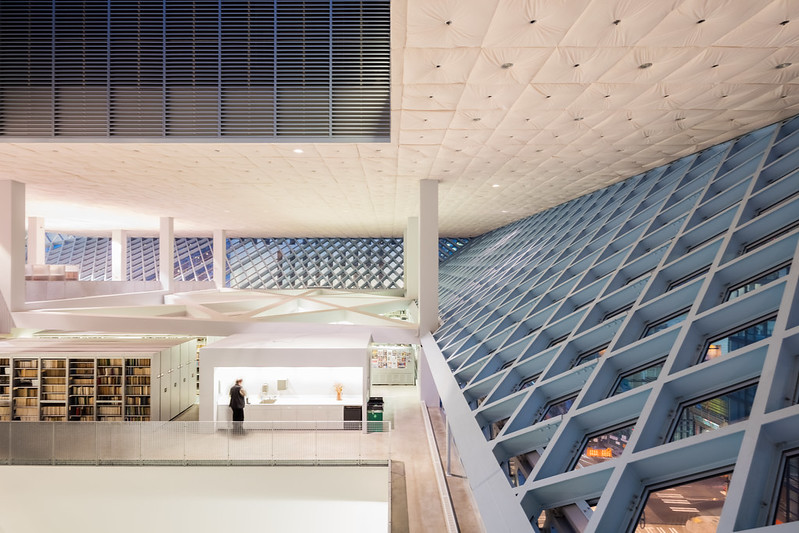
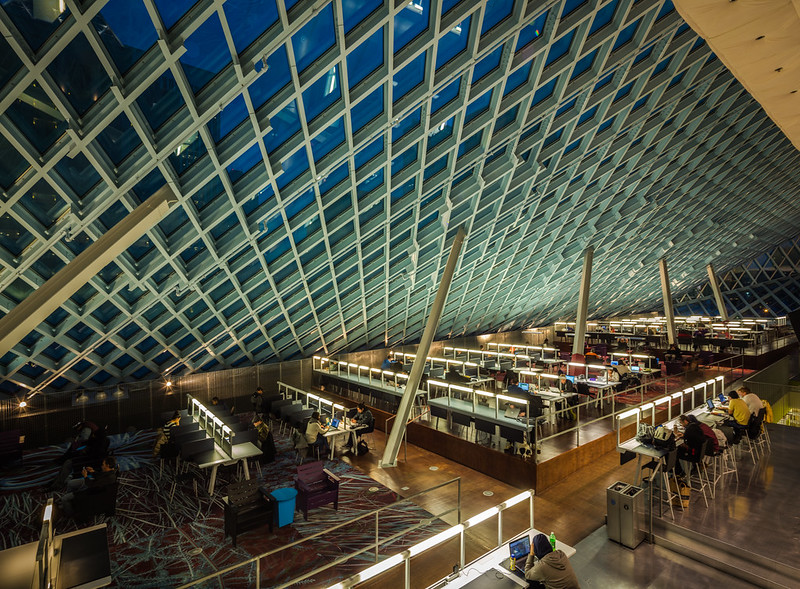
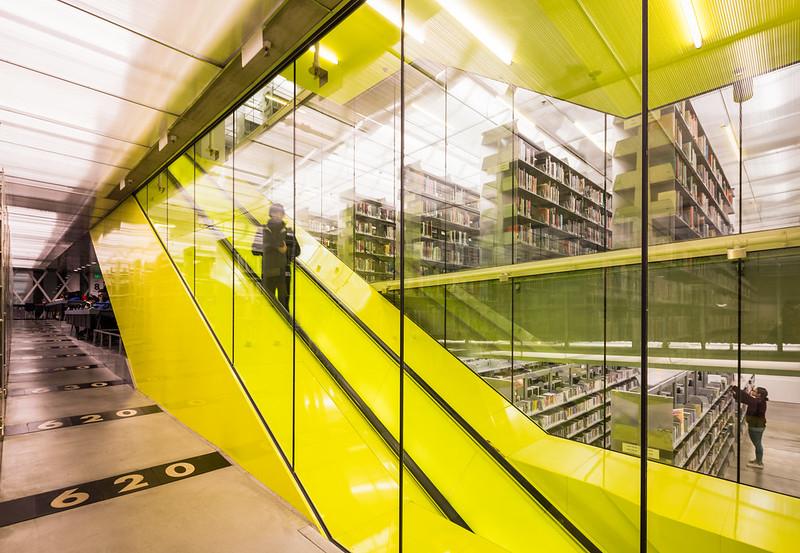
Even the Seattle Central Public Library - a real building - did it better, with tilted multi-floor window planes, escalators, multi-floor corkscrew walking path with numbering on the floor, unexpected openings overlooking big open spaces, etc.
Right now, space is criminally underused in cities or allocated so inefficiently that we don't really need acrologies yet. We can get more green in cities and making these places more pleasant and human space to live.
The more interesting question is why so many people feel this place in the first place. Why this puzzling fascination? I don't have this with any other place.
Why do the pictures feel like home?
While I shouldn't, I remember it as people struggling to make ends meet but also as an incredibly happy place because of the tightly knitted social fabric. The need to help others and the need to be helped creates top notch relationships.
I don't foresee a future where any city feels the desire to model itself after the Kowloon Walled City in terms of density, because in order for that to happen it would have to imply that physical space itself is the bottleneck for the population, rather than things like the availability of energy/food/water (which was true for the KWC for historical/political reasons).
So, essentially Berlin inside the ring. Each "kiez" (a neighbourhood) is sort of a village of its own.
I lived in Hong Kong just under 10 years, and a friend of a friend grew up in the walled city.
As far as I understand this happened even before the handover.
Kowloon seems to exist outside/before these restrictions, and might therefore feel more "free" in some way. It might also be why fantasy/science fiction fantasy tends to take place in a slightly more "lawless" and uninhibited world.
When I say “free” and “uninhibited”, I am talking only about the mind playing with fantasy, not the actual lived experience of residents
And the resulting pest presence yes. Yuck :)
>Medical and dental care were no problem at all: many of the residents were doctors and dentists with Chinese qualifications and years of experience but lacking the expensive pieces of paper required to practise in the colony. They set up their neat little clinics in the City, oases of cleanliness and order, and charged their patients a fraction of what they would pay outside.
Source: City Of Darkness: Life In Kowloon Walled City (1993)
I doubt most of the people who lived there felt that way. There were rules enforced by the powerful people living there, it just wasn’t enforced formally via laws. Instead, strongmen imposed their own rules.
Nominative determinism?
Most recently, the setting of the video game Stray is basically Kowloon with the serial numbers filed off.
In the same way that people living in Chaos yearn for a Franco or an old King because they symbolize order, regardless of the realities of their reign. Just a projection space that is sufficiently ill-defined that it becomes a canvas.
If you're into technology - like anyone on Hacker News - you're probably fascinated by seeing high complexity in a small space. That's one of the things about tech that makes it exciting to me. Look at my smartwatch - so much complexity crammed into something so small. Such high entropy. It's just fundamentally interesting because there's so much there.
I know it was no treat for the people that lived there, tho. Conditions sucked.
(Bit of a tangent, but I also wonder if there's a link between this and my (very bad) social media addiction. There's just so much stuff to look at on a place like reddit or tiktok. Such high information density.)
This diagram sort of reminds me of playing Sim Tower, or those books of cross sections of things that were popular entertainment when I was a kid. I guess they hit the same part of the brain.
I suppose, having written the old Mac computer game Glider, it might be obvious why I am drawn to it since it kind of looks like an insanely large "house" that someone might have created for the game.
On the other hand I feel like I have had dreams in spaces that I imagine are like this — and I feel like these dreams may have pre-dated the game I wrote?
Or maybe it's a kind of Blade Runner vibe of the future that the city gives off — or like the early police chase scene in Chung King Express ... [1]
I imagine it as having both good and bad qualities. I imagine crime is always present — but that too exploration is always there too. A younger me would have loved to try to get lost, try to find my way home.
[1] https://youtu.be/0uMekCFDnkI