News for hackers. Stuff that matters.
Re:Webb captures iconic Horsehead Nebula in unprecedented de... by itishappy on Monday April 29, 2024 @12:15PM (#40200270)
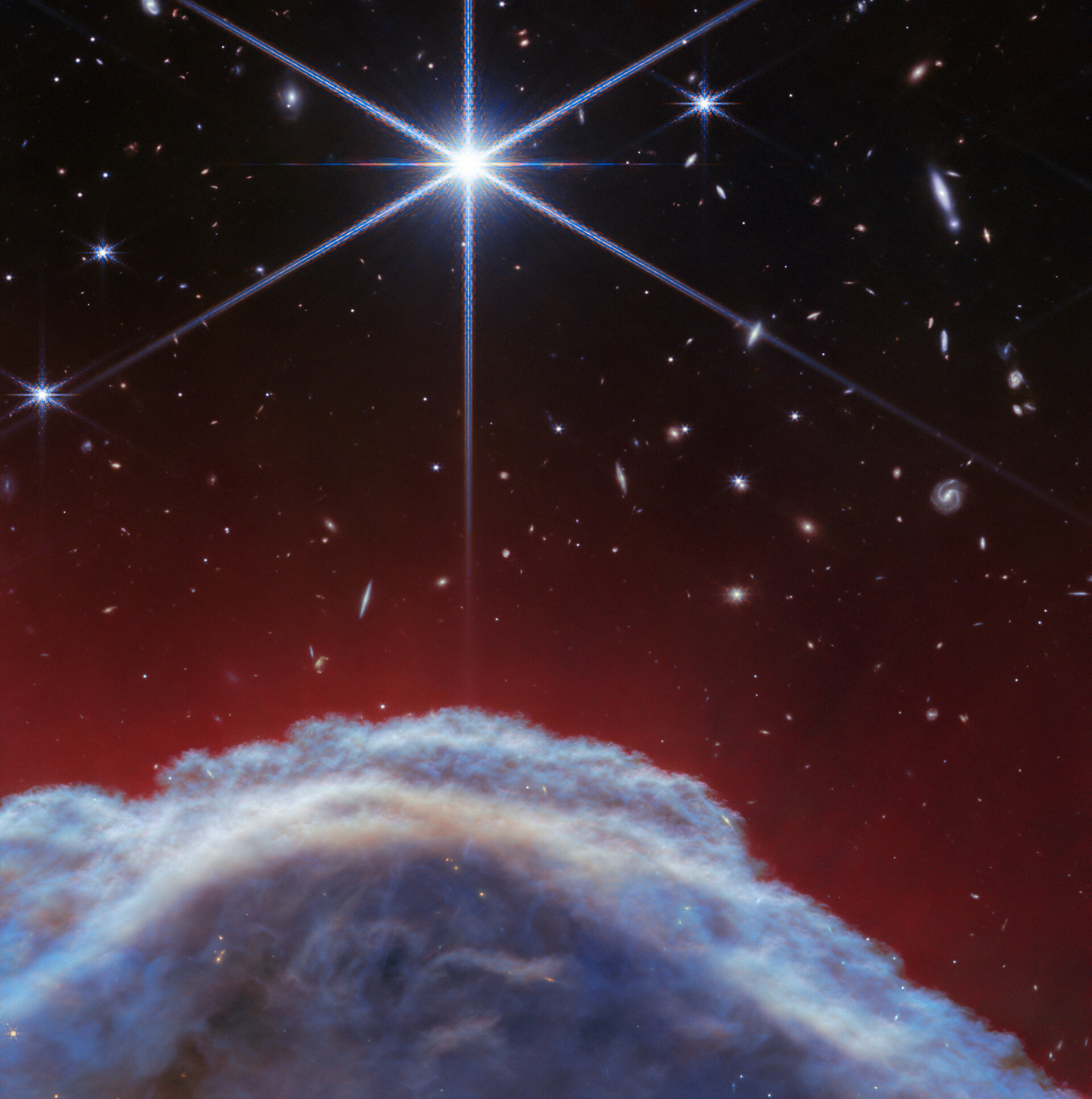
Wow. The NIRCam image is probably going to be the most exciting new photo, but I can't get over how well MIRI reveals the internal structure of the nebula.

NIRCam: https://www.esa.int/ESA_Multimedia/Images/2024/04/Horsehead_...

MIRI: https://www.esa.int/ESA_Multimedia/Images/2024/04/Horsehead_...

Comparison: https://www.esa.int/ESA_Multimedia/Images/2024/04/Slider_Too...

Re:Webb captures iconic Horsehead Nebula in unprecedented de... by dylan604 on Monday April 29, 2024 @12:28PM (#40200508)
I love that there are multiple sensors that can be compared to like this, but also love when the optical images from Hubble are compared as well.

The images that combine all of the frequencies from Chandra X-rays, Hubble's optical, and now Webb's IR make for some truly fascinating images.

Re:Webb captures iconic Horsehead Nebula in unprecedented de... by GrumpyNl on Monday April 29, 2024 @04:24PM (#40203691)
Is this image of what the eye would see or is it modified?
Re:Webb captures iconic Horsehead Nebula in unprecedented de... by Sharlin on Monday April 29, 2024 @05:24PM (#40204307)
The JWST, as is well known, is a near and mid infrared telescope, its range (600 to 2850 nm) overlapping with human vision only a little bit in the deep red. So every single JWST image is necessarily in false color.
Re:Webb captures iconic Horsehead Nebula in unprecedented de... by dylan604 on Monday April 29, 2024 @05:46PM (#40204503)
Even Hubble images are false color as well. It uses filters and then recombines them to RGB channels. People naturally ask what they would actually see, but they actually wouldn't see much of anything. Using a telescope to look at things, one only sees a black and white image. We've been shown so much from sci-fi with space ships showing nebulas and nova remnants out their view screens, but that' just not what one would see.
Re:Webb captures iconic Horsehead Nebula in unprecedented de... by dekhn on Monday April 29, 2024 @06:46PM (#40205022)
No. A normal visible light telescope absolutely shows color. You can just point a DSLR with a zoom lens and no filters at the sky, take a picture of M42, and confirm that yourself.
Re:Webb captures iconic Horsehead Nebula in unprecedented de... by dylan604 on Monday April 29, 2024 @06:51PM (#40205076)
I'm sorry, but the last time I checked a DSLR is not my eye. I have plenty of images from my telescope and various cameras. How you can conflate the 2 is beyond me. Comparing a long exposure from a digital sensor to what your eye can see is beyond bonkers and confusion of the topic at hand, or right in front of our eyes to keep it on subject
Re:Webb captures iconic Horsehead Nebula in unprecedented de... by dekhn on Monday April 29, 2024 @07:59PM (#40205710)
Maybe I misread your statement "Using a telescope to look at things, one only sees a black and white image". Certainly you can see color when looking at planets (mars, jupiter, saturn). But more importantly: you can see M42 in color with a telescope and eyes, it doesn't need to be a camera or film. If your point is that it's hard for your retina to detect a rich color spectrum from distant objects without either magnification or time-averaging, sure, but that's not how your comment reads.

Before you jump to "bonkers" maybe give the people you reply to some credit- I'm an amateur astronomer with facts at his disposal.

Re:Webb captures iconic Horsehead Nebula in unprecedented de... by dylan604 on Monday April 29, 2024 @08:21PM (#40205896)
> Before you jump to "bonkers" maybe give the people you reply to some credit- I'm an amateur astronomer with facts at his disposal.

As am I, and any time I use an eye piece, it is nothing but b&w for DSOs even for something as bright as Orion's Nebula. The spirit of the conversation is if people can see the true color the way images from large telescopes posted in articles like this. They cannot. You take the reaction from the average person that has only seen processed images after looking through a telescope for the first time, and they will almost always have a bit of disappointment in their voice. I have taken my scope to rooftop bars and let patrons look through at whatever can be seen at the time. I have yet to do this and not meet someone that's never looked through a telescope with their own eyes--which is the point of my effort.

Re:Webb captures iconic Horsehead Nebula in unprecedented de... by dekhn on Monday April 29, 2024 @08:33PM (#40205995)
I understand. The way you wrote it it sounded like you were implying that the scope itself strips the color spectrum ("black and white") when really it's just the light is so faint that our cones don't really register color while our rods can easily register bright white light. (i work with weird people who don't like false color and instead look at the image as a series of monochromatic filtered images because you can see more detail that way)

For demonstration, I always attach a DSLR to prime focus and display Live View.

Re:Webb captures iconic Horsehead Nebula in unprecedented de... by SiempreViernes on Tuesday April 30, 2024 @09:28AM (#40210769)
Your comment about the colour fidelity of deep sky objects is waay too sloppily written for you to get away with that tone!

I mean, just look at what you wrote:

> Using a telescope to look at things, one only sees a black and white image.

as anyone who owns a telescope that can point at trees knows, you can definitely "look at things" and see them in colour (assuming you have normal colour vision).

Re:Webb captures iconic Horsehead Nebula in unprecedented de... by dylan604 on Tuesday April 30, 2024 @12:00PM (#40212536)
Yes, because in a thread about the JWST, then moving to backyard telescopes, we all naturally assume we're pointing them at trees.
Re:Webb captures iconic Horsehead Nebula in unprecedented de... by pmontra on Tuesday April 30, 2024 @07:27AM (#40209805)
> Using a telescope to look at things, one only sees a black and white image.

I remember seeing Jupiter in colors when looking at it from the backyard of a friend of mine.

That telescope didn't have a motor and we were constantly chasing Jupiter manually. It stays inside the ocular only for a few seconds, then Earth points us into another direction.

Re:Webb captures iconic Horsehead Nebula in unprecedented de... by HumblyTossed on Monday April 29, 2024 @01:41PM (#40201505)
Crazy how many galaxies are in that one photo (in the background).
Re:Webb captures iconic Horsehead Nebula in unprecedented de... by afterburner on Monday April 29, 2024 @01:58PM (#40201737)
Number of stars in the Milky Way: 100 billion

Number of galaxies in the universe: 200 billion to 2,000 billion

Re:Webb captures iconic Horsehead Nebula in unprecedented de... by markus_zhang on Monday April 29, 2024 @02:05PM (#40201817)
Is 2,000 billion some theoretical limit or something else? Thanks.
Re:Webb captures iconic Horsehead Nebula in unprecedented de... by sandworm101 on Monday April 29, 2024 @02:11PM (#40201892)
Yes. Take the age of the universe, multiple by the rate of expansion to get the total size of the universe, then multiple by the average density of galaxies in the observable universe. There are some further complications, but at the root it is basic algebra.
Re:Webb captures iconic Horsehead Nebula in unprecedented de... by glenstein on Monday April 29, 2024 @04:55PM (#40204023)
>Take the age of the universe, multiple by the rate of expansion to get the total size of the universe, then multiple by the average density of galaxies in the observable universe

My understanding is that, at the largest scales, clusters of galaxies are organized along a series of gravitationally bound filaments, sometimes called the cosmic web.

So they aren't distributed like random noise, but more like a web. I have no reason to think this changes anything about calculating average densities, but it is notable that there's the general density but probably a significantly different density within that structure.

Re:Webb captures iconic Horsehead Nebula in unprecedented de... by causal on Monday April 29, 2024 @02:30PM (#40202103)
Replying to the other replies here - this regards the observable universe. Speed of light limits and all that. Of course we have no reason to believe the universe just stops at the point where we happen to lack the ability to observe.
Re:Webb captures iconic Horsehead Nebula in unprecedented de... by sandworm101 on Monday April 29, 2024 @02:40PM (#40202220)
Well, no. The density in the observed universe is used to extrapolate the number of galaxies in the non-observed universe. The size of that universe is extrapolated from the rate of expansion and the time since the big bang.

The size and shape of the observable universe also changes. A moving observer, say someone doing 30% of lightspeed, will see further in one direction than another. Accelerate quickly enough and the "dark" side of your custom observable universe might catch up with you, causing all sorts of havoc.

https://en.wikipedia.org/wiki/Unruh_effect

Re:Webb captures iconic Horsehead Nebula in unprecedented de... by nilkn on Monday April 29, 2024 @03:11PM (#40202644)
You’re assuming that space was compressed into a single point at the Big Bang. However, this is not implied by the Big Bang or cosmology. All we can truly infer is that the universe was very hot and dense and that spacetime experienced rapid expansion. We do not know the size, extent, or shape of space at that time, and we don’t even know how much matter and energy were present. We only have a notion of the density.
Re:Webb captures iconic Horsehead Nebula in unprecedented de... by sandworm101 on Monday April 29, 2024 @03:22PM (#40202808)
We may not know the exact size at the start, but we know it was infinitesimally smaller than it is today. So the size of the initial universe isn't a big factor in the equations about how big it likely is today. Weather it started as a few centimeters across or a few thousand light years across, both are functionally zero compared to the current size.
Re:Webb captures iconic Horsehead Nebula in unprecedented de... by nilkn on Monday April 29, 2024 @03:33PM (#40202979)
We don’t know that, though. Consider an evolution of a flat coordinate plane given by (x,y) -> (e^t * x, e^t * y). This process can run forever and has the property that all points appear to move away from all other points through time, yet the size of the plane never changes.

It’s better to think of the Big Bang as describing a point in time rather than a point in space.

Re:Webb captures iconic Horsehead Nebula in unprecedented de... by mynameishere on Monday April 29, 2024 @04:49PM (#40203957)
Does anyone know why wolframalpha is plotting this with cute little arrows?

https://www.wolframalpha.com/input?i=plot+%28x%2Cy%29+%3D+%2...

Re:Webb captures iconic Horsehead Nebula in unprecedented de... by itishappy on Monday April 29, 2024 @05:23PM (#40204294)
It's a vector field! It has 2 dimensional inputs and 2 dimensional outputs, so it doesn't fit on your traditional graph.

    f(x,y) = (c * x, c * y)
    f(x,y) = c * (x,y)
    f(P) = c * P
If you give some thought to what `c` is doing to each point of your plane (start with the origin!), I bet that graph might make a bit more sense. :)
Re:Webb captures iconic Horsehead Nebula in unprecedented de... by thaumasiotes on Tuesday April 30, 2024 @12:01AM (#40207118)
> Consider an evolution of a flat coordinate plane given by (x,y) -> (e^t * x, e^t * y). This process can run forever and has the property that all points appear to move away from all other points through time, yet the size of the plane never changes.

What do you mean by that last claim? Any observable region is bigger at later times than it is at earlier times. The reason all points always appear to be moving away from all other points is that that is in fact happening.

What's the significance of claiming that the size of the infinite plane never changes? It's just as true that if you start with the unit interval [0, 1] and let it evolve under the transformation f(x) = tx, the size of the interval will never change -- every interval calculated at any point in time will be in perfect 1:1 correspondence with the original (except at t=0). But this doesn't mean that the measured length of the interval at different times isn't changing; it is.

Re:Webb captures iconic Horsehead Nebula in unprecedented de... by BearOso on Monday April 29, 2024 @05:13PM (#40204196)
We know the observable universe was part of the big bang and is expanding, maybe even because we're observing it. We have no concept of whether that dense spot was all there was, and there are a whole slew of other caveats, so it could even be orders of magnitude larger.

Our current knowledge is functionally zero in the grand scheme of things.

Re:Webb captures iconic Horsehead Nebula in unprecedented de... by irjustin on Monday April 29, 2024 @07:31PM (#40205451)
> Well, no. The density in the observed universe is used to extrapolate the number of galaxies in the non-observed universe. The size of that universe is extrapolated from the rate of expansion and the time since the big bang.

> We may not know the exact size at the start, but we know it was infinitesimally smaller than it is today. So the size of the initial universe isn't a big factor in the equations about how big it likely is today. Weather it started as a few centimeters across or a few thousand light years across, both are functionally zero compared to the current size.

Most things you're saying is correctly rooted except for what's beyond the observable universe. I'm not sure why the staunch belief that you can confidently claim this.

The replies to you aren't wrong, they represent a significant portion of the scientific community that says our universe is likely infinitely big and that, possibly, the big bang was infinitely small, yet still, still infinitely large. An infinite expanding into infinite still results not knowing what's out there.

PBS Space time talks about it in terms of "scale factor"[0] instead of absolute diameter.

To be clear, these are all theories (as opposed to laws), so your take _could_ be valid, but generally, it points infinitely large.

[0] https://youtu.be/K8gV05nS7mc?t=271

Re:Webb captures iconic Horsehead Nebula in unprecedented de... by causal on Monday April 29, 2024 @03:21PM (#40202784)
Yeah this is a difficult concept, and I think the way the big bang is commonly portrayed in media often leads to this misconception of the big bang as starting at a point in space rather than a density.

I uncovered this for myself when asking, "where is that point now?" and discovering it was never a point at all, space is expanding from all points simultaneously.

Re:Webb captures iconic Horsehead Nebula in unprecedented de... by sandworm101 on Monday April 29, 2024 @03:38PM (#40203069)
The easy answer to the hard concept is that the big bang is not the increase in size of a thing. It is an increase in dimensions, including time. Our notions of size, of dimension, might not exist outside the bubble. We would therefore never perceive an edge, but that doesn't mean that one does not exist nor that there may be a finite size.
Re:Webb captures iconic Horsehead Nebula in unprecedented de... by Baeocystin on Monday April 29, 2024 @05:40PM (#40204448)
I explain it to folks as if one was trying to go further south than the south pole. There's nothing physically impeding you; it's simply that once on the pole, all directions are north.
Re:Webb captures iconic Horsehead Nebula in unprecedented de... by regularfry on Tuesday April 30, 2024 @08:32AM (#40210334)
Even that's not especially easy, because you then need to deal with "if the dimensions themselves are changing, why aren't protons the size of planets?"
Re:Webb captures iconic Horsehead Nebula in unprecedented de... by Nevermark on Monday April 29, 2024 @03:52PM (#40203284)
> The density in the observed universe is used to extrapolate the number of galaxies in the non-observed universe.

The unobserved universe is likely to be many orders of magnitude larger than the observed universe. It is possible that it is unimaginably larger.

Technically, it is possible that the unobserved universe is infinite, however whether that is a credible option depends on individual scientists informed intuitions. We simply have no experimental or theoretical evidence either way at this point.

So there is no estimate of how many galaxies there are in the universe in toto.

Re:Webb captures iconic Horsehead Nebula in unprecedented de... by pdonis on Monday April 29, 2024 @03:28PM (#40202903)
> The density in the observed universe is used to extrapolate the number of galaxies in the non-observed universe.

As has already been pointed out, our best current model of our universe is that it is spatially infinite. That means an infinite number of galaxies.

The finite galaxy numbers that astronomers give are for the observable universe.

> The size and shape of the observable universe also changes.

Not the way you are describing, no. The observable universe does increase in size as time goes on, because there is more time for light to travel so the light we see can come from objects further distant. Its shape, however, does not change.

A good reference is Davis & Lineweaver's 2003 paper:

https://arxiv.org/abs/astro-ph/0310808

> A moving observer, say someone doing 30% of lightspeed, will see further in one direction than another.

I don't know where you're getting this from. What part of the universe you can observe from a given point does not depend on your state of motion.

> Accelerate quickly enough and the "dark" side of your custom observable universe might catch up with you, causing all sorts of havoc.

This is nonsense. The Unruh effect is (a) nothing like what you are describing, and (b) irrelevant to this discussion anyway, since the Unruh effect only applies to objects which have nonzero proper acceleration, which is not the case for any galaxies, stars, or planets in the universe.

Re:Webb captures iconic Horsehead Nebula in unprecedented de... by layer8 on Monday April 29, 2024 @02:51PM (#40202371)
As far as we know, the total universe may have infinite size, and thus contain infinitely many galaxies.
Re:Webb captures iconic Horsehead Nebula in unprecedented de... by an-honest-moose on Monday April 29, 2024 @03:07PM (#40202583)
That doesn't necessarily follow - the universe can be infinite in size, but contain a finite amount of matter.
Re:Webb captures iconic Horsehead Nebula in unprecedented de... by layer8 on Monday April 29, 2024 @03:13PM (#40202690)
True, I was keeping the reasoning about the average density. A homogeneous universe is still the null hypothesis.
Re:Webb captures iconic Horsehead Nebula in unprecedented de... by pdonis on Monday April 29, 2024 @03:29PM (#40202918)
Not the universe we observe, no. There is no valid model in GR that has this property and matches our observations of the universe as a whole. Models with a finite amount of matter surrounded by an infinite region of vacuum exist in GR, but they are not homogeneous and isotropic on large scales, while our observations indicate that our universe is.
Re:Webb captures iconic Horsehead Nebula in unprecedented de... by worldsayshi on Monday April 29, 2024 @02:26PM (#40202051)
Is that really the way to see it? As I understand it, the Big Bang didn't happen in "one place". The Universe is expanding from an compressed state - the Big Bang state. But there is no center point. We can only see that there's expansion but it's not from a single point. The only known "center point" is us. And the only reason it's a center point is because we can only see as far away as light has traveled since the Big Bang.
Re:Webb captures iconic Horsehead Nebula in unprecedented de... by pdonis on Monday April 29, 2024 @03:30PM (#40202931)
> As I understand it, the Big Bang didn't happen in "one place"...there is no center point.

That is correct. The only tenable answer to "where did the Big Bang take place" is "everywhere".

Re:Webb captures iconic Horsehead Nebula in unprecedented de... by reactordev on Monday April 29, 2024 @02:39PM (#40202198)
This theory of multiple points supports the big ring and other structures outside the “this shouldn’t exist” bubble. The bubble is the Big Bang + rate of expansion. It was thought that there was nothing outside of the farthest point… but there is!
Re:Webb captures iconic Horsehead Nebula in unprecedented de... by reactordev on Monday April 29, 2024 @02:37PM (#40202170)
What about the big ring [0]? Or other mega structures of galaxies outside that “bubble”?

[0] https://en.m.wikipedia.org/wiki/Big_Ring

Re:Webb captures iconic Horsehead Nebula in unprecedented de... by injidup on Monday April 29, 2024 @02:27PM (#40202068)
So if the universe has a size then what do you see if you are on the edge of it? Do you see stars to the left and nothing to the right? I mean given the speed of light and the age of the universe and the rate of expansion there are regions inaccessible to us but that doesn't quite mean the universe has a finite size.
Re:Webb captures iconic Horsehead Nebula in unprecedented de... by dotnet00 on Monday April 29, 2024 @02:38PM (#40202192)
The observable universe has a size, the cosmic microwave background is what we 'see' at the 'edge' in terms of photons (~400k years after the big bang). We could see further if we could map out the gravitational wave or neutrino backgrounds (1 sec after the big bang).

But for now we can't really say if the universe in its entirety has a finite size.

Re:Webb captures iconic Horsehead Nebula in unprecedented de... by mvkel on Monday April 29, 2024 @03:09PM (#40202620)
Fascinating. Do you think it's possible that we can map these out in the next 50 years?
Re:Webb captures iconic Horsehead Nebula in unprecedented de... by dotnet00 on Monday April 29, 2024 @03:41PM (#40203105)
For the gravitational wave background, maybe with LISA we might be able to get a glimpse, but the neutrino background seems like it'd take some truly unprecedented breakthroughs in our ability to detect neutrinos to have any chance of mapping it out.
Re:Webb captures iconic Horsehead Nebula in unprecedented de... by mvkel on Monday April 29, 2024 @04:52PM (#40203994)
Funny, in reading up on both, I had higher hopes for the gravitational waves.

It seems like GWB is a superposition of infinite overlapping waves that would be impossible to single out and "unwind" in order to form a map.

And big bang neutrinos are very weak, which makes them undetectable. My assumption was we'd need a breakthrough in measurement sensitivity but is there more to it?

Re:Webb captures iconic Horsehead Nebula in unprecedented de... by datameta on Monday April 29, 2024 @05:51PM (#40204538)
Naive thought - can a subsurface detector on the moon serve as an ultracold shielded scenario?
Re:Webb captures iconic Horsehead Nebula in unprecedented de... by dragonwriter on Monday April 29, 2024 @02:30PM (#40202106)
Finite size doesn’t require an edge. Consider the surface of a balloon for a 2-D case (or the perimeter of a sphere, for a 1-D case): it has finite extent, but no edge.
Re:Webb captures iconic Horsehead Nebula in unprecedented de... by lupire on Monday April 29, 2024 @02:40PM (#40202218)
It has a surface, though, which is what PP was asking about.An answer to the question is, yes, nesr the edge/face, one side is dark. But relativity and expansion makes the situation a bit more complicated.
Re:Webb captures iconic Horsehead Nebula in unprecedented de... by mvkel on Monday April 29, 2024 @03:01PM (#40202496)
Isn't the rate of the expansion of the universe increasing?

And that assumes the observable universe is homogeneous, which it isn't

Re:Webb captures iconic Horsehead Nebula in unprecedented de... by pdonis on Monday April 29, 2024 @03:32PM (#40202952)
> Isn't the rate of the expansion of the universe increasing?

It is now, but up until a few billion years ago, it wasn't, it was decreasing. Many of the objects we currently see are far enough away that the light we are now seeing from them was emitted while the universe's expansion was still decelerating.

> that assumes the observable universe is homogeneous, which it isn't

No, the models cosmologists use do not assume the universe is homogeneous period. They only assume it is homogeneous on average, on large distance scales (roughly scales larger than the size of the largest galaxy clusters).

Re:Webb captures iconic Horsehead Nebula in unprecedented de... by layer8 on Monday April 29, 2024 @02:48PM (#40202328)
*observable universe
Re:Webb captures iconic Horsehead Nebula in unprecedented de... by afterburner on Thursday May 02, 2024 @12:50PM (#40238366)
Yes. I find it amusing I sparked a debate on what might be beyond the observable universe, when my point was entirely about what you could theoretically observe in the night sky.
Re:Webb captures iconic Horsehead Nebula in unprecedented de... by bufferoverflow on Monday April 29, 2024 @08:52PM (#40206113)
100 billion is the low end estimate for our galaxy.

400 billion is the high end.

Re:Webb captures iconic Horsehead Nebula in unprecedented de... by ridgeguy on Monday April 29, 2024 @08:42PM (#40206052)
A few years ago, I calculated that there are approximately one Mole (6e23) of stars in the visible universe. That was a fun result.
Re:Webb captures iconic Horsehead Nebula in unprecedented de... by m463 on Tuesday April 30, 2024 @12:28AM (#40207246)
We are probably looking at galaxies when we look at some stars and have no idea how many turtles deep things go.
Re:Webb captures iconic Horsehead Nebula in unprecedented de... by HenryBemis on Monday April 29, 2024 @01:51PM (#40201634)
And when 'zooming in' and seeing the top 2/3 of the photo (https://www.esa.int/var/esa/storage/images/esa_multimedia/im...) I am super amazed that all these small discs showing are galaxies. GALAXIES (sorry for the caps).

How tiny are we (Humans, Earth, Solar system)... less than a speck of dust in the Sahara.

I used to look up in space when I was growing up and there wasn't any light pollution to the small town I was growing up in. At some point I think I started suffering from 'cosmic horror'. In later years I would pay attention only to the moon, and that reduced my stress significantly.

Nowadays (like in this bit of news, with photos) when I stick to the small photo in an article, I feel ok. When I see it in full size and I zoom in, and I realize that "sh*t! these 5-10-50 tiny white marks are GALAXIES.. and I have to change topics/tabs to keep the cosmic horror at bay.

Re:Webb captures iconic Horsehead Nebula in unprecedented de... by syspec on Monday April 29, 2024 @02:23PM (#40202029)
Experience that all the time with the same imagery, with the same amazement / horror combination.

What's more amazing is when you share this fact to most people "did you know each dot here is a GALAXY, not a star!" they go "heh... interesting" and shrug.

For some reason that makes the whole thing even crazier to me

Re:Webb captures iconic Horsehead Nebula in unprecedented de... by dotnet00 on Monday April 29, 2024 @04:32PM (#40203773)
I think it just doesn't really click for people most of the time. Eg for my mom no amount of showing science pics and explaining the scale of the distances conveyed things, it only really clicked when Jupiter became visible in the night sky as a particularly bright and large point of light which caught her interest, and when we moved to somewhere dark enough that the galactic plane was faintly noticeable.
Re:Webb captures iconic Horsehead Nebula in unprecedented de... by HenryBemis on Monday April 29, 2024 @06:38PM (#40204957)
Yeah, I haven't seen the milky way with naked eye for a few years.
Re:Webb captures iconic Horsehead Nebula in unprecedented de... by chrisweekly on Monday April 29, 2024 @02:08PM (#40201867)
Interesting. I've also always had a visceral response to particularly clear night skies - but it's only ever been a profoundly positive feeling. It kind of erases the idea that my "problems" have any significance at all.
Re:Webb captures iconic Horsehead Nebula in unprecedented de... by lm28469 on Monday April 29, 2024 @06:10PM (#40204712)
The loss of dark skies is so painful, maybe the worst thing modern life brought to us. I remember laying in the grass with my grandma looking at the stars for hours, she would tell me how the whole village gathered around the only TV they had to watch the moon landing live, about sputnik, galaxies, satellites, &c. there aren't many things as mesmerising, maybe watching a fire or the ocean waves, but it doesn't trigger the same emotions in me.

I don't travel much but when I go to remote areas star gazing is up there on my list of things to do; watch the stars until you're about to pass out from hypothermia, go back inside, make some tea, enjoy the fireplace, forget about the daily (non) problems, it never gets old

Re:Webb captures iconic Horsehead Nebula in unprecedented de... by Koshkin on Monday April 29, 2024 @03:59PM (#40203390)
And yet, it is the atomic nucleus that is one of the most complex objects in nature.
Re:Webb captures iconic Horsehead Nebula in unprecedented de... by datameta on Monday April 29, 2024 @05:54PM (#40204573)
Complex in terms of our attempts to fully define it, or?
Re:Webb captures iconic Horsehead Nebula in unprecedented de... by jjbinx007 on Monday April 29, 2024 @04:49PM (#40203963)
Cosmic horror is a good one. I've only seen the Milky Way with my own eyes a couple of times and the last time gave me an existential cosmic horror too.

I went to sleep thinking about the unignitable size and age of what's all around us in every direction, but particularly that I had just looked at our own galaxy... a galaxy that has been there for billions of years, has always been there my entire and is there right now and there's only this tiny invisible thin bit of atmosphere separating us from it.

Then I thought about the fact tha our solar system is orbiting it right now, and we're orbiting the sun on an invisible track, and the moon orbits us on its own invisible track too.

That's quite a lot to deal with when you only woke up for a pee in the middle of a night in a camping holiday in Wales.

Re:Webb captures iconic Horsehead Nebula in unprecedented de... by tobias2014 on Monday April 29, 2024 @05:00PM (#40204076)
To fuel your cosmic horror: Some of the dots may even be galaxy clusters
Re:Webb captures iconic Horsehead Nebula in unprecedented de... by HenryBemis on Monday April 29, 2024 @06:38PM (#40204965)
Hahahahaha cheers, I had just forgotten about this and was going to sleep, but hey, what's a couple more hours of freaking out! :)
Re:Webb captures iconic Horsehead Nebula in unprecedented de... by nick238 on Tuesday April 30, 2024 @01:58PM (#40213993)
I kinda had an out-of-body experience when watching the Kurzgesagt video on The Largest Black Hole in the Universe. https://www.youtube.com/watch?v=0FH9cgRhQ-k

Watching the zoom-out to picture ultra-massive black holes is surreal.