Last year we installed a Mitsubishi hyper heat ductless system.
We used zero gas this year. Read it again, zero.
It’s lakefront, very remote, and the largest electricity bill i got was around $450 for a month and then they dropped back to something more like $250. The savings are huge, I’m no longer stressed about running out of gas…and the heat pump performed well beyond its advertised specifications. We had a few -25C days and it was humming hard, but the house stayed a comfortable 20C inside. The house is around 3000sqft and we didn’t even get the largest unit, i can’t stress enough that they actually operate better than advertised.
We would run a fire from time to time but we did that with propane too, it’s mostly ornamental.
https://photos.app.goo.gl/FCwLJQAtoG67g9y86
https://photos.app.goo.gl/TwiMaSAj9hGxYqby6
(Also, how do you guys function with those strange units? Therms, BTU/hr, etc. - all so confusing. Surely electrification and the shift to heat pumps could be a convenient excuse to start using watts (kW in this magnitude) for heat and joules (usually MJ) for gas!)
(You get used to whatever units you're using, and the US units make some calculations easier and others harder. If I could switch it all over to the SI system without massive transition costs I would, though!)
https://news.ycombinator.com/item?id=39144329 has a bit of details on the experiment I ran back in 2022 to prove 135°F flow would work for us. (If you have a condensing boiler, you can run this experiment safely; if you have a non-condensing boiler, you can run it, but not for very long as you'll be damaging the flue and boiler with condensation at these lower temps.)
My outdoor reset curve (sadly, on a gas combi boiler because of the "pretty unusual product" factors) is now set to 105°F at 55°F OAT and 154°F at 0°F OAT (which is lower than the design temperature here, but it gave me more resolution to tweak the line to fit the loss just right; it's spot-on on the lower end, with the system running 22-24 hours per day when it's cold out and stays that way up until around freezing, where the utilization falls off).
Matching the gain to the loss quite closely has resulted in a house that's the most comfortable since we moved in in 2007 and gas bills with the combi went down about 46% (versus a 1990s oil-to-gas conversion of a 1950s boiler, so not a realistic comparison for anything that wasn't built by General Motors [not a typo]).
Even our cast iron radiators are smaller than you might expect for the age of the house, because they were designed for water above its normal boiling point (using mercury pressure: https://www.jefftk.com/p/mercury-spill).
But, you've already discovered your reset curve with modern equipment, so you know the right answer for your place.
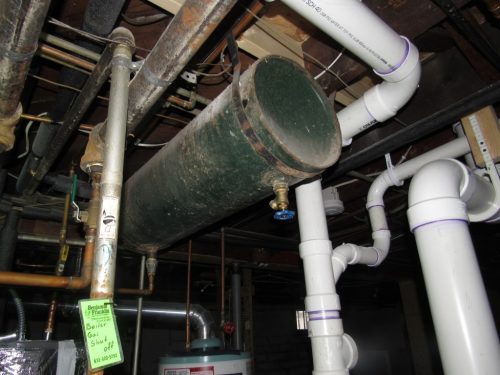
Thanks for the story on mercury pressurization! Fascinating. I learned a lot about our old house (originally gravity circulated as well, but near as I can tell, pressurized only to the typical 12-15 psi and with an in-ceiling green steel expansion tank: https://structuretech.com/wp-content/uploads/2020/03/Old-sch... )
(And of course, sorry to hear about your contamination inconvenience and expense!)
Over here they're called hybrid heat pumps and are quite popular. (At least with those that offer to sell them.) They're used in improving existing gas powered solutions. The heat pump takes most (or usually all) of the heating, while the existing gas heater provides hot water and can add peak heat if needed.
Popular brands here are:
- Remeha, with the types Elga Ace, Mercuria, and Mercuria Ace - Nefit/Bosch with Nefit EnviLine hybrid and Bosch Compress 7400i AW - Vaillant aroTHERM plus/pro/split
There's also the Quatt Hybrid, which I haven't heard of before, but it looks nice. And according to their website it has a large market share.
I think the challenge is determining how much energy you save. I guess we could run the calculations and back out nat gas savings.
Managing the microcontrollers might be a bit of a pain though.
I would love it if there were a service or some code to look at 1) gas prices 2) electricity prices 3) how efficient the two systems are and switch back and forth depending. Like... if it's -10C out, run the gas. As it gets closer to 0C, switch over at some point.
If gas is flat out always cheaper, you could still put a cutoff point where you're willing to spend a bit more because it's better for the environment.
In many regions electricity isn't as cheap as ours though, so that changes the game.
I'd argue that's politically motivated and very deliberate however...
http://ets.aeso.ca/ets_web/ip/Market/Reports/CSDReportServle...
Is there two per indoor head?
Similar to our situation, also in Canada; we cut our fuel bill by 3/4 after getting a heat pump. I still run the furnace on the coldest days, because it's hard to beat. But 9 days out of 10 the heat pump is all we need. The fact that it doubles as an AC unit (and is even more efficient) is gravy.
I also bought a heat pump hot water tank, and so far so good.
More to the point, I'm looking for a recommendation for a smaller unit to heat 750 sq ft. in Quebec.
I had a Moovair with three heads installed.
Huge bonus that its been cheaper, and substantially...but I just love relaxing about the reduced risk of the house running out of fuel.
Aren't basically all modern heatpump variable speed, and thus can modulate back?
That said, I totally agree with your overall point about right-sizing your heat pump, but it is more about saving money on the unit rather than worrying about cycle times.
I do hear the minisplit working hard those weeks, but we just needed a bit of extra help from the floor heating to have a comfortable 20C indoor.
Whether you call that mini-split or not is up to you, but it's definitely a heat pump system that is Hyper Heat and supplemental electric heat capable, and getting down to one-ton units seems "mini" to me.
Mini-split means "smaller than conventional system ["mini"], condensor and evaporator are connected by long refrigerant lines ["split"]". It doesn't necessarily mean "wall/floor/ceiling indoor unit that has no ducts", though a "ductless mini-split" is the most common configuration of mini-split (because of the cheapness and ease of installation). https://zeroenergyproject.com/2022/03/09/what-is-a-mini-spli...
That much? How do I get in on that?
My energy supplier's demand reduction scheme only pays £10/month total.
Many new homes that are heat pump only will also require some sort of resistive heating as a backup.
My HVAC guy keeps telling me to install a couple of heat pumps (he doesn't like driving out to me), solar panels, and an in-house battery; what sort of complexity was this job? Are there online sources you used?
You can also gain quite a bit by just fixing drafts and putting in proper insulation. Which can be much cheaper to do. I also had the guys go thru and fix an leaks in the duct system. That way the air was coming out where it should. It is amazing how badly that is installed many times. I also had them put in an attic fan which vented the attic when it got to about 110F. Insulation would have helped more there and I screwed up and put it off. If your house is older than 2000. I say go thru and review the existing insulation and look for drafts first.
It trimmed my bill from about 350 a month to 200. My new house has excellent insulation the house is slightly bigger and the power bill is in the 80-150 range (less because I got solar, but I figured out the actual cost anyway). It has one unit and an air valve to switch between the floors. So the total cost is lower but the one unit will run longer. That savings I am getting is mostly because of better insulation.
The only thing that might catch you up is designing the system and ensuring you right size it for your heat load requirements. I'm sure you could research this pretty well, but your HVAC guy might also be happy to consult on that portion.
That used to be true but modern air-source heat pumps are better. But even so the efficiency drops it's just physics. Even if a heat pump can grab heat at -15C it will need to run longer when it's very cold, reducing lifespan of the unit. At some point it will just switch over to pure electric so your power to heat 1:4 is now 1:1.
Ground source heat pumps are far better and even more efficient that air source but quite expensive to install.
I'm in Northern England and it's not uncommon for weeks of -5c to 5c in winter, some snowy days, plus serious damp making it feel even colder. So I'm curious if a similar system would be similarly amazing here.
I've read many people say they work perfectly because it won't hit -20c (a nice Strawman...)
I think Northern England climate is ideal for heat pumps -- it never gets too cold, never gets too hot.
Some naysayers will say that it doesn't work the 3 days of the year where it's -15°C outside, without talking about the other 100+ days where it's not that cold and where the heat pump is amazing.
Disclaimer: I self installed one for my house (13kWth) and I'm very glad I did