It is usually stated as fact with no backup. I’m open to being swayed either way by evidence. Do you have a link that represents the data that leads you to this conclusion?
And ditto for those who disagree with you.
Otherwise it’s just random people saying the other person is wrong.
After much turmoil the government negotiated a fixed strike price for £127/MWh = $160/MWh for 35 years after construction.
That is simply insane costs to pay for electricity. Those costs are expected and is why the only projects that ever gets going have government backing.
On top of this we subsidize the accident insurance. In the US it called the Price Anderson act, each nuclear plant pays a miniscule insurance premium compared to the Fukushima accident cost.
https://en.wikipedia.org/wiki/Price%E2%80%93Anderson_Nuclear...
Add another 10 - 20 cents for delivery depending on if it's a city or rural.
Last I checked that was with the subsidies (in use most places right now) that buffer the Russia-induced energy crisis. These are running out, partly because the way all the different subsidies were being hidden was unconstitutional.
German wholesale electricity prices are both cheaper than French and in line with the rest of Europe.
For the public there are quite high taxes to encourage energy efficiency, which the industry of course does not pay.
So you now claim that wholesale prices are cheaper, without subsidies I would presume. Do you have figures do back up those claims?
Not everybody agrees with you.
https://apnews.com/article/germany-economy-energy-crisis-rus...
"Germany risks “deindustrialization” as high energy costs and government inaction on other chronic problems threaten to send new factories and high-paying jobs elsewhere, "
"...a government-funded cap on industrial electricity prices to get the economy through the renewable energy transition."
I guess there may be some subsidies involved.
"...It was mistaken political decisions that primarily developed and influenced these high energy costs. And it can’t now be that German industry, German workers should be stuck with the bill.”
"A 2011 decision to shut down Germany’s remaining nuclear power plants has been questioned amid worries about electricity prices and shortages."
"In the meantime, energy-intensive companies are looking to cope with the price shock."
"“The perception of Germany’s underlying strength may also have contributed to the misguided decisions to exit nuclear energy, ban fracking for natural gas and bet on ample natural gas supplies from Russia,” he said. “Germany is paying the price for its energy policies.”"
By the way, here are some cost figure:
https://www.tech-for-future.de/wordpress/wp-content/uploads/...
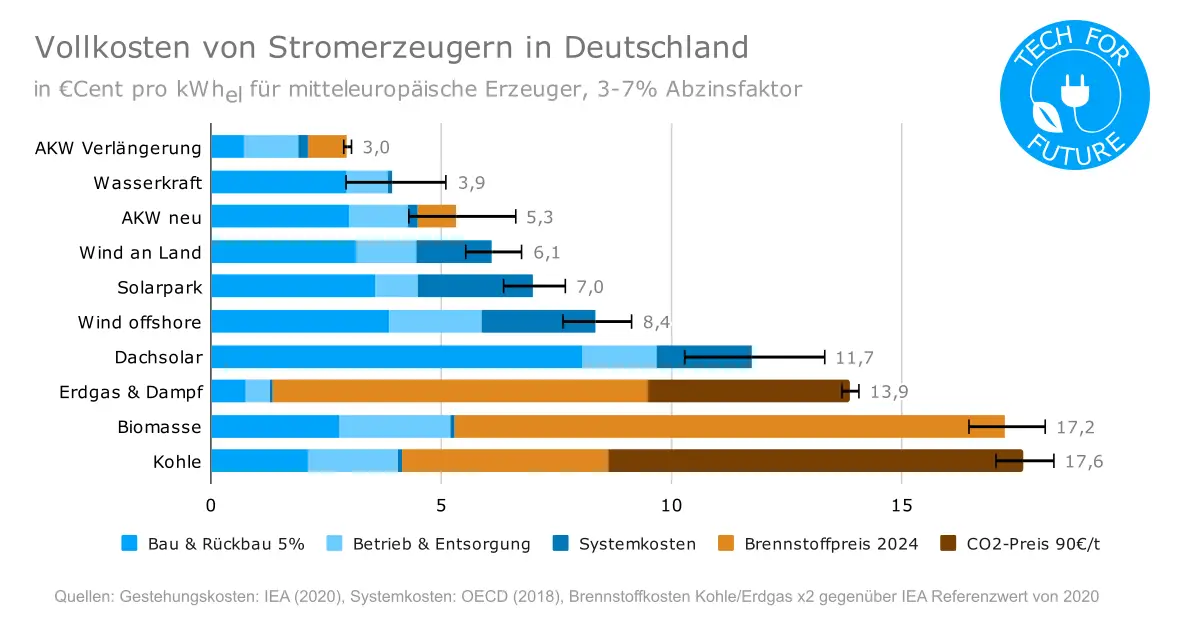
3,0 €Cent/kWh Nuclear, extension
3,9 €Cent/kWh Hydro
5,3 €Cent/kWh Nuclear, new
6,1 €Cent/kWh Wind on shore
7,0 €Cent/kWh solar farm
8,4 €Cent/kWh Wind offshore
11,7 €Cent/kWh solar roof
13,9 €Cent/kWh gas + steam
17,2 €Cent/kWh biomass
17,6 €Cent/kWh coal
It usually comes down to two factors.
One, the time horizon over which we observe and discount the levelised cost of energy (unsubsidised) relative to the plant’s lifetime. Nukes’ long lives mean their tremendous capital costs’ amortisation matters. In this, the anti-nuke tends to fudge its numbers.
Two, the degree to which we believe the Nth model will be cheaper than the 1st. We’ve built two AP1000s in America, both in the same series. China has built four, one in just nine years (multi-year delay for coolant pumps), in two roughly-parallel series. So the anti-nukes’ too-slow argument is bunk. But the pro-nuke team needs a learning curve barely demonstrated in another country to continue.
The meta-debate, however, is between and and or. I’ve seen no good reason not to pursue both building nukes, where the cost curve is unknown, and building wind and solar, where the details around storage (and how we’ll pay for it) is unknown.
We have much more evidence of contruction being too slow (if that's what you mean); why is one example from the other side more convincing? Also, China is not directly comparable, being able to undemocratically externalize the welfare of residents, construction workers, and operators.
Also, the last sentence seems to agree that the evidence is weak ?
> the anti-nukes ... the pro-nuke
Maybe there are also people who just care about getting the best outcome, aren't on a team that has drawn a predetermined conclusion, and are working with the data.
Because it’s a Gen III+ design.
> the last sentence seems to agree that the evidence is weak
It’s a new design.
> people who just care about getting the best outcome, aren't on a team that has drawn a predetermined conclusion, and are working with the data
Very few people who have done this conclude we should go all in on a single solution. Nuclear, natural gas, solar and wind look like a solid mix.
It’s cleaner than the alternatives and has its distribution infrastructure already built. While waiting for more solar, or waiting for more solar and wind and nukes, those coal and oil plants are still burning.
And yet... the Netherlands closed down the Groningen gas field because the green voters wanted it and because they showed a few slightly cracked walls on a few houses on TV and claimed it was because of the gas field (and not because of shoddy foundations and poor construction).
https://en.wikipedia.org/wiki/Groningen_gas_field
We also could have been doing fracking on land. Maybe in the future?
https://www.investigate-europe.eu/posts/europes-energy-crisi...
(2.9 on the Richter scale isn't much.)
And the biggest Danish gas field in the North Sea is still down due to the old off-shore facilities being scrapped and new ones being built. This is done by TotalEnergies and should have been completed more than a year ago. It was delayed by Covid-19 but should then have been completed by summer this year. It is still not complete :(
High expectations from TotalEnergies: https://totalenergies.com/projects/gas/tyra-major-offshore-p...
Danish realities: https://energinet.dk/gas/forsyningssikkerhed/tyra/
The last platform was only put in place in October 2022 (and there was still lots of work to do): https://energiwatch.dk/Energinyt/Olie___Gas/article14460490....
That doesn't exist yet.
>It’s a new design.
Which doesn't exist yet.
Vaporware is always cheaper.
Yes, it does. Per the original comment. AP1000s have been built and are generating power.
The storage details are not unknown. Battery prices are very known and continuously decreasing. As are the costs for wider grids. As are the costs of hydro storage. Some of them may be higher than we’d like, but they’re very known and going down. Unlike nuclear which has not been going down or getting faster.
Even in China, they are building solar wind and hydro far faster (and with increasing speed) than nuclear.
They’re known and currently high. The unknown is when it reaches a lower level.
> Unlike nuclear which has not been going down or getting faster
AP1000s are being built faster. We don’t know if we can manage cheaper.
> they are building solar wind and hydro far faster (and with increasing speed) than nuclear
Yes. Both. That’s my point.
What long economic payback time means is that the risks are huge. A 15 year construction and 40 year payback time and we are in the 1960s. A 60 year payback time and it's 1940s and the second world war is raging. How reasonable is it for Churchill, FDR and Stalin to predict energy investments that they only expect to get returns on in the 2020s?
All while competing solutions are already eating nuclear energy's lunch.
Trying to use long amortization is simply a crutch by people who do not understand basic economics. You can extend the amortization for renewables power plants with similar effects.
The chosen 20 years are simply because it is more economically efficient to replace them early, because what we expect to have available in 20 years are so much better that the economic efficiency gains are worth it.
Engineering a renewable plant for 40 or 60 years is trivial, it simply is not worth it.
A read for you is: "Understanding the Time Value of Money"
Don’t do that. China built its first AP1000s in 9 years, including waiting approximately half that time for a coolant pump. We take about that long to NEPA a transmission line. The problem is very obviously permitting.
> can extend the amortization for renewables power plants with similar effects
No, you can’t, because they aren’t being built to actually last that long. Nukes are.
> what we expect to have available in 20 years are so much better that the economic efficiency gains are worth it
You’re confusing technological progress with the time value of money. The former is unpredictable, particularly between two technologies progressing at different frontiers.
Maybe it's safety, democracy (locals and others get a say in having a local nuclear plant) or lots of other things we could speculate. What does the evidence say? And even if permitting is involved, that could just be the mechanism of safety, democracy, etc.
Words like 'obviously' and 'bunk' (in a prior comment) aren't persuasive, just provocative - they signal to me that you won't listen to anyone else (maybe you don't mean it that way).
That it’s not safety related. The evidence being in the block you quoted: it shouldn’t take 10 years to clear a wire through environmental review.
For what? These threads are littered with citations and specific data.
> Do you work in the industry?
Nope.
Yeah, because China is what we want to emulate. Of course, if it paints nuclear power in a positive light you gotta do what you gotta do.
> No, you can’t, because they aren’t being built to actually last that long. Nukes are.
Which means you do not understand economics 101, while still trying to justify something that goes against it.
They are built for a certain lifespan because that is what investors find are the optimal between construction cost and payback time. It is trivial to engineer renewable a plant to last 40 or 60 years. The construction cost would of course not double or triple to achieve this.
Thus we aim for 20 years, because that is the current optimum.
> You’re confusing technological progress with the time value of money.
Technological progress, means risk, because your solution might become obsolete and a stranded asset before it pays back the investment.
Technological progress is the time value of money. The same as political progress. Imagine you construct a factory in eastern Ukraine in 2005. What is the risk of Russia invading?
This is why the time value of money is an exponential factor, the longer out you go the larger the profit must be because the risk increases exponentially.
No, but we don’t throw out data we don’t like. Pre-AP1000, in the modern era, the data are grim. Post-AP1000 it’s much better.
> Which means you do not understand economics 101
Have you ever held a senior role in finance or banking? If you’re going to go ad hominem, don’t bring a rubber duck to a battleship.
> we aim for 20 years, because that is the current optimum
It’s because it divides by 5. It’s a short-hand, similar to the value of a company being 10x and a reasonable margin of error 15%. (It’s also an available risk-free rate in most currencies.)
> trivial to engineer renewable a plant to last 40 or 60 years. The construction cost would of course not double or triple to achieve this.
Data sorely lacking. (Outside hydro.)
> Technological progress is the time value of money
No, it is not.
> This is why the time value of money is an exponential factor
Oof, no, it’s not. Seriously, you can derive this and it’s elementary finance. Also, like, the marshmallow test.
Why aren't you answering the point? Is it that hard to substantiate your claims that a 60 year amortization + 15 year construction = 75 years is reasonable.
> Data sorely lacking. (Outside hydro.)
You mean like the data available on economic nuclear energy? :)
> Oof, no, it’s not. Seriously, you can derive this and it’s elementary finance. Also, like, the marshmallow test.
Do you see the year in the investment time ending up in the exponent? Of course in reality you expect the money to trickle in over time reducing the risk a bit.
https://www.investopedia.com/articles/03/082703.asp#toc-calc...
What do you mean reasonable? It’s real. We amortise over long time horizons in project finance all the time. Also, look up residual value. (And dams.)
And yes, I’m contesting both 60 and 15; they’re 80 and 10 and could be 80 and 5 with permitting reform. And within that latter envelope, it works with conventional financing. (The same problem plagues HVDC lines, which also take 10+ years to permit.)
> Do you see the year investment time ending up in the exponent?
You may actually enjoy reading some of the foundational texts whose concepts you’re glancing across. (Principles of Economics, Mankiw, is a classic. For a more-applied text, Fabozzi’s Fixed Income.)
You’re citing real things. But you’re connecting them nonsensically. Investopedia isn’t a replacement for training, though it’s a good reference once you’ve learned the material.
(The exponent comes from compounding time preference. Its time component is orthogonal to technological progress, which embeds in the rate. That’s why it’s constant. If you want to consider obsolescence risk, you start getting into hyperbolic discounting.)
Residual value for nuclear power plants are negative. The plant is EOL and now it is time to decommission the entire site.
Now you try to equate nuclear power with infrastructure, even though we have cheaper alternatives which the public don't even have to finance. Sounds reasonable?
For the private industry a typical expected discount rate is 10-15% above the risk free return rate to account for known and unknown risks.
Apply this to nuclear investment. For the money being returned year 60, in percentage, what is the risk?
Please calculate it, don't try to suggest different methods of "delaying gratification", that is simply trying to talk around the subject because you know the answer.
The risk premium for the expected returns year 60 are ludicrous which is why no one suggests it.
Not what residual value means.
> you try to equate nuclear power with infrastructure, even though we have cheaper alternatives which the public don't even have to finance
Infrastructure isn’t dependent on source of financing. Neither do ROI calculations, though you might scope them differently for public benefit. We are doing none of that here.
> risk premium for the expected returns year 60 are ludicrous which is why no one suggests it
Plenty of large projects model residuals and terminal value over the long term. Bankers typically stop modelling when the financing has to be rolled over for practical reasons; it’s unnecessary to be precise.
I’m genuinely curious what your background in this is.
> Please calculate it
Lots of people at federal agencies, banks and private companies are; their work is cited across these threads. But if you’re arguing about the definition of time value and infrastructure, I don’t think that’s a productive place to start. There is seldom substitute for fundamentals.
The investment horizon is so long that we can't model it. Sounds good!
Looking at Hinkley Point C, Lazard, IEA, NuScale and the French accounting agency the number is $120-180/MWh.
You've found one low quality source which massage the numbers to fit your narrative and continue harping about it.
OK, let's take China out of the equation.
https://web.mit.edu/kshirvan/www/research/ANP193%20TR%20CANE...
Still the same reactor chugging away…
> even the unsubsidized fully loaded cost with current technology is far cheaper than anything else
What in the GP addresses that question?
What I mean to say doesn't require data, but perhaps I didn't communicate well.
And then ethanol subsidies. 40m acres are subsidies to grow corn for ethanol, which is a net energy loss. [6,7]
1) https://e360.yale.edu/digest/fossil-fuel-subsidies-2022
2) Last year, fuels that drive climate change and pollute the air were underpriced to the tune of $7 trillion. It’s hard to think of a more misguided policy: https://www.bloomberg.com/opinion/articles/2023-10-16/climat...
4) Air Pollution Kills 10 Million People a Year. Why Do We Accept That as Normal?: https://www.nytimes.com/2022/07/08/opinion/environment/air-p...
5) https://ourworldindata.org/grapher/death-rates-from-energy-p...
6) Ethanol is a net energy-loser. According to their calculations, ethanol contains about 76,000 BTUs6per gallon, but producing that ethanol from corn takes about 98,000 BTUs: https://slate.com/news-and-politics/2005/07/the-stupidest-fe...
7) https://www.linkedin.com/pulse/acre-corn-grown-ethanol-vs-so...
Some projects are simply too large with too long a payback period for private investment.
First, nuclear requires very large corporations. Other energy sources don't require size to the same degree. Solar panels can be purchased by the homeowner and installed by a local Mom-and-Pop shop.
Second, it depends on how we define 'public subsidy'. If we accurately price externalities, such as climate impact, then we are effectively reducing subsidies (i.e., letting people use the commons for free is a subsidy).
Nuclear power plants can be state-owned, and commonly are outside the US. For example, all Canadian nuclear power reactors are owned by provincial governments (about half of Ontario's reactors are on long term lease to a private operator under a public-private partnership deal, but the reactors are still government owned). In France, the company which owns and operates all the reactors in the country is majority owned by the French state.
Requiring generating assets to be owned and operated by private enterprises seems to be a primarily American phenomenon.
At least, find a way for that wealth transfer to reach the public, not the shareholders.