I agree it's a bit difficult but I used to make a few pounds of guacamole a day and it always worked great.
I always find it funny that I didn’t bother to change the name here.
If it's ripe, put the rest in the fridge, and you'll have a week or two to eat them at your leisure.
If it's soft it's way way overripened. Take a piece of cardboard between you fingers and squeeze - that's the firmness level that indicates the avocado is ready. Actually even more firm than the cardboard and the avocado is still ready.
> where you can sometimes feel the level of hardness/softness more accurately (if it is a particularly thin-skinned one), you bruise it
You are squeezing way too hard.
None of what you described sounds accurate to me but I'm spoiled in the Southwest. Ripe avocados are definitely soft and when I find the rare one that isn't, it's usually a bad avocado altogether (most of the flesh is very tough despite being overripe).
https://upload.wikimedia.org/wikipedia/commons/thumb/c/c9/Av...

See how the outside is super bumpy, and there's a thick rigid brown layer before you get to the green flesh? Rock-hard skin even if the flesh is soft. A serrated knife helps to cut through it without smushing the flesh.
While I see other photos that look like this:
https://daily.jstor.org/wp-content/uploads/2017/05/avocado_1...
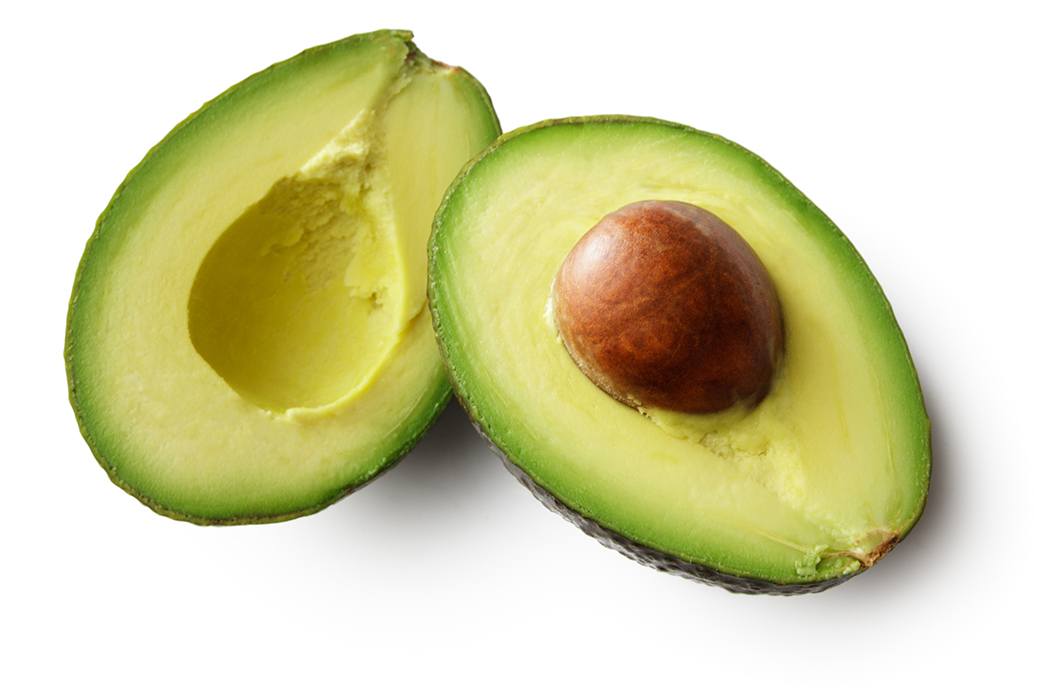
Where the skin is visibly much thinner and smoother and there's no brown layer, and I can only imagine that's the type of avocado where people can judge its ripeness. But those don't seem to be available in NYC at my local store or Whole Foods or anywhere...
I don't know who these people are, but they exist!
Except sometimes it's a little thinner/softer that you can actually press the outside, but you still have to use so much pressure it bruises the avocado. There's zero way of "gently" checking.
I've opened avocados that are still rock-hard on the outside, after waiting a full week, only to discover they're overripe and brown/gray on the inside.
And I have no problem with any other fruit or vegetable. Just avocados because of their crazy thick/hard rind where I live.
I just don't see how it can be "user error". My only suspicion is it's a different subvariety or grown for extra-thick skin for longer-distance transport or something.
A durometer is the cheapest at about $40. If you're right that it's impossible to tell by hardness then it wouldn't work. But you might find that it's more sensitive than your fingers and so it can work?
I would be interested to know the result of a durometer test on your fruits because about 85% of consumers report firmness as a useful measure - a lot but certainly not everyone. So yes maybe there is some granularity to discover there: specific situations where firmness just doesn't work well?
I can say with absolute conviction that it isn't the rind giving you trouble. I can pick every ripe Hass avocado out of a bin of 50, and never once be wrong. That said, there are a couple of stores in my current area that have garbage Hass avocados. The ones I buy from this store are consistently gross and fibrous, even when ripe, and have a very short window. I boycott these stores. They either have a second rate supplier, or else somehow ruin the product in transport.
By the way, you need a gentle touch and the ability very slowly, smoothly increase pressure. You pick up the avocados that are not yet ripe, the moment one is on the threshold, such that there is a nearly imperceptible give which does not bounce back, you buy the avocado. It should not bruise the fruit, and you won't be able to detect it when peeled. After this check, you can visually tell when it has fully ripened, ~1-2 days later. For what it's worth, I've never successfully ripened one AFTER cutting into it, and I've never kept an uncut avocado for more than 4 days.
I think this is the most helpful comment -- first of all, I'm now just convinced that the stores I usually go to must be getting garbage avocados for whatever reason, I genuinely never guessed that would be a per-store thing. I'll try some different places, there must be different suppliers.
And I think:
> nearly imperceptible give which does not bounce back
Could be the key. I've always been looking for some pretty obvious give -- saying it's borderline impercetible seems like it might be the key. Other commenters here seem to be saying something similar.
Also good to hear the majority of people advising to feel the side or bottom (not the stem end as the article suggests).
I think there's hope for me yet! So thanks to you and everyone else who's been helping.
I get both of those here in SoCal, or at least a varieties that look similar to those photos - the bumpier variety is noticeable when I come across it (it's definitely tougher). I never paid attention to the thickness of the skin or kept track of how quality correlates to the bumpiness, though. I'll keep an eye out from now on.
I wonder if there's a single vendor/broker supplying the stores in your area. Have you tried buying them from outside the boroughs?
More usefully, you can buy pre-mashed avocado in the same style as pre-made guacamole. If the use case involves (or could be made to involve) mashed avocado this option has a serious shelf life (presumably it's irradiated or similar) and lives in the fridge until use time.
It looks though that Consumer Physics stopped selling their SCiO device that was ~$250 to consumers, and I don't know if there is any equivalent current alternative.
I already can't imagine going back to life before my infrared thermometer -- for food, for liquid temp, for pan temperature, for pan hotspots...
And similarly you can pry my sous vide circulator away from my cold dead hands.
If there was seriously something guaranteed to tell you ripeness, that would be golden. (Pineapples, mangoes, and melons like canteloupes, are sometimes tricky too -- I'm usually pretty good at figuring them out, but sometimes they surprise you.)
Could the photography technique work to determine ripeness? Assuming the fruit is fairly motionless of course.
He showed me the SCiO in person a few times, and IIRC always had to make direct contact with the solid probe, so I'd be surprised if a NIR photograph would be a suitable substitute. I think it also mainly measures the area of the fruit where you make contact, so to get an optimal picture about the ripeness of a single fruit it's good to take multiple measurements. That also usually makes fruits with tick skins/shells (e.g. melons) hard to measure.
There seems to be a startup[0] aiming to bring suitable sensors to smartphones so that anyone has access to it - something that the food checker research literature has been hinting at for some time.
One of the reasons photographers enjoy infrared photography¹ is because foliage shows up brilliant white against pitch black² skies³. Photosynthesis is inhibited by both green and IR light so plants are bright in IR for the same reason our eyes see it as green.
I absolutely think that you could get the same result with a flash photograph from a good modern camera and probably just using the green channel. One of the many things these cameras are designed to be good at is detecting minute subtleties in shades of green⁴.
I’m looking forward to trying it on the weekend.
―
1. Traditionally done with a monochromatic black and white film where only deep, bright reds gave the negative any density, rendering as brightness in a positive print. This is in contrast to “panchro” black and white where a bright object of any color would print as white.
2. Unlike blue light, the atmosphere disperses almost no infrared.
3. A good example of all of the above is here: https://fineartamerica.com/featured/infrared-willow-tree-stu...
4. Our eye’s sensitive to green is partly why digital cameras have twice as many green sensors as they do red and blue. It’s also why high fidelity inkjet printers use more shades of ink for printing photographs. (Epson printers use one yellow, two different cyans, and three different magentas.)
Test a variety of ideas (perhaps start with what is given here) until you find something that works for you.
Challenge yourself: either practice someone else's technique, or invent your own.
Outcome: satisfaction for the rest of your life every time you use your technique and get a perfect avo!
https://www.rickbayless.com/ingredient/avocado-1/
I've mostly had good luck, but sometimes they're just bad to start with, bad because they're bruised from mishandling, or have been exposed to too much heat.
I don't see a lot of the tough leathery ones, but I have seen a few. (Seattle, so I'm not in the southwest.) I wonder if they are a different varietal or just dried out.
Source: I’m from Mexico.
Then I press the avocado around the centre and compare. If it is around the same I open and eat. Seems to work most of the time — with the super thick skinned ones I generally press higher up on the avocado (closer to the stem)
Also, the longer and thinner the point at the tip of the avocado, the less random the brown spots are. I rely HEAVILY on this to avoid loss, since I buy them 24 at a time when I go to Costco.
> "The window of time in which they are absolutely perfect—soft and tender with no brown spots or streaks—is notoriously short."
But then it claims:
> "...gauge ripeness by touch: Using your fingers, very gently press on the avocado near the stem end (that's where the avocado was once attached to the tree). You want to feel a slight tenderness and give. If the avocado is very firm, it's not ready; if it feels soft and mushy, it's gone too far."
I have gotten this wrong so many times that it seems like useless advice. The skin of the avocado is so stiff and wrinkly by the stem end, you simply cannot tell. By the time you apply enough force to feel through the skin, you're going to explode the avocado.
But if you try pressing against the side, where you can sometimes feel the level of hardness/softness more accurately (if it is a particularly thin-skinned one), you bruise it.
I'm an expert in the kitchen at basically everything else, but trying to figure out if an avocado is ripe or not just absolutely defeats me. I've routinely cut into an avocado I thought was underripe, only to discover it's so over-ripe it's inedible, because the skin all over is so darn tough that the whole thing simply felt rock-hard all over. It's like fossilized reptile skin.
How does anyone do it? I'm talking about regular Hass avocados bought in the northeast US shipped from Mexico.
At the end of the day, I just buy a few, wait 3 days, cut into one, and if it's ripe I try to eat the rest quickly. If not, I throw it out, wait another couple days, and repeat. Ugh.