Of course the ocean itself is warming up, so I guess we're screwed either way. ¯\_(ツ)_/¯
It's yet another safety that is going to disappear.
Lighter surfaces (snow, ice, clouds) typically reflect more light and heat. Darker surfaces (water, ground, asphalt) absorb light and emit thermal radiation, which is then trapped within the atmosphere by greenhouse gasses.
The atmosphere is differentially transparent to visible-light frequencies (high transparency) and infra-red radiation (low-transparency). That's the essence of what causes greenhouse warming, and we're adding more of the gasses (CO2, methane, and others) which are more effective at trapping heat.
Changes to surface characteristics (such as glacial melting) and atmospheric conditions (cloud formation, with dependencies on whether these are high-altitude or low), as a result of greenhouse-gas induced warming, provide feedback cycles which amplify or dampen effects. Many of the known feedbacks accelerate warming.
That's in addition to other feedbacks such as warming arctic-region permafrost, releasing both trapped CO2 and methane and triggering decomposition which generates more of these, or the "clathrate gun hypothesis", in which frozen and dissolved methane hydrates, themselves exceedingly powerful greenhouse gasses, are released at a rapid and accelerating rate. Among potential scenarios is a runaway greenhouse gas effect where global climates warm far beyond human or biological tolerance, either regionally or globally.
> 1.74% of total water on earth
Glacier melting is just another milestone in a road that will be pretty hard to stop walking till the end.
https://en.wikipedia.org/wiki/Tipping_points_in_the_climate_...
As glaciers (69% of fresh water) melt, oceans absorb more heat. This leads to rising sea levels and altered currents (e.g. AMOC). The warming air influences weather patterns and increases atmospheric moisture. As the permafrost thaws, it releases additional greenhouse gases. Elevated water vapor amplifies the greenhouse effect, and changing cloud formations further influence global temperatures. These shifts in ecosystems affect both Earth's reflectivity (albedo) and global biodiversity.
Some of these impacts can serve as feedback mechanisms, potentially further accelerating the rate of change.
Wikipedia: https://en.wikipedia.org/wiki/Albedo
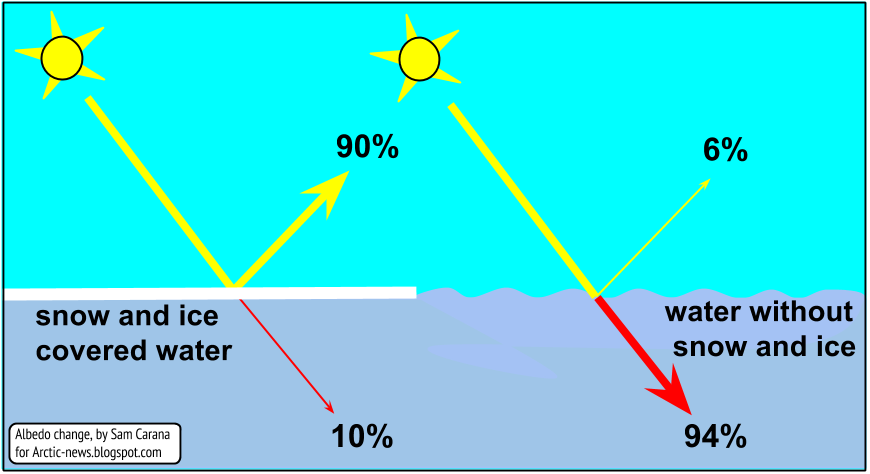
So, fresh snow might have an albedo of up to at around 0.8 or more, where as darker surfaces like asphalt are at around 0.04 to 0.12, so, the less albedo, the more it'll absorb instead of reflect (esp. back out into space).
The thing is that darker type rock materials also work as sort of heat capacitors in the sunlight, so basically, instead of reflecting that heat energy back into space, it'll stay around and warm up things.
Not sure if this constitutes as an example of a climate feedback loop (or an accelerant to one), but at least the albedo loss is one of the main concerns among climate scientist when they talk about i.e. (northern) polar ice cap melt -- instead of reflecting the heat back into space via snow and ice sheets, the heat energy gets absorbed by the sea, and that causes all sort of additional wacky stuff.
Arctic News often talks about it and even have this illustration on what happens if i.e. ocean ice is gone: https://3.bp.blogspot.com/-AHyeWIcSSVw/U70d6UBytbI/AAAAAAAAN... (although 0.9 albedo in that one is like at the higher end of expectancy for a fresh snow pack/ice sheet covered with white snow, the albedo drops rapidly with subsequent surface melt etc.)
it's amazing how many runaway feedback loops can take us to extreme heat or cold near the extinction line either way. I think we could weather an ice age, but I think billions wouldn't make it. We'd create underground homes with lights to grow food or something in a space station or on the moon.
We're pretty resourceful, I think it'd take more than that to take us out. An asteroid is much more certain extinction, unless we do have an actual colony in space or on the moon.
> We're pretty resourceful, I think it'd take more than that to take us out.
I'm a bit frighted by what I think the answer is.