I'm all for bringing the bison back; but we certainly do not need cattle.
True
> Cows have a place in the natural grasslands cycle
Not really true.
Cows graze on different plants than bison and have different grazing habits. It's not the same, and we can't really replace bizon with cattle, no matter how much would cattle farmers want us to believe that.
https://grist.org/climate-energy/cattle-grazing-is-a-climate...
https://www.oxfordmartin.ox.ac.uk/publications/grazed-and-co...
> if climate change makes those grasslands uninhabitable to them then that is bad
We can safeguard these grasslands by reforesting vast areas of livable land. If you truly support preserving these native grasslands, you'd likely advocate halting crop production, reintroducing bison, and protecting them through pasture reforestation for climate change mitigation. Agreed?
https://en.wikipedia.org/wiki/Biotic_pump
https://iopscience.iop.org/article/10.1088/1748-9326/10/8/08...
Climate impact of beef: an analysis considering multiple time scales and production methods without use of global warming potentials
https://journals.plos.org/climate/article?id=10.1371/journal...
Rapid global phaseout of animal agriculture has the potential to stabilize greenhouse gas levels for 30 years and offset 68 percent of CO2 emissions this century
You seem to be under the impression that every grassland is just a forest that humans have stripped bare but grasslands are naturally occurring in every continent except Antartica and cover a massive area of the Earth, much of which is land completely unsuitable to agriculture.
Even for the portions that are suitable, I don't subscribe to the notion that we are going to solve the climate crisis by paving over every square inch of natural habitat with soy fields; in part because I think that would be an ecological catastrophe but mostly because absolutely nobody is going to go along with that plan.
It's not a solution if you can't convince anyone of it. Similarly, based on your comments in this thread I don't think you're going to be convinced of any moderation on your position so I'm not sure there's much more benefit to discussing.
If cows are required for a conservation of some ecosystems (and I doubt it, sources?), let's have those cows. But those are not the reasons for keeping the remaining 99.99%.
> You seem to be under the impression that every grassland is just a forest that humans have stripped bare
No, I'm not.
> I don't subscribe to the notion that we are going to solve the climate crisis by paving over every square inch of natural habitat with soy fields
I don't either, but we're doing exactly that right now ... for the cattle. 76% of soy is grown for animal feed.
https://ourworldindata.org/soy
We would need just 25% of land to feed everyone on plant based diets.
https://ourworldindata.org/land-use-diets
If the world adopted a plant-based diet we would reduce global agricultural land use from 4 to 1 billion hectares
And we have to switch to those diets ... because when those developing countries develop, they'll want to eat what we do. If everyone were to adopt the western diet, we would need 5+ earths, and we don't have those. We currently import a lot of that meat / feed from other countries, but that's unsustainable.
https://www.eurekalert.org/news-releases/917471
Feeding 10 billion people by 2050 within planetary limits may be achievable
A global shift towards healthy and more plant-based diets, halving food loss and waste, and improving farming practices and technologies are required to feed 10 billion people sustainably by 2050, a new study finds
> It's not a solution if you can't convince anyone of it
It'd be enough to remove subsidies for polluting sectors. Animal ag would be deeply unprofitable without those, and higher prices would make those products unattainable to most.
> I don't think you're going to be convinced of any moderation on your position
No, I'm not. Animal agriculture is not necessary in this day and age. It's extremely destructive and is an obstacle to the mitigation of climate change and other aspects of overshoot, such as reforestation and dwindling biodiversity.
> so I'm not sure there's much more benefit to discussing
As you wish.
> grasslands are naturally occurring in every continent
Not all cattle are equal and not all grasslands evolved with cattle.
In the US bison and cattle aren't quite the same, and in Australia there were no cattle until introduced by Europeans .. now Australia has feral cattle damaging the natural grasslands:
https://news.csu.edu.au/feature/are-feral-cattle-the-brumbie...
it's one thing to fart and fart and fart in the grasslands—killing the climate in the process—but Amazon deforestation? someone should lay down the law on these cows.
https://ourworldindata.org/drivers-of-deforestation
https://www.discovermagazine.com/environment/weve-lost-35-pe...
https://www.globalwitness.org/en/blog/terrible-trade-burger-...
https://www.science.org/doi/10.1126/science.abp8622
The drivers and impacts of Amazon forest degradation
https://arstechnica.com/science/2023/02/argentina-lost-one-f...
Argentina lost one-fifth of its Atlantic Forest in the last four decades
https://www.theguardian.com/environment/2023/feb/19/colombia...
Cattle, not coca, drive deforestation of the Amazon in Colombia – report
https://earth.org/major-companies-responsible-for-deforestat...
13 Major Companies Responsible for Deforestation
https://news.mongabay.com/2023/05/3-million-hectares-of-colo...
3 million hectares of Colombian Amazon deforested for illegal pasture: Study
https://www.ucsusa.org/resources/whats-driving-deforestation
What's Driving Deforestation?
https://www.theguardian.com/environment/2023/jun/02/more-tha...
More than 800m Amazon trees felled in six years to meet beef demand
https://www.theguardian.com/environment/2023/jun/27/destruct...
Destruction of world’s pristine rainforests soared in 2022 despite Cop26 pledge
https://www.nature.com/immersive/d41586-023-02599-1/index.ht...
Trouble in the Amazon - "we are killing this ecosystem"
https://www.nature.com/articles/s41586-023-06391-z
Tropical forests are approaching critical temperature thresholds
Some effects of animal / cattle farming:
Greenhouse Gas Emissions - Cattle farming is a significant contributor to methane emissions, a potent greenhouse gas that contributes to global warming. Burps and manure decomposition.
Deforestation: land is cleared for cattle grazing and to grow feed crops, leading to deforestation and habitat loss. 50+% of pastures were originally forests.
Loss of Biodiversity: the expansion of cattle farming leads to loss of biodiversity as natural habitats are converted into grazing lands, animal ag. is the biggest driver of biodiversity loss.
Water Usage: cattle farming requires substantial water resources for drinking, irrigation, and feed crops, contributing to water scarcity in some regions.
Land Degradation: overgrazing by cattle can lead to soil erosion and degradation, reducing land's fertility and ability to support vegetation.
Antibiotic Use: cattle are often raised with the use of antibiotics, contributing to the development of antibiotic-resistant bacteria.
Waste Management: handling and managing the large quantities of manure produced by cattle is a challenge, leading to potential pollution and odor issues.
Oceanic Dead Zones: runoff from cattle farms containing excess nutrients contributes to the creation of oceanic dead zones—areas of water with low oxygen levels that can't support marine life.
Eutrophication: nutrient-rich runoff from cattle operations causes eutrophication in water bodies, leading to excessive plant growth, oxygen depletion, and harm to aquatic ecosystems.
Energy Intensity: raising cattle requires significant energy inputs for feed production, transportation, and processing.
Land Use Competition: competition for land between cattle farming and crop production can exacerbate food security challenges.
Indirect Environmental Impact: cattle farming's environmental impact extends to the entire supply chain, including transportation, processing, and distribution of beef products.
In essence, I'm not saying that our current meat practices are ideal. I'm saying is that it's just not a simply self-correcting problem.
Cattle contribute about 14% of emissions which means that it won't reduce enough to solve climate change by itself, it'll just mean no cows, then no grasslands, and then no species that depend on grasslands. It'll just be another gradually worsening affect of climate change, not a self-invoked solution. The solution to anything with the ecosystem is a sustainable balance.
https://www.pnas.org/doi/10.1073/pnas.2204892120
The total mammal biomass:
- livestock (≈630 Mt)
- humans (≈390 Mt)
- wild marine mammals (≈40 Mt)
- terrestrial wild mammals (≈20 Mt)
Do you know how much land animal agriculture occupies (cattle being the most land-demanding)?
https://ourworldindata.org/uploads/2013/10/World-Map-by-Land...
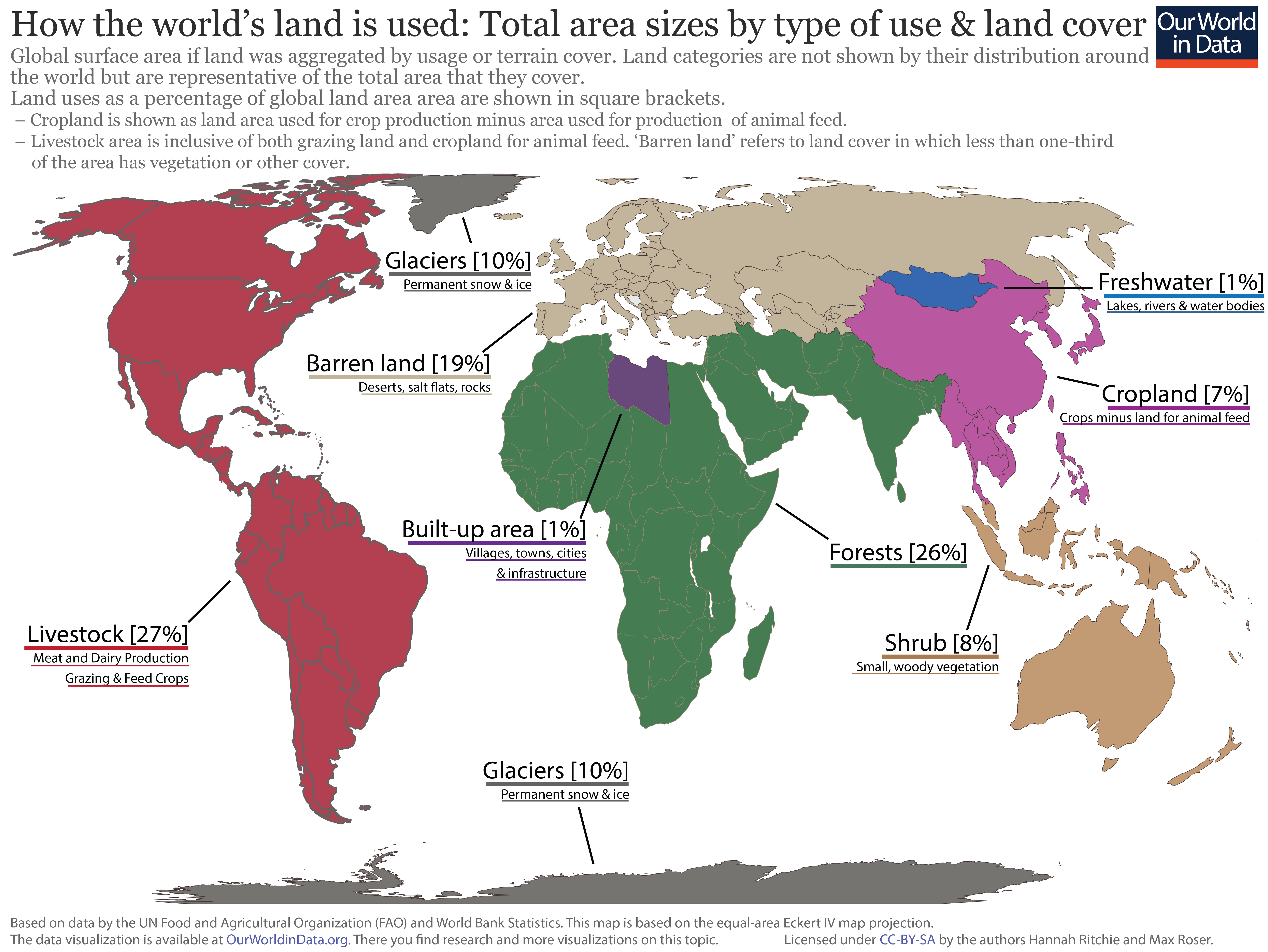
https://ourworldindata.org/land-use
https://ourworldindata.org/land-use-diets
Do you know that animal species have experienced a 70% decline in just last 50 years, that we're driving nearly one million species to extinction, that we're in the sixth mass extinction which we'll manage in just 100 years probably, and that cattle is the main driver?
https://www.nature.com/articles/d41586-019-01448-4
Humans are driving one million species to extinction - landmark United Nations-backed report finds that agriculture is one of the biggest threats to Earth’s ecosystems.
https://onlinelibrary.wiley.com/doi/epdf/10.1111/brv.12974
More losers than winners: investigating Anthropocene defaunation through the diversity of population trends
https://www.theguardian.com/environment/2022/oct/13/almost-7...
Animal populations experience average decline of almost 70% since 1970, report reveals
https://pubmed.ncbi.nlm.nih.gov/26231772/
Biodiversity conservation: The key is reducing meat consumption
https://www.unep.org/news-and-stories/press-release/our-glob...
Our global food system is the primary driver of biodiversity loss
https://en.wikipedia.org/wiki/Holocene_extinction
https://en.wikipedia.org/wiki/Planetary_boundaries#Nine_boun...
> we need to get together as an entire global species and determine and maintain some Optimal Bovine Population Threshold
Yes, it's zero.
I've never argued for a forced extinction; that's just silly. We're driving numerous species to extinction by favoring only a few animal species and devastating ecosystems to support their breeding and proliferation.
Let's argue that we should maintain an equivalent population of cows and water buffalos. Would that be enough? We could allow these cows to freely roam on grasslands, reserving the remaining grazing lands for other animals whose habitats we have taken from them. Seems fair?
> you're not exactly living in the same shared reality that the rest of us live in
Thank you ... I don't want to. I couldn't look my children in the eyes when they'll learn what we've done with the world.
https://www.hsph.harvard.edu/news/hsph-in-the-news/milk-heal...
according to science, cow farts cause climate change, climate change causes temperatures to rise, high temperatures kill cows, dead cows can't fart (well, after their last big one, anyway).