> If you look at a pulsar, that is 12B light years away from us, it will pulsate significantly slower than expected.
In this case, I think, it is that the pulsar blinks slower by a factor of 5. I presume they already have corrected out the redshift related time dilation and 5 is what was left.
With one exception all known pulsars are in the Milky Way; they are too intrinsically dim (and obscured by dust, much of which is local to them, produced in their progenitor star's explosive demise) to see them at extragalactic distances. The exception is PSR J0540-6919 in the Large Magellanic Cloud (the LMC, a satellite galaxy to the Milky Way), which is atypically bright in gamma rays and so is visible to the Fermi-GLAST telescope in low Earth orbit.
Pulsars have unique periods, ranging from about a millisecond to about ten seconds. The period is determined by a number of factors including the rotation rate (spin), the offset of the beam from the spin axis, precession of the beam axis and the spin axis, differential rotation within the pulsar, time-dependent collimation of the beam, and so on. Here's a quickie image: <https://www.astronomy.ohio-state.edu/ryden.1/ast162_5/pulsar...>. When we see a pulsar we are catching some of the cyan-shaded region as it's dragged around the spin axis. In the case of linked diagram above, if we are way to the below-left, we would see the strongest part of the pulse about once per full rotation.
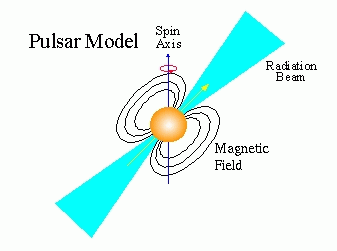
Some pulsars have highly predictable periods of a few milliseconds; this pulse rate can be stable for decades. Other pulsars are subject to occasional and unpredictable speed-ups and speed-downs. These are probably driven by the movements of relatively large internal structures and/or the infall of material onto the crust of the neutron star (its own supernova debris, or gas from a binary-or-multi-star partner).
Since all but one discovered pulsar is in the Milky Way and the LMC is close enough, there is no cosmological redshift involved in pulsars. We may eventually have telescopes powerful enough to spot bright pulsars at the margins of other galaxies, but not soon. When we can, it will be interesting to see what spectral features have a redshift dependence.
Now, on to quasars and the study press-released at the link at the top of the page.
Variable quasars only work vague like pulsars where we substitute a few solar mass neutron star a few thousand light years away for a billions of solar mass black hole near the centre of a distant galaxy billions of light years away. Dust and gas around the distant supermassive black hole generates a magnetic field which causes a relativistic jet to form, in which charged particles from near the black hole are swept into a long tube and thrown far away from the black hole; in the process these charged particles (especially electrons) emit synchrotron radiation, which we detect. All quasars are extragalactic -- there are none very close to us -- so all quasars have some nonzero redshift distance.
The periodicity of variable quasars probably has little to do with the spin of the central black hole, which can be one rotation every few hours up to practically not rotating at all. Quasar variability is best measured in months. We tend to conclude that we only see bright quasars when the beams are always pointed in roughly our direction (and that quasar beams are very wide because they spread out with distance). This should hold true no matter how quickly or slowly the black hole is spinning. The study summarized in the link at the top is in part a check on that.
As to the light (and radio and gammas and so on) from bright quasars, astronomers mostly pay attention to are broad emission lines (BELs) that appear and disappear; these are the "changing-look quasars" (CLQ) and the optical luminosity varies enormously (> order of magnitude detected here). The CLQ BELs are predictable enough that they can reveal the redshift on the emission lines particularly the ones in the mid-infrared, giving a distance to the CLQ.
There are also quasars that brighten and dim without a change in spectral lines, the so-called changing-state quasars (CSQ); the most highly-variable quasars (HVQ) are CSQs. The mechanisms for variability for CLQs and CSQs differ, but both have to do with dynamics in the accretion disc rather than being directly driven by the black hole spin.
Unlike pulsars which have bright/dim periods of milliseconds to seconds, highly variable quasars have bright/dim periods best measured in months. Pulsars also generally run on a bright/dim/bright/dim/... cycle or (for a favourable orientation) bright/dim/VERYbright/dim/bright/dim/VERYbright/... but variable quasars can get brighter And brighter AND brighter and then suddenly quite dim and then brighter and dimmer and so forth, with practically no predictability. The brightening and dimming can be at different wavelengths, presumably because the accretion disc (bright in most wavelengths) is hidden behind host-galaxy dust and gas (which appears as thin spectral lines, redshifted according to distance).
For near-experts wanting to know more about CLQ vs CSQ, the CRTS transient survey has a nice overview <https://arxiv.org/abs/1905.02262> (see fig 1.).
The study summarized at the top and in preprint found at <https://arxiv.org/abs/2306.04053> focuses on the differences in luminosity variability in different wavelengths in CSQs. Roughly, the absorption lines near the quasar and in gas and dust and so forth between the quasar and us imprints the spectrum in a way that allowed the authors to sort many quasars into initial groups ("buckets") with common spectral features. In this study the preserved freatures are the relative brightness at a number of wavelengths seen by different telescopes. As long as the varying brightness doesn't cause quasars to be ejected from their initial buckets, the cause of the variability is not related to a redshift (neither because of local motions in the host galaxy, or local motions of Earth, nor because of cosmological redshift). Consequently cause of the variability must be either very local to the quasar or very local to us. Since quasars in a bucket are scattered across the sky, the reason for the variability is most likely not something local to us. Also we would struggle to explain why quasars might look variable due to some near-Earth influence, but why type Ia supernovae (and your friends the galactic pulsars) do not.
If one decides the variability is caused by something local to each quasar, but not having to do with the quasar's meanderings through its host galaxy, then one compares the variability period of quasars in a bucket. It turns out that, for each bucket (with ~identical strengths in each of a set of wavelengths), the varability period (each dimming or brightening event) is longer at higher redshift. This is consistent with an expanding universe identical to the one in the standard model of cosmology.
See also https://www.astro.ucla.edu/~wright/Lyman-alpha-forest.html or https://w.astro.berkeley.edu/~jcohn/lya.html for one specific absorption line of great interest, driven by bright quasars, and affected by the redshifts both of matter very near the quasar and matter along the way from quasar to us.
Edit: Thank you for the detailed post. Learned a few things from it.
Sorry that there's two "standard model"s. One often hears "concordance model" or "standard cosmology" or \Lambda-CDM instead, as a result.
This study's novelty is in showing that [a] the changing luminosities of both families of variable quasar can be usefully compared and [b] similar variable quasars have similar luminosity-changing rates at similar redshift; if the redshifts differ, the less-redshifted one's brightness changes more frequently and more quickly.
> Lewis explained that the brightening and fading of quasar light, known as their variability is like the stock mark, unpredictable on the surface but with statistical properties that allow it to be modelled over time. This variability can be used like the ticking of a cosmic clock. It was this understanding and the complex quasar firework display from 190 of these feeding supermassive black holes that allowed the team to spot time dilation when the universe was just 1.5 billion years old, less than 10% of its current age.
The research was on the variations of "quasar radio intensity", not pulsar frequency. The scientists formulated a model to statistically predict intensity variation and used those projections as their "clock".
c = X m/s
m = c * 1s / X = X/X m
s = X * 1m / c = X/X s
c = X*(X/X m)/(X/X s)
X is const, so c is const too.
We observed pulsars 12B light years away. They pulsed at a frequency significantly less than what we see from equivalent pulsars today. Implication is that time passed more slowly at that time in the universe.
Instead of assuming that "everything must always be the same", would it not be easier to assume that sometimes things are just wildly different, even when they are of the same type?
If you think that the Ph.D astrophysicists who concluded this totally overlooked this obvious flaw, take it up with them?
Or that light travelled more slowly at that time in the universe. I don't think we have conclusively proven c to be a constant, right? Or is this a case of "c and t are so inextricably linked, it doesn't matter in practice which one changes, the result is effectively the same"?
Well, except then I guess it's not technically FTL. Damn you, universe!
We obviously can't directly test what the speed of light was 1.5 billion years after the Big Bang. But we can test for changes in the fine structure constant back then, which would have to have been different back then if the speed of light were different. No such changes have been found.
Anyway, meter and second are defined as fraction of c, which ruins any discussion about variability of time or distance, because we are talking about c instead.
However, when we are talking about variable time, we need to talk about variable size too. If distant quasar was 5x slower, then it must be 5x larger.
But imagine the following: That 12 billion years ago some scientist built a briefcase-sized machine with a laser array with trillions of mirrors in a complex pattern. The laser is inside the machine and fires a regular one-second pattern into the bank of mirrors. From there the light just bounces around and around in the machine until it emerges out of an aperture. Because there are so many mirrors constructed in a complex pathway, it ends up taking 12 billion years for the light to emerge from the device. We come across the briefcase sitting in one of the craters on the Moon's south pole just as the pattern of light is emerging for the first time. (Let's pretend that whoever built the device included tech that would prevent the signal from attenuating.) The question is, would the pattern still be at a one-second interval, or will it be slowed down? If I'm understanding this news item correctly, the pattern would be still at the original speed because it will not have experienced time-dilation effects relative to us on Earth like we see in distant quasars.
No time dilation, not even from black holes, can slow down (or speed up) light.
Instead, the light's frequency from your perspective is what changes. This is where redshift/blueshift comes from. (Imagine the waveform being compressed/stretched out.)
This is one of the crucial insights of special relativity.
No, it doesn't. The laws of physics, including the speed of light, were the same then as now. The article's description is seriously misleading. The effect it is talking about is only an appearance due to the redshift of light from back then. It does not mean that anything was "really" happening slower.
I was about to write that myself. It's our frame of reference vs distant massive frame of reference. It is a quite natural explanation.
In the special relativistic setup in your final sentence, the spaceship occupants could in principle watch our clocks and observe that ours are ticking slowly, with the same redshift.
Observers at a high cosmological redshift cannot watch our clocks at all. They can only look at the even more distant past of what will become our clocks in billions of years, and there's no reason to think that the redshift we ascribe to them is the redshift they ascribe to our precursors.
(Indeed the gravitational redshift from the metric sourced by Earth (assuming "us" are Earthbound) breaks the reciprocity -- if only slightly -- that would be observed in Minkowski space.)
This is true, but it doesn't change the fact that the "time dilation" described in the article is like the time dilation in special relativity, and is not like gravitational time dilation, with respect to what the article is talking about.
> there's no reason to think that the redshift we ascribe to them is the redshift they ascribe to our precursors.
Indeed, there is every reason not to think this. But that still doesn't change the fact that the "time dilation" due to cosmological redshift is like the time dilation in SR, not gravitational time dilation, with respect to what the article is talking about.
Even that comparison doesn't make much sense because, as raattgift already pointed out in the comments[0],
> Reciprocity in Minkowski space is relevant.
So from observer A's point of view the clock in observer B's frame of reference will tick more slowly, but from observer B it will appear the other way around.
This is sounds contradictory but the reason for this is that observers in different frames won't even agree on what a valid time measurement is. This is called relativity of simultaneity[1].
[0]: https://news.ycombinator.com/item?id=37250897
[1]: https://en.wikipedia.org/wiki/Relativity_of_simultaneity
That's a good question and the Wikipedia has an oversimplified answer here: https://en.wikipedia.org/wiki/Cosmic_time
Basically, what it boils down to is imagine a clock traveling at the same rate of expansion as the universe (the Hubble flow). Now further imagine that clock ticks once per year. The phrase "1.5 billions years after the Big Bang" means such a clock will have ticked 1.5 billion times. It's the only way you can do time that makes any kind of sense, when you think about it, since time is literally relative.
Relativity is what makes things weird, because what you're really wondering is if we somehow had a clock on earth that also ticked once per year (standard years like we measure today), how many ticks would it have ticked after the aforementioned clock ticked 1.5 billion times? Such an "earth clock" will have ticked more times, due to the difference in time dilation. If you're still following along, then that means when we say such a clock I first described, the cosmic clock, has ticked 13.8 billion times, this supposed earth-bound clock will have ticked a near infinite amount of time - meaning, from our perspective, the Big Bang singularity is an infinite amount of our time in the past, even though our cosmic clock will have only ticked 13.8 billion times since the event!
Welcome to relativity!
Note this is the same issue with approaching the singularity of a black hole. The clock approaching the singularity will reach the singularity in the time its gravitational acceleration indicates and will proceed normally to the singularity. From outside of the black hole (you have to imagine being able to make this observation) you will never see the object reach the singularity. Such an event is always in that observer's future.
If you think this is bollocks - it's GR's time paradox and is the result of a singularity, which is a strong sign that things have gone awry. BUT - we do know time dilation exists and we know GR works well right up to the point of the actual singularity so while from our perspective the object reaching the singularity probably isn't infinitely in our future, it's very, very far in our future. Likewise, for the Big Bang singularity even though the cosmic clock ticked off 13.8 billion years, from our perspective the event was much further back in time than that.
Weird stuff!
If you're comparing two physically separated frames of reference it makes sense to talk about "this many seconds here corresponds to that many seconds over there". But when you're talking about the speed of time for the entire universe, how do you form such a ratio?