That analogy also implies that space wraps around, which no experiment has ever shown to be true. This contradiction is why I have trouble.
It’s a good analogy otherwise, but the details are the interesting part.
Haven't read the paper but one likely could tell from the density.
> That analogy also implies that space wraps around, which no experiment has ever shown to be true.
It's an analogy meant to highlight one particular aspect, not be a perfect model of spacetime. In mathematics, there is no shortage of topological objects that are infinite but not closed otherwise.
I had actually always learned that it went from single point to infinite instantly but grows more dispersed. But recently have been seeing a lot things in a similar vein, Kurzgesagt put out a video and even a special pin about the size of the universe at different points of time. It would seem if we know that to be the case and we know the growth rate we could then estimate the size of the universe now, but nobody suggests a finite universe with a certain size as the present universe, just the past.
That would additionally suggest that there is a ‘center’ of the universe which I again have always learned as N/A since it is infinite. Really confuses me.
The observable universe has a definite size. Shortly after the Big Bang, what is now the observable universe was the size of an apple etc. Now it is many tens of billions of light years across.
The observable universe does have a center - you, the observer.
I don't know what that means. As a kid, my notion was that spacetime was "infinite", that galaxies floated in spacetime, and were moving apart. Gradually I became (a bit) more comfortable with the notion that spacetime is somehow created by "stuff", and that a location in spacetime that has never seen a photon isn't a location in spacetime at all.
A lot of commenters here seem to be saying that spacetime was always infinite; they claim that the universe that used to be the size of an apple is now the whole observable universe. The implication is that there was plenty of stuff beyond the "apple-peel", but that all that external stuff has never had a chance to interact in any way with the interior of the apple.
I don't know how to grok that. There's plenty of stuff that used to be part of the apple that isn't observable; presumably there was some location within the apple that later became the Milky Way, and any photon departing that location 13.8B years ago will never be observable. Arguably, more than half of what used to be the apple will never be observable.
The story I've been sold is that it's not that stuff is moving apart, but that spacetime is expanding. I can visualize 3D space expanding; one moment it's the size of an apple, a few moments later it's the size of a grapefruit. But what does it mean for time to expand? The very idea of expansion is of a thing that grows relative to time. Spacetime is the idea of everything, everywhere, all at once. It's not an anthropocentric notion; it doesn't depend on observers, and I fail to see how spacetime can be considered to be evolving in time.
Neither is especially accurate. Spacetime is not a substance, and it's not created or destroyed. It's the thing physics happens on, for lack of a better non-mathematical description.
> But what does it mean for time to expand? The very idea of expansion is of a thing that grows relative to time.
Same thing as for space: that component of the metric - the shape of spacetime - is an increasing function of coordinate time. But you can always pick a coordinate system where only the spatial components are expanding: it's not physically meaningful either way. The metric is the real object.
> She’s pointed towards a few different articles saying that the most accepted theory of physics is that the universe started from a single point, and that there is language such as “it grew to the size of an apple” within a small amount of time after the Big Bang.
These articles implicitly talk about the observable universe. Or they're just wrong. It definitely didn't start from a single point, but there was a time where the observable universe was the size of an apple (or anything else that is larger than a point).
In other words, the idea that the observable universe could be the size of an apple has its own contradictions. An apple is a definite size, and can fit only a certain number of atoms. However the expansion of the universe doesn’t seem to be creating more atoms; it’s only moving them around. Therefore all apples would’ve been the same size they were today, just packed more closely together. Hence “the size of an apple” seems to lose all meaning.
This contradiction seems to clear itself up if one allows for a “before the big bang”, since there’s no need to say that everything was compressed to a single small volume.
Well, sure, it's possible. I was assuming the current cosmological standard model is correct, which might in fact be wrong, or at least incomplete. Actually, I'm certain it's incomplete.
Today we can trace back the universe to when it was a tiny fraction of a second old using standard physics. Everything is well understood. Before that: who knows?
> An apple is a definite size, and can fit only a certain number of atoms.
There were no atoms when the current observable universe was the size of an apple. It was too hot for atoms. It was more like a quark-gluon plasma.
> Therefore all apples would’ve been the same size they were today, just packed more closely together. Hence “the size of an apple” seems to lose all meaning.
Obviously "the size of an apple" is a phrase for laymen. We could say "10cm in diameter" using the standard definitions of the meter and second.
>This contradiction seems to clear itself up if one allows for a “before the big bang”, since there’s no need to say that everything was compressed to a single small volume.
There is no contradiction.
Galaxies recede faster than light, so atoms are shedded by that process. If anything it seems like there must have been more matter in the early observable universe than today. But “10cm in diameter” seems to imply otherwise.
Pretty much, yes. (Let's ignore the possibility of proton decay for now.)
> Galaxies recede faster than light, so atoms are shedded by that process. If anything it seems like there must have been more matter in the early observable universe than today. But “10cm in diameter” seems to imply otherwise.
Not sure what you mean by "shedding atoms", but I'm pretty sure I can say that this is not the case.
So this has less to do with an infinitely sized universe and more with the question of “What exists beyond the edge of the universe if it would be finite in size?”
This would mean the universe has positive curvature. Experimental evidence points towards the universe being flat (zero curvature), though there is some margin for error that could go either way (positive or negative curvature).
There are several flat compact manifolds, they're just not simply connected.
Imagine getting in a spaceship and setting off in a direction, close to the speed of light- if you travelled for long enough you’d arrive back where you started. Like someone walking on the surface of the earth.
Any current cosmologists can correct me, but I believe the consensus is that the shape of the universe is a hyper-spheroid, I.e a 4D sphere.
All current evidence points to the shape of space and the universe being relatively "boring" in that it behaves roughly like people would expect unless in the presence of a strong gravitational field.
> Although it is usually assumed in the literature that a flat or negatively curved universe is infinite, this need not be the case if the topology is not the trivial one. For example, a multiply connected space may be flat and finite, as illustrated by the three-torus.
A picture like this is in every cosmology textbook: https://upload.wikimedia.org/wikipedia/commons/9/98/End_of_u...
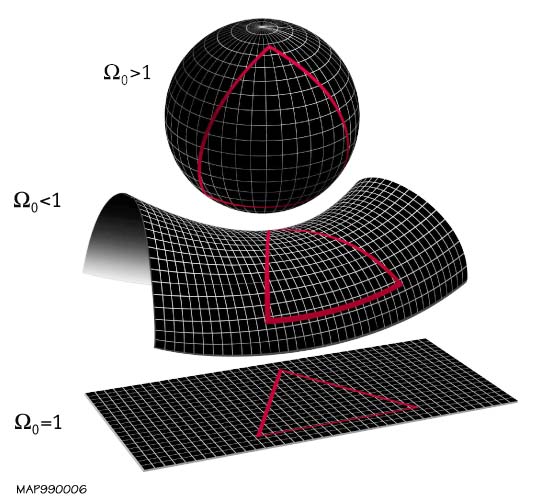
Which one it is depends on the density. There is a critical density at which the universe is flat, and our current best measurements basically allow for all three possibilities. It's just hard to say if something is flat or actually spherical but really, really huge.
- today’s observable universe is roughly 13.8B years. By the time you travel to the edge of that universe, others stuff has travel from that edge to even further position at various speed including faster than you do. Therefore you never get to that edge, making it infinite.
- before/at big bang universe is a single point. You are within this single point but can’t go outside because time does not exist and traveling need time.
- when the big band happened, it grew in size very, very fast, close to speed of light. During that enlargement phase it grew to the size of an Apple and if you were within it and try to look in any direction, the further think you can see is the Apple skin. That’s the observable universe. But to see the skin you need to go there or wait for particule to come to you (eg photon). By that time the universe has already dilated and grown a lot wider. Some particules from the skin are already far away. You’ll never be able to see them : by the time needed for information to come to you, other information goes in the opposite direction.
This is true but it's not what astronomers mean when they say the universe may be infinite. They're talking about the whole universe, not the just the observable part, and they really do mean actually infinite in extent.
> before/at big bang universe is a single point.
Unlikely. We know that what is now the observable universe was very very very very very dense. Predictions of a literal singular point are the result of extrapolating past the point where we know for a fact that our best physical theories break down.
Careful. That's the age of the observable universe, not the size. The radius of the observable universe is 47B light years, which is larger because of inflation.
> Therefore you never get to that edge, making it infinite.
FWIW, I disagree with the conclusion. Finite but expanding fast is not infinite (disclaimer: mathematician not a physicist).
The properties of the observable universe are consistent with an initial state where the temperature was so high that the protons and neutrons were free, not bound in atomic nuclei, like today.
This means that the temperature corresponded to a kinetic energy of several tens of MeV per particle. At such a temperature, the state of the matter is a plasma composed only of protons, neutrons, electrons, positrons, photons and neutrinos.
At this temperature, the matter has the simplest possible composition. At lower temperatures the particles become bound in nuclei, atoms and molecules, which become more and more complex with decreasing temperatures. At increasing temperatures, the higher the temperature is, more and more mesons, baryons and heavy leptons are generated and the plasma composition becomes more and more complex.
However, at that temperature where the matter has the simplest composition, any traces of its former evolution have been practically erased and we do not have any rational reason for making suppositions about it. Perhaps the matter was indeed even denser and even hotter, but there is no basis for this extrapolation except some philosophical belief that is not based on any scientific observation.
An extrapolation towards greater temperatures and densities could be justified only if we knew boundary conditions around the universe, which we do not know.
In conclusion, what can be known with reasonable certainty about the Big Bang starts from a moment in time when the temperature corresponded to a kinetic energy of several tens of MeV per particle, and all extrapolations to times before that moment are hypotheses that are not based on any experimental data, so they can be neither verified nor falsified.
The supposition that the Universe may have started from a single point is something that has nothing to do with science, but it may be a religious belief.
Inflation covers a much different era, 10^-32s after the big bang.
so we just don’t know. we have no evidence of that but all theories would simply change with the new information and that would become standard physics.
So a universe containing only photons has no definite scale - it can re-imagine itself as being the size of a grapefruit, or any size you like. Penrose uses this idea to wish away the awkward and evidence-free idea of cosmic inflation.
I guess we have the luxury of removing ourselves from the universe while thinking about it, if Platonism is a thing.
Reminds me of the halting problem.
If we multiply the Hubble time by c, we have the Hubble length, which is what is being talked about with expressions like "the size of an apple". That is, if the universe was "apple-sized" the Hubble length was on the order of an attoparsec rather than the ~4.4 gigaparsecs today. Extending the Hubble length in all directions gives us a spatial surface at the Hubble time, which means that on (or inside) that surface is everything that generates something which can in principle be detected here-and-now. That's the "size" which is being talked about. Because the Hubble time is shorter in the past, so too is the "size" of the Hubble volume in the past.
It is somewhat easier to think about your question in respect to the universe a bit later, like during Big Bang nucleosynthesis (BBNS) when the Hubble length was on the order of 100 parsecs and adiabatic expansion had cooled the contents of the Hubble volume (Hubble length in every direction) enough that hydrogen, helium, and lithium nuclei could form. Going back to the Hubble time we turn ~100 parsecs into ~300 light years, divde that by c and have a then-Hubble-time of 10 billionths of a second. So something ~speed-of-light (actual light, gravitational radiation, neutrinos, ultrarelativistic charged particles) emitted billionths of a second earlier and at maximum distance (~100 parsecs) would be reaching our galaxy now, billions of years later.
Anything emitted then towards us but from further than that ~100 parsec boundary would not reach us at all. Anything emitted from then but travelling on longer paths (gravitational lensing, interaction with gas or dust, or simply having intrinsic mass like a neutrino) will arrive later. And of course anything emitted then might not be aimed at us, so might never get here at all. So, and I'll touch on this again below, what happens to a BBNS proton that formed about 100 parsecs from protons that ended up in the Milky Way, if it happens to get a kick in a direction away from those Milky-Way-BBNS protons? It becomes unobservable, leaving the observable universe. But what do we call wherever it ends up? And in that region, whatever we all it (the unobservable universe?), are physics the same as in the parts of the observable universe we've studied?
Back to your apple-sized observable universe. We can continue a regression before BBNS, which takes us through epochs where electrons and photons and weak force counterparts are so hot and compressed they become something else (the fields of the electroweak unification), and so on. As we do so the Hubble time is shortened, and so too is the Hubble length. Eventually the Hubble time is so short that gravitational time dilation (from differing concentrations of energy and momentum) becomes a significant fraction. Thus it, and c*Hubble_time -> Hubble_length is subject to fluctuations of significant and growing fractions of the the average (mean or mode). [Ultimately this is where there is an early-universe conflict in the predictions of General Relativity (which is fine with this; we just stop splitting spacetime into spaces indexed by an averaged Hubble time {technically, the derivatives of the Robertson-Walker scale factor \a becomes un-useful}, and index on some other notion of time (or treat the whole region of spacetime as a block) and quantum field theory (which needs a clearer and quite linear notion of time to plug into its equations).]
Regressing further we will calculate a lower-bound Hubble volume which is for all practical purposes infinitesimal, and thus "a single point" is a reasonable description for the observable universe at about that early age. Anything outside the then-infinitesimal Hubble volume will never reach us. Anything inside could in principle, but again lots of that wasn't aimed in our direction and/or ended up becoming "frozen" into non-massless matter (some of which will eventually radiate, like galaxies full of stars, with some of that radiation aimed at us).
> didn't start from a single point; it has always been infinite
We don't know what if anything is outside the Hubble volume at any time, including in the most distant past. It's strange to think that there is nothing at all one parsec beyond the present Hubble length of ~ 4.4 billion parsecs. Where does the light and cosmic rays from distant galaxies radiated radially away from us go? Does each distant galaxy have its own Hubble volume[*], just like each of us locally have? We can only decide to adopt the Copernican principle and say that some distant barred-spiral galaxy has the same view as the Milky Way does -- galaxies scattered similarly in every direction. Adopting that view motivated Guth, one of the originators of studies of cosmic inflation, to calculate that there may be something like 10^23 Hubble volumes "outside" our own.
These would be 10^23 100-parsec volumes adjacent to each other all arranged around our 100-parsec BBNS volume. Each such volume may have the same early expansion history as ours, so (regressing) this would be a lot of apple-sized Hubble volumes, and ultimately a lot of effectively point-sized Hubble volumes. 10^23 is finite, of course, but I don't think we can preclude a much much larger finite number, and we can go so far as to ask questions about a literal infinite number. There will be some lower bound of Hubble volumes adjacent to, outside of, and causally disconnected from our own; that lowest number is much greater than one, however, or cosmic inflation fails to solve certain geometry problems. Additionally, zero ("our Hubble volume is it") raises the hard question of what happens even just a metre beyond the Hubble length. Is it new physics? Would there be some evidence close to but inside the Hubble length? Maybe even in galaxy clusters only tens of millions of parsecs away their radiation or morphology may show proof that they're close to an observer-independent sharp Hubble edge? JWST is already generating relevant data.
Finally, from a comment of yours downthread,
> An apple is only a certain number of atoms, far fewer than the 10^80 that we have today
When the Hubble length was about half the length of an apple, there weren't any atoms at all -- it was too hot and dense for any of the particles you'd recognize in the Standard Model. That's why I chose the BBNS epoch (~100 parsec) instead of the deep elecroweak or GUT epoch at "apple-size" (~ 1 attoparsec). (And additionally atoms can be wholly ionized at much lower temperatures, so I write here about nuclei instead).
At BBNS only hydrogen and some helium and trace lithium atomic nuclei were formed. All the carbon and so forth in an apple today was formed through stellar nucleosynthesis.
There are fewer atomic nuclei today than at the end of BBNS because stellar processes fuse multiple hydrogens into carbon, oxygen and other "non-metal" (in the astronomy sense) nuclei. Also, stellar black holes have taken lots of atomic nuclei out of the picture. And also some nuclei will have taken trajectories away from us and are now further than the present day Hubble length.
In cosmology we talk about the average density of baryons, compared to the averaged density of other things (among them radiation (mostly photons), relativistic and cold neutrinos, dark matter, dark energy). That is we are interested in the fraction of energy at a point that is baryonic (atomic nuclei, and more particularly protons, being the bulk of that). At earlier times, when the Hubble length is shorter, the (averaged, expected, typical) contribution of baryons at a (typical, average) point is higher. Baryonic matter has diluted with the expansion of the universe.
Your 10^80 figure will come from taking this pointwise baryon density and applying it to all the points in space at the present Hubble time, cross-checking it with estimates of the masses of typical galaxies and an estimate of the galaxy count. The baryon density today can also be arrived at by comparing the baryon density at the time the cosmic microwave background radiation formed (that density left imprints in it) and the expansion history since then (which we get by various means).
- --
[*] Unlike the Hubble time as the reciprocal of the Hubble constant, it is useful to think of the Hubble time at a point (in spacetime) as capturing the expansion history at that point. Since gravitation retards the expansion, every point (in spacetime) has its own Hubble time. Importantly, the Hubble time of a hydrogen nucleus peacefully floating in deep inter-galactic-cluster space will be longer than that of a hydrogen nucleus within our sun, even if they were both formed primordially. The gravitation of the sun and the Milky way and other nearby masses means the solar hydrogen has experienced less expansion. This takes us a tiny step closer to understanding the expanding universe in systems of coordinates other than the standard comoving coordinates, which is more relativistic in spirit. It reminds us that in comoving coordinates we are working with uniform densities of matter thanks to averaging, and are explicitly ignoring significant overdensities of matter (which slow down the ticking of clocks nearby).
Others have already clarified that the big bang tells us the observable universe used to be tiny. In other words, the universe was much denser. It does not tell us the absolute size of the entire universe.
Moving to higher dimensions it might be the case that there are many universes, i.e. perhaps from a 5D perspective the multiverse is an infinite series of nested 4D universe hyperspheres, and one could go on and on like this into a infinite series of dimensions, but it's all just mathamatical metaphysics at that point as there's no observational evidence for any of that.
a) Bing Bang model of evolution of Universe: single point, big bang, expansion of Universe, acceleration of expansion, time dilation, space-time warping. (6 extra elements)
b) Steady Universe model of evolution of Universe: tired light. (1 extra element)
They aren't. Your view is correct, at least according to our best current model of the universe.
I suspect that your wife is misinterpreting the articles she is reading; I suspect they are saying only that our current observable universe, which is finite in size, started out as a single point. Which is sort of correct, but is not the same as saying the entire spatially infinite universe started out as a single point.
Part of the problem here is that the "initial singularity" in the models being described (which is where the "single point" language comes from) is not actually part of the universe; it's a mathematical limit that does not actually correspond to anything physical.
> Either the universe isn’t infinite, and therefore has some kind of edge
The "edge" part is not correct. A spatially infinite universe would have the spatial topology of a 3-sphere, which has a finite volume bot no edge (just as the 2-sphere surface of our Earth has a finite area but no edge).
It's not expanding into anything, because it's infinite.
I always hear "space itself is expanding" but how does that work with topology?
When you travel in a given direction you will arrive back where you started?
Surely that "shape" or "object" or topology or whatever you want to call it has a volume, relative to something else, or it wouldn't be able to be calculated?
As you can tell, I have no idea what I'm talking about but endlessly curious on this subject.
Infinite things don't work like our ordinary intuitions expect.
> I always hear "space itself is expanding" but how does that work with topology?
The topology doesn't change as the universe expands. "Expanding universe" just means that a particular metric (geometry) is imposed on the topology. If you think of the spacetime of the universe as a stack of 3-dimensional spatial slices, "expansion" just means that a given pair of points in space gets further and further apart as you advance from slice to slice into the future. That is perfectly well-defined for infinite slices, even though it's hard to imagine intuitively. The math works just fine.
> When you travel in a given direction you will arrive back where you started?
No. That would be the case for a spatially finite universe with the topology of a 3-sphere. But our spatially infinite universe has the topology of Euclidean 3-space.
> Surely that "shape" or "object" or topology or whatever you want to call it has a volume
The spatial 3-volume of the universe is infinite.
> relative to something else, or it wouldn't be able to be calculated?
Not at all. The universe doesn't need to be embedded in anything else to have a well-defined volume.
I’ve found it easiest to think of this in one dimension first.
Imagine a number line. It’s infinite in both directions, in the sense that you can move along it and never reach an end. Suppose we’re sitting at X=0 and look in the positive direction at X=1. That point is distance 1 away from us. Look the other way at X=-1, and that point is distance 1 away, too.
Now let’s multiply the number line by 2. The point that used to be 1 is now 2, and 2 is now 4. 0.5 is now 1. Look in both directions, and it’s still infinite by the same definition; you can travel in either direction and never reach an end. We’re still at X=0 and look in the positive direction. The point that used to be 1 is now distance 2 away. Same with what was previously -1.
There’s nothing special about the location at the origin either. If we had originally sat at X=10 and looked at X=11, we’d now be at X=20 and looking at X=22: a distance of 2 away. In this way, every point has an equal claim to being the “center of expansion.”
In one dimension, this is equivalent to saying that “space expanded,” it was infinite before, and it’s infinite after expansion.
The universe is certainly very big but whether it's finite or infinite is not known with certainty, see https://en.wikipedia.org/wiki/Shape_of_the_universe#Infinite...
The universe is infinite, or at least appears so. The cosmic background radiation was because the early universe was hot everywhere. However, I’ve been telling my wife that the universe didn’t start from a single point; it has always been infinite. The concept of “smaller” is only because the matter was less dispersed than it is today. Veritasium’s video seems to support this argument.
She’s pointed towards a few different articles saying that the most accepted theory of physics is that the universe started from a single point, and that there is language such as “it grew to the size of an apple” within a small amount of time after the Big Bang.
How can both views be correct? Either the universe isn’t infinite, and therefore has some kind of edge, or it is, and has always had infinite size.