As evident from your (absurd) comparison you're responding to the parent from the perspective of another completely different problem. Consuming less meat and more plant-based foods, including going fully vegetarian, is absolutely within grasp for a substantial amount of people in the west.
I'm convinced that it takes a very special consumer (minority) to actually suffer a significant reduction of quality of life from being forced to give up meat.
Long term goals (“everyone just needs to do <x>”) can (must) coexist alongside shorter term incentives and PR campaigns.
To your point, hyper fixation on the long term goal makes it seem unachievable.
But conversely, short term incentives must necessarily be informed by long term goals if there’s hope of establishing a useful incentive structure.
Success will require focus on both ends of the spectrum.
Ultimately what we’re talking about is society-scale habit change, and habit change relies on both a belief in a long term outcome and a commitment to daily progress towards it.
It's not even a feasible long term goal, though. There are plenty of places where steady progress will lead to achievements in the long term that seem unbelievable now - science may yet reverse climate change, achieve nuclear fusion at scale, cure cancer (and aging), etc.
This isn't one of those things, though. There's no path from where we are now to nobody eating animals that involves us just making incremental progress, a bit at a time. Long-term goals are great, but long-term goals that can't plausibly be achieved are bad.
It sounds like you’re imposing a specifically slow set of increments here.
We know that these goals can’t be met overnight, so the only option is some kind of incremental progress.
But the size of those increments certainly isn’t set, and will be increased (voluntarily or not) as our situation becomes more dire.
> Long-term goals are great, but long-term goals that can't plausibly be achieved are bad.
I think it’s problematic to conclude that what we’re discussing can’t be plausibly achieved. Insanely difficult, sure, but at some point these decisions will be made for us.
Going further and calling these kinds of goals “bad” seems actively harmful.
The “everyone just needs to do <x>” part wasn’t a reference to a long term idea, it was them replying to somebody expecting that immediately (or, with a more forgiving reading, in a shorter term)
I’d read my comment as addressed to both parent comments.
Everyone loves to eat healthy or at least believe that they're doing so. A salad is a great healthy choice (until you slather it with dressing, which is nutritionally awful stuff.)
But a house salad is composed of the cheapest ingredients ever: you've got tomatoes, iceberg lettuce, shredded carrots, cucumbers, a little shredded cheese and croutons. But you can charge at least $7.99 for something that simple. And you can offer a protein to go on top for extra profit.
And truthfully there's very little nutrition of any kind in that ingredients list. When you've grown your lettuce in impoverished soil, and your tomatoes are picked green and "ripen on the vine" or artificially induced, there's not much they can offer. Someone once said to me, "How do you kill an iguana? Feed it nothing but iceberg lettuce."
Now don't get me wrong, salads are a great part of anyone's diet and we should never neglect salads, because they're certainly preferable to a burger and fries every day. But vegetables, being cheap to produce and profitably marked up, are hindering many a plan to stay healthy.
Developed countries do not build food plans based on the good nutrition of the populace, they're based on maximizing shareholder value for the agribusiness conglomerates, and subsidizing the most strategically important crops. We could eat corn until we are literally blue in the face.
As long as your corner convenience store is jammed with corn chips, beef jerky, and beer, Americans will never eat healthy, even if the Food Pyramid is rehabilitated. I have seen some good progress made on bringing fresh produce to food desert areas. I hope those initiatives succeed and continue.
Also, https://www.myplate.gov is very reasonable. The problem with food guidelines aren't that they're wrong. It's that nobody adheres to them the same way they don't adhere to a guideline like "get daily exercise".
My source here is 10 years old, so it does not have up-to-date information on whatever MyPlate is pushing. But it says: "[the pyramid] no longer gives any clear recommendations whatsoever. It is fairly open to artistic interpretation."
Previous food pyramids were demonstrably "perverted", such as one where a major food group component consists of sugars and fats. Carbohydrates were the base of that pyramid.
Luise Light, Ed.D., explained that "3-4 daily servings of whole grains were changed to 6-11 at the base" as a concession to the processed wheat and corn industries. The processed white-flour, low-nutrient products which she had placed at the peak, were moved to the base, encouraging a foundation of sugars, fats, and highly-processed sweets. The wording was changed from "eat less" to "avoid too much".
The food industries and their allies in Congress were pissed because they said the USDA shouldn't be telling citizens to "eat less" of anything!
Many health guides are written by pharmaceutical companies, and therefore everyone in hospitals here gets Jell-O. Cool stuff.
> a major food group component consists of sugars and fats.
How many servings of sugar and fat does it say?
https://upload.wikimedia.org/wikipedia/commons/6/6d/USDA_Foo...
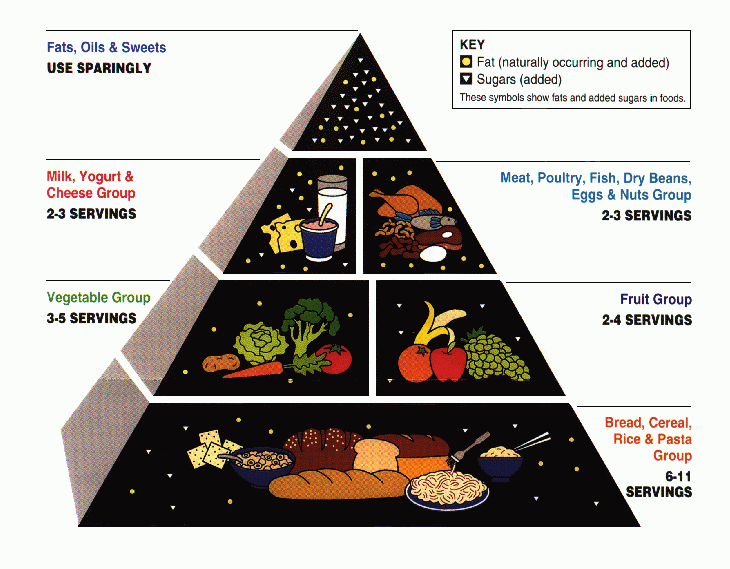
This one doesn't even give servings, it says to use sparingly.
The Wikipedia copy derides and downplays some of the criticisms, but at least they admit that criticism exists.
Vegans consume a variety of plant-based foods such as fruits, vegetables, grains, legumes, nuts, seeds, and plant-based alternatives.
Most of the recipes you know and love can be modified to have a vegan version.
The free market created and continues the problem.
But how is that any less dime a dozen? In theory, I agree with you. But the reality is, we don't have the politicians with the backbone or the will to say "I'm going to make your food more expensive." People lost it when eggs shot up in price. Imagine that across the entire diary and meats section at the supermarket?
Incentive work, but this Fed gov solution is DOA.
No one steps up to be accountable for waiting. No one steps up to be accountable for a painful solution.
What could go wrong? We're living it.
We can start with abolishing the subsidies. Thanks to them, meat is somehow cheaper than vegetables and fruits. Makes zero sense to subsidize all the fatsos who cant even see their own dicks. Or the gym bros who easily consume 10x what I do.
And what about the animals? What sort of life they must have. Never even seen the sun because their flesh has to be abundant to the point almost no one gives a crap about if it's thrown away. Who cares, it's cheap!
I realise this is a shitpost but it's Friday and I had a beer, so excuse me.
I am venting. The things I complain about have been bugging me for decades and I am under no illusion that my occasional rants can change anything, nicely worded or abrasive.
This has not worked for a long time in the US. Conservatives have repeatedly cut their nose to spite their face. Plenty of states have still refused to expand medicare simply because it's a liberal policy, and the conservatives in these states have not wavered in their support of those politicians despite directly suffering as a result of poor access to healthcare. They will simply boot up a GoFundMe and muse about "why can't we just set up one big GoFundMe for everyone?" without an ounce of self reflection.
Consider Florida: Thousands of conservative voters died from covid needlessly, while cheering on Desantis as he made it a crime to not allow someone in your private business who didn't take precautions.
It's better to fix incentives such as making meat more expensive through taxes or fewer subsidies on meat or feed grains (corn). Or making vegetables cheaper. I could see a serious PR campaign to support farmers/small business (conservative hook) and eat local planet variety combined with fulfilling recipes or even tax breaks for fast food items that are vegetarian.
To make things work at society scale you need incentives, let the free market work for you.