My source here is 10 years old, so it does not have up-to-date information on whatever MyPlate is pushing. But it says: "[the pyramid] no longer gives any clear recommendations whatsoever. It is fairly open to artistic interpretation."
Previous food pyramids were demonstrably "perverted", such as one where a major food group component consists of sugars and fats. Carbohydrates were the base of that pyramid.
Luise Light, Ed.D., explained that "3-4 daily servings of whole grains were changed to 6-11 at the base" as a concession to the processed wheat and corn industries. The processed white-flour, low-nutrient products which she had placed at the peak, were moved to the base, encouraging a foundation of sugars, fats, and highly-processed sweets. The wording was changed from "eat less" to "avoid too much".
The food industries and their allies in Congress were pissed because they said the USDA shouldn't be telling citizens to "eat less" of anything!
Many health guides are written by pharmaceutical companies, and therefore everyone in hospitals here gets Jell-O. Cool stuff.
> a major food group component consists of sugars and fats.
How many servings of sugar and fat does it say?
https://upload.wikimedia.org/wikipedia/commons/6/6d/USDA_Foo...
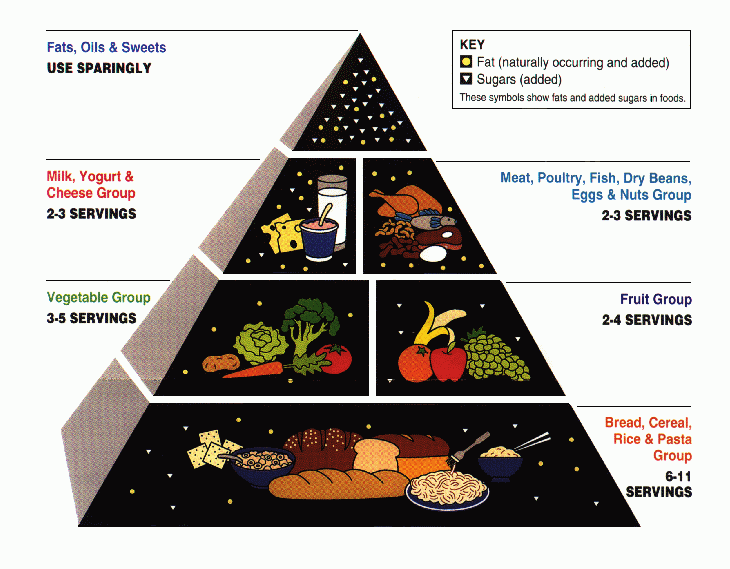
This one doesn't even give servings, it says to use sparingly.
The Wikipedia copy derides and downplays some of the criticisms, but at least they admit that criticism exists.
Also, https://www.myplate.gov is very reasonable. The problem with food guidelines aren't that they're wrong. It's that nobody adheres to them the same way they don't adhere to a guideline like "get daily exercise".