What is meant by that saying is, “well the first time we ran the machine it worked just fine, so we got all excited, but then it consistently failed after that”, with the lesson being, increase your sample size before you pass judgement.
LLMs almost suffer from the opposite. Because they are correct so often the danger is in assuming the response is always correct.
Maybe, “even a Swiss made watch needs to be checked against the town bells”?
1. "Most winged creatures either have paws (like bats) or lay eggs (like birds and insects)" - but bats don't have paws.
2. "However, if we consider the term "wings" more broadly" - why do we need to consider the term "wings" more broadly? Nobody is arguing there is some definition of "wing" that would exclude bats. Bat wings evolved from largely the same structures that bird wings did.
3. "there are some species of bats that give live birth" - all species of bats give live birth - stating it like this makes it sound like there are some species of bats that lay eggs or something.
4. "...provided we interpret "wings" in a broad sense and "paws" in a strict sense." Again, no "broad" or "strict" senses are needed. Bats have wings and no paws.
To be clear, I still think ChatGPT is amazing, but these kinds of things highlight some of the differences between LLMs and human cognition.
First, you'll notice the added "work it out step by step" to encourage what is called chain-of-thought in the literature. Second, generate say, five responses from the LLM, then take all five responses and uses them in another prompt where you ask the LLM to reflect on all of the five responses, a process being called reflection. Then you take all of that, including the original prompts, and in another separate prompt ask it to figure out the best response, a process known as resolving. You could end it with another prompt to remove the step-by-step work and just return a succinct answer.
Given that most people have computers and RAM is dirt cheap right now, I'm already maxing out all of my devices.
But it does seem like a single call to an LLM is not the correct approach.
I’ve gotten the best results from attempting to mirror how I would operate in response to a prompt. Much of this is colored by decades of philosophical readings, which in my case means a decent amount of analytical philosophy along with latter Wittgenstein and other post linguistic turn thinkers.
So when I break things down, either in some kind of approach inspired by Frege, Wittgenstein or unadorned self-reflection, I can see that the unconscious mind seems to be doing something recursive before my conscious mind is ready to start fumbling over the word.
It seems like an LLM is just part of a larger cognitive architecture that will use these metacognitive approaches.
It’s also very obvious that mammalian brains are much more efficient than GPUs.
Can hind limbs of bats be classified as paws? English is not my native language, so I'm just being curious.
Bat paw: https://upload.wikimedia.org/wikipedia/commons/e/e1/Bat_in_a...
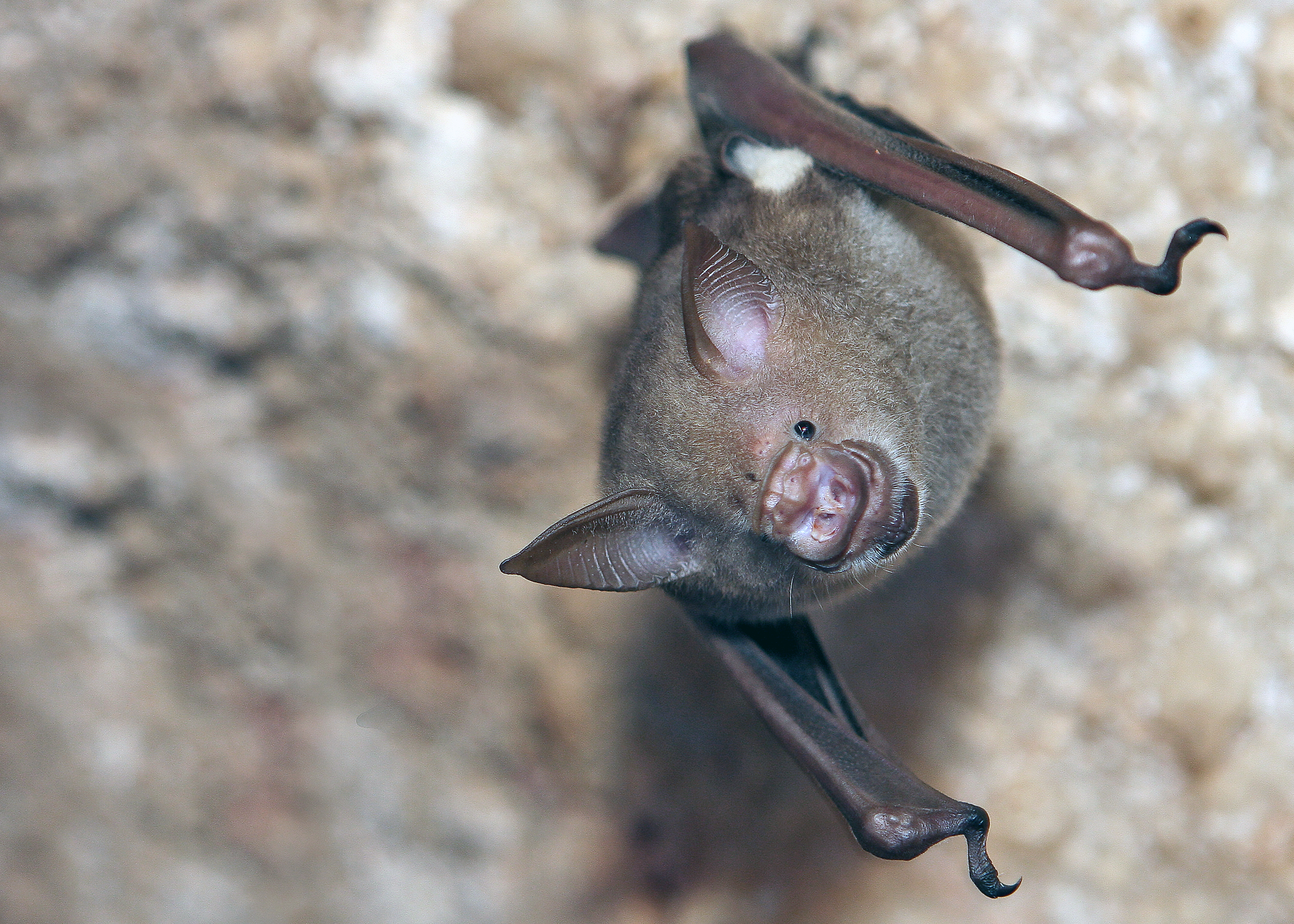
ChatGPT was totally in tune with this concept. The appendage on the elbow of the wing can be a paw or not a paw but it certainly evolved from paws. The reasoning was spot on and amazingly nuanced.
Doing some digging, paws are "soft foot-like parts of a mammal, generally a quadruped, that has claws" (Wikipedia). Bats do appear to have claws, but not really with the same structure as a paw; they don't seem to be mounted above a soft, fleshy pad. Rather, they're at the top of the wing, sitting on bone. They're also very different in function, when I've had the fortune to see a bat they seemed to use the claw to climb in a somewhat similar way to how climbers use ice axes.
My impression is that bat's claws are the anatomical equivalent of a thumb, not a hand/paw, and that the entire paw or hand of bat's ancestors evolved into their wings (sort of like if your fingers became very long and webbed and then you were able to fly with them).
So, my conclusion is that no, the claws of a bat are not a paw.
As long as it has claws according to vocabulary dot com it is a paw.
It's clear that you either aren't a native English speaker, don't have much experience with bats, or are just trolling.
I've spent a lot of time in caves with bat experts. Nobody during that time ever referred to bats' paws and if you did they would think you were making some kind of joke.
Quote:
   Paw : the foot of a quadruped (such as a lion or dog) that has claws

   broadly : the foot of an animal
I think among your bat friends maybe they won't call it a paw. But outside of that in other contexts (like here) it's a paw because if fits the definition of a paw in the English language according to the very official source of Merriam Webster.
I also understand that you might not realize how heated this sub thread was as the other guy deleted half his posts and flagged one of mine (therefore possibly making it invisible to you). So adding a little heat to something that looks tame isn't a big deal. I won't continue the flame war but I will continue the discussion.
It's not my interpretation. It's about the interpretation by Merriam Webster. I believe not only is it your interpretation that is incorrect when compared to official sources, but you didn't fully read the official definition either.
The eagle is not a quadruped. The definition in Merriam Webster says it has to be on a quadruped for it to be a paw. Hence your example is completely irrelevant. Please correct your mistake.
Are you aware of the "showdead" function in your settings? I don't think they deleted any comments, they were flagged. If you turn on showdead, you'll be able to see them again. (You can't delete a comment someone's responded to, or after 2 hours.)
I don't know if that other commenter flagged your post, but I don't think it matters. I didn't flag any posts here, but both of you guys were getting flagged. In situations like that, I try to interpret the flags as a request from the overall community not to have that sort of discussion on the forum. The sort of argument you were engaged with (and I recognize this isn't fully on you here, it takes two to tango) is against the guidelines of the site and generally frowned upon by the community, so there's no reason to suspect this other commenter was flagging you. At least 3 people were flagging both of your posts.
I understand that you feel pointed language is appropriate in a debate, and that HM'd guidelines here are patronizing. That's all well and good. The objection of the community isn't a moralizing one. It's a practical one; the issue is that flamewars displace the type of discussion this community is seeking to have and erode the good will on which the forum turns.
(And I do agree that bats crawling on the ground is quadrupedalism, for what it's worth. I'm not sure if that makes them a quadruped or not since that isn't their primary move of locomotion, indeed my understanding is that it's a vulnerable position for them and that it's quite deadly [since they can't evade predators].)
Take a look at this. The bats are walking on all fours: https://youtu.be/ewmydjekJnU?t=62 This is not a vulnerable position as they crawl on all fours on cave walls rather then the ground. On the ground they are vulnerable, on the wall or ceiling of some cavernous structure they are safe.
It says: "I don't really write stuff. What I do is use my personally trained LLM (trained on my own conversations) to respond to people. So you are talking to me in a way but not really.
Any query my LLM gets wrong I will interject with my own response but this is only 5% of the time."
Maybe this is not off-topic after all. Does HN have a policy on bots?
You had a comment comparing me to calvin and hobbes comic cartoon. I called you out on that post telling you that that was a deliberate provocation. You deleted that post and now you're lying about it. This is flat out wrong.
Given that that was a lie, most likely you didn't vouch for any of my posts and you're the one that flagged mine.
Just please stop responding. Your participation in this thread is raw flame and you are manipulating the optics. I'm happy to continue the conversation with other people, but clearly you no longer want to discuss things and are just provoking people.
edit: Aaand you flagged this post. Thanks!
Anyway I'm enjoying imagining bats with little paws, it's an amusing image.
https://www.merriam-webster.com/dictionary/paw
Look up the definition of a paw. I think you have a sort of mixed up definition of what it is. Possibly a different definition used among your "bat expert" friends.
And I quote (again):
   Paw: the foot of a quadruped (such as a lion or dog) that has claws
   broadly : the foot of an animal
The thing you are referring to is likely are these soft pads that are often on the paws, sometimes called paw pads.
But this nuance in the definition of the word paw was addressed by chatGPT.
Reminds me of: https://www.gocomics.com/calvinandhobbes/1989/11/03
The person you queried mentioned "intentional goading." Which is what you're continuing to do with that Calvin and Hobbes link. I think this, the flag and accusing me of trolling is taking it too far. A little goading is ok during a debate, I returned the goad (which I shouldn't have), but ultimately I didn't have a problem with it. I think, now though, it has escalated now past the point of no return. I think I'll be exiting this thread. Farewell.
ChatGPT is being more logical to be honest.
It’s true, some species of bats give live birth.
To assume all bats give live birth might be committing the fallacy of induction.
Chiroptera fits under Mammalia in the phylogenenetric tree.
Bats give live birth.
I know what both 3.5-turbo and 4 say on my account, but I think I might be in some cost-effective inference holdout group because it’s always so dumb.
See how ridiculous that sounds?
CoT or <work> tokens are not 'cheating' - they allow the system to have (as an analogy) a sheet of paper to work out the problem, instead of relying on a single step to jump through thousands of steps of reasoning. It's trained on the algorithmic reasoning embedded within natural language (Transformers<=>GATs+PE⊂GNNs, which are dynamic programmers, and align well with algorithmic reasoning), so the steps are necessary to lay out in as much detail.
What does that possibly have to do with GPT-4 shitting the bed if you draw the logic puzzle out of a deck of cards instead of cherry-picking and hinting it?
I cheated, and used bc, the unix utility.
These three maneuvers (the correct answer, the agency shown by cheating, and the crystallized intelligence of unix) handily demonstrate both my own intelligence, and that of my species.
The LLMs aren't in the same category of being, yet. It's not clear they ever will be; while I think silicon is a viable substrate for intelligent agents, it still strikes me as doubtful they'll be any more descended from the current machine learning systems as they are from Symbolics Lisp.
It seems to me that the ability to reason ( though primitive it may still be) is an emergent property of sufficiently large differentiable hash/lookup tables (and if you think about the mechanism of reasoning, that seems... Reasonable).
According to "folks in the know", the scaling limits of GPT architecture seem to be nigh, but if it were a bit higher I wouldn't be surprised if LLMs would have made it.
You might get more use out of these tools if you learn how to use them and these natural language instructions are how you use these tools.
It’s like calling the reverse gear on your car a cheat code!
What animals don’t have paws or lay eggs, but have wings? Work it out, step by step.
Here are the steps on how to find animals that don't have paws or lay eggs, but have wings:
1.Define the terms. What do we mean by "paws"? What do we mean by "eggs"? What do we mean by "wings"?
2. Identify animals that meet the criteria. There are a few animals that meet the criteria. One example is a bat. Bats have wings, but they don't have paws. They also don't lay eggs. Another example is a butterfly. Butterflies have wings, but they don't have paws. They also don't lay eggs.
3. Confirm that the animals meet the criteria. We can confirm that the animals meet the criteria by looking at their anatomy. Bats have wings that are made of skin and bone. They also have claws on their feet, but these are not paws. Butterflies have wings that are made of scales. They also have legs, but these are not paws.
4. Draw conclusions. Based on our findings, we can conclude that there are a few animals that meet the criteria of having wings, but not paws or eggs. These animals include bats and butterflies.
Here are some additional details about bats and butterflies:
Bats: Bats are mammals that are able to fly. They have wings that are made of skin and bone. Bats use their wings to fly at night, when they hunt for food. Bats are important pollinators and they also help to control insect populations.
Butterflies: Butterflies are insects that have wings that are made of scales. Butterflies use their wings to fly during the day. Butterflies are important pollinators and they also help to spread seeds.
The only animals that fit the description of having wings, no paws, and no eggs are bats. Bats are mammals, which means they give birth to live young. They also have wings, which are made of skin stretched between their elongated fingers. Bats do not have paws, as their feet are adapted for grasping branches and other objects.
Here is a step-by-step process for determining which animals fit the description:
1. Identify all animals that have wings. 2. Eliminate all animals that lay eggs. 3. Eliminate all animals that have paws. 4. The remaining animals are bats.
Here is a list of animals that have wings, no paws, and no eggs:
- Bats
It is important to note that there are some animals that may appear to fit the description, but do not. For example, some insects have wings, but they do not have paws and they lay eggs. Additionally, some birds have wings, but they do have paws and they lay eggs.
ChatGPT (GPT-4):
Sure, let's go through this step by step:
First, you asked for animals that don't have paws. This would exclude mammals such as dogs, cats, bears, and so on, as these species have paws.
Second, you specified animals that don't lay eggs. This eliminates a wide range of animals including all birds, most reptiles, and some fish and insects, as they all lay eggs.
Finally, you asked for animals that have wings. Wings are typically found in birds, bats, and insects.
Given these three criteria, we can see that we're in a bit of a conundrum. Most winged creatures either have paws (like bats) or lay eggs (like birds and insects).
However, if we consider the term "wings" more broadly, there are some species of bats that give live birth (don't lay eggs) and technically don't have "paws" but rather winged limbs adapted for flight.
So, based on the constraints of your question, the best fit would be certain species of bats, provided we interpret "wings" in a broad sense and "paws" in a strict sense.