Chile and Iran were egregious examples of the US sticking our oar in.
It’s been over a generation of peace, so people have forgotten them.
For instance the ukraine and russia war is a proxy war for the USA but is not for russia, as russia is fighting.
Perhaps not for the country, but it could be for Putin. It's dangerous to make a man with the nuke codes desperate toward the end of his life.
The chain is even longer then the higher ups decision to actually launch a nuke though.
Would you press the button to nuke another country knowing that doing so will very likely kill your entire family and you?, or would you ignore the order?.
You always talk about the nukes because it's all you have left.
Western leaders will never bow to the nuclear threat because doing so means Russia/China can get their way in everything if they just use the nuclear threat.
I talk about nukes because I believe it's the biggest danger the world faces and have for a long time. I grew up in the shadow of the cold war being drilled on how to hide under my desk when the missiles came. Far before Ukraine I was mystified by everyone's ability to forget that threat still exists. It seems possible and even likely to me that nuclear catastrophe will come before and be far greater in magnitude than any AI or climate catastrophes, for me it overshadows every other threat. Apparently I'm not the only one that perceives a threat: https://thebulletin.org/doomsday-clock/
Are we calling Iraq and Afghanistan losses? Sure would be great if we established a liberal democracy in Afghanistan, but it seems like after Osama was killed, Americans mentally declared victory and we were just burning money and lives.
Iraq had their leader overthrown and a new government established. Its really hard to call that a loss, even if it wasnt a perfect liberal democracy like we want.
Neither came out great but both are stable, Iraq is not destabilizing the region and Afghanistan isn't harboring people who want to attack the west and have the capability to.
That said, we never should have invaded Iraq and we probably could have accomplished what we accomplished in Afghanistan and more had we more seriously pursued diplomatic options in 2001.
Throw in some shock and awe on Taliban forces if we wanted to make more of a point, I suppose.
The mood in 2001 was one where diplomacy was impossible short of unconditionally handing over everyone in Al Qaeda to the US.
That wasn't an unreasonable request all things considered. We should have tried much harder to get the Taliban to accept that deal. They needed to look like more legitimate government with a stronger grip on power. We needed Al Qaeda. It should have been an easy deal to make. Marketing it would have been harder.
We've made the same deal a dozen times before. It's not like we didn't have the playbook ready to go. All we had to do was translate the end user guides from Spanish and replace "commies" with "Al Qaeda". Obviously the details would have needed to be hammered out but it's not like the precedent wasn't there.
None of which was happening anywhere close to US borders. In finance they say that past performance is no guarantee of future results, but you're eager to bet everything you have on this war outcome nonetheless.
Yes it did, you're arguing against basic facts.
That's exactly what Russia was counting on. Should we (by we, I mean the rest of the world) just let them annex whatever land they want, with no consequences or resistance?
There's no "whatever land". The war is going for a particular land with particular significance to Russia, similarly to Panama's significance to the US [1]
[1] https://en.wikipedia.org/wiki/United_States_invasion_of_Pana...
As Putin himself said, Russia has no borders, so the orcs' goal is to subjugate everyone.
What history does Russia have in Romania (it still occupies Transnistria)?
What history does Russia have in Crimea (orcs only became the majority because of the execution/expulsion of the natives https://upload.wikimedia.org/wikipedia/commons/6/6a/Ethnic_P... )
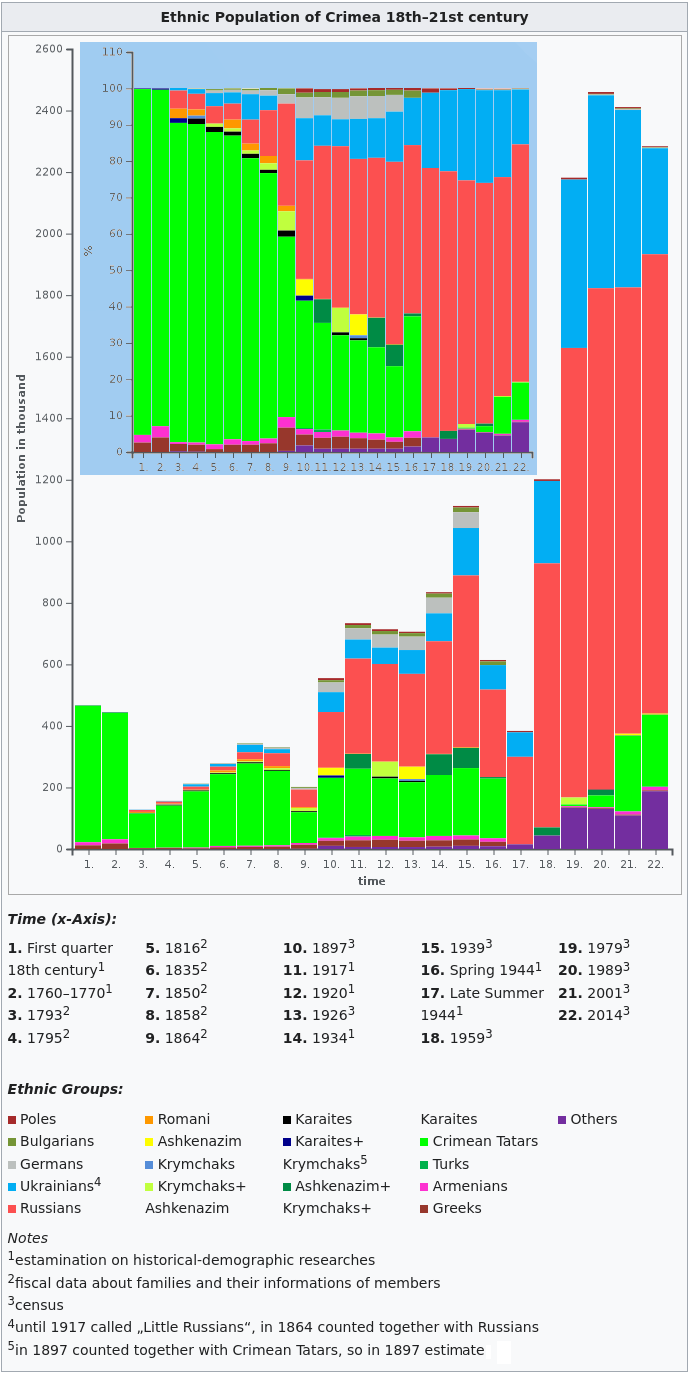
> similarly to Panama's significance to the US
Why is it that Russians are the most jingoistic "Americans"? Whenever someone points out what Russia is doing, they immediately praise the US for doing a lesser version of the same thing.
If there's a similar significance does that mean you'll leave Ukraine afterwards?
> What history does Russia have in Romania (it still occupies Transnistria)?
It has the same common history with Carpathian Ruthenia land that Ukraine isn't willing to return to Hungary and Romania.
> Whenever someone points out what Russia is doing, they immediately praise the US for doing a lesser version of the same thing.
That's to show you that double-standards exist and that nobody seems to care as long as it serves their agenda.
Yeah why is it our problem?
Assuming you believe in honoring the alliance, it's a lot easier to provide Ukraine with ammunition than to let it fall and have to send American troops to fight in Poland/Romania/etc.
https://en.wikipedia.org/wiki/Munich_Agreement
We didn't do anything when they annexed Georgia and Crimea and here we are. It's certainly concerning.
Sticking to this line is basically resigning yourself to the status quo while claimimg yourself morally above it.
Just for one thing: geriatrics control most policymaking in America, and they won't be fighting anything.
It's not just rhetoric. The underlying truth is that there have been wars in history that were worth fighting, and for which people did head to their nearest Army office and sign up to fight. And if a war doesn't reach that standard, then it begs the question why it's worth fighting at all.
You're free to challenge the premises of the conflict by showing me a Russian city destroyed to grounds by Ukrainians, like Mariupol or Bakhmut.
You're welcome to read an Black American socialist, Glen Ford, and his brief account of where things were headed as far back as 2014, though:
https://redsails.org/ford-on-ukraine/
I think that President Obama’s attempt to destabilize Russia will be seen by history as disastrous as George Bush’s invasion of Iraq in 2003. Like the Iraq war, the de facto declaration of “war by other means” against Russia will accelerate the very dynamic that it intends to halt: the steady weakening of U.S. imperialism’s grip on the world. It will increase the resolve of a host of nations to disengage themselves from American madness and to strengthen collaboration and cooperation among many countries, and not just Russia and China.
The result will be the exact opposite of Washington’s intention. The attempt to isolate and destabilize Russia, the other nuclear superpower, may appear to some to be an act of brashness, a flexing of American muscle, an act of imperial overconfidence and recklessness. People thought the same thing when Bush went into Iraq. They were shocked and more than a little bit awed. [1] In fact, sometimes I think that Americans are more shocked and awed by the American military than anybody else. But the Iraq invasion, and the brazen offensive against Russia, as well as the so-called “Pivot Against China” and the octopus-like U.S. military entrenchment in Africa — these are really symptoms of weakness and desperation.
U.S. imperialism is losing its grip on the world and responds to its weakening condition with massive campaigns of destabilization. Destabilization characterizes U.S. foreign policy today more than any other word. The purpose is to reverse the general dynamic of global affairs today in which U.S. influence and power shrinks in relative terms as the rest of the world develops. U.S. and European hegemony — and that is the ability to dictate the terms of economic and political life on the planet — has daily diminished in myriad objective ways, ways that we can measure by the numbers. China’s soon-to-be status as the world’s biggest economy is just one aspect of that decline.
The process is inexorable and it’s gaining momentum. The trajectory of imperial decline has been firmly set ever since the Western capitalists decided to move the production of things — that, is the industrial base — to the South and the rest of the planet. Inevitably power and influence follow and imperial hegemony diminishes. This is of course unacceptable to the rulers of the United States who now find themselves in objective opposition to all manifestations of collaboration and mutual development under terms that are not dictated by Washington. They are in objective opposition to all manifestations of independence by countries in the world. This applies not just to China, not just to China and Russia, but to the rest of the BRICS and to other developing nations. And it even applies to America’s closest allies.
That is because hegemons don’t really have allies. All they have are subordinates, and so the U.S. is quite prepared to do serious harm to European economic interests by pressuring them to break long established economic ties to Russia. They will ultimately do the same thing in the pacific region with China and cause great destabilization there. They do so not because of strength but because of growing relative weakness. Their desperation compels them to risk war because their only clear superiority is in weapons.
However, the net end result, if we survive these flirtations with all-out war, can only be further isolation of the United States and the further weakening of imperialism. I think there is on what passes for the left in the United States a tendency to describe U.S. aggressions like the Iraq war, like the current offensive against Russia, as mistakes and miscalculations: “They didn’t mean to do that.”
In reality the U.S. goes to the brink and beyond the brink of war because it perceives itself as having no other choice. Its soft power is fading. It has few other means beyond the military to strategically influence events. It recruits or buys allies where it can get them, be it jihadists or Nazis. As imperialism’s sway in the world shrinks, so do its options.
U.S. policymakers surveyed the world in 2002 and in 2003 and they concluded that the dynamic in Asia was going against them. They knew that most of the world would be horrified with a war against Iraq, but they rolled the dice anyway and invaded. The net result was the opposite of what they intended. The U.S. was humiliated and the U.S. was humiliated so badly that the rulers of the United States chose to put a dramatically different face on U.S. power — a Black face, Barack Obama.
Iraq was supposed to be a forward U.S. base in Asia to disrupt China’s growing ties in the region. Instead the Iraq war exposed U.S. imperialism’s weaknesses. In the days before that invasion, we wrote in Black Commentator that the U.S. had reached too far and succeeded only in accelerating the process of its own decline. Today Barack Obama is rolling the dice just like George Bush did. To sever Russia’s ties to Europe, Washington has surveyed the global scene and concluded that it has no other choice. The result will be a strengthening of ties between Russia and China, a great anxiety and rethinking among Europeans about their ties to the United States which is about to harm their economy, and an acceleration of imperialism’s death spiral.
Power to the people!
This is obviously false. American soft power has consolidated post-Ukraine.
> Iraq was supposed to be a forward U.S. base in Asia to disrupt China’s growing ties in the regio
No it wasn’t. China wasn’t a strategic rival when we invaded Iraq.
Chess is played 5 moves ahead
The Iraq war strikes you as 5D chessmanship?
Disagree. For example USD's status as the world reserve currency is slowly starting to come into question after we used our financial system as a weapon against Russia. Other countries are starting to trade with Russia in their currency. Arab countries are starting to trade oil in non-USD. Countries like China are looking to take advantage and establish their currency as USD's replacement.
The U.S. dollar has always had people looking for a replacement. (There is a solid economic argument for America de-internationalising the dollar for domestic purposes.) It was weaker in the wake of 2008 than it is today.
> Other countries are starting to trade with Russia in their currency. Arab countries are starting to trade oil in non-USD
The petrodollar hypothesis is a debunked explanation for American hegemony, even dollar hegemony. I traded oil in pounds sterling and euros years ago--much of the world settles own way.
Also, this limited definition of soft power ignores American military supremacy, both on its own and with its alliances, which are strengthening, as well as American economic heft, which in even the most pessimistic estimates is a commanding strength through at least the 2050s, a timeline even the stupidest heads of state can see. It's this soft power that keeps the Russian hard power frontline a few miles off its border and the Chinese' a few miles off its shore.
(People also tend to overstate the real economic effects of the dollar losing reserve status, equating it with Britain post-Suez.)
You seriously think I’m going to read the garbage?
Then, why do object to the premise?
The article opens up with false claim, why should I read further?
    As a concerned observer of US foreign policy, I must say that I have serious reservations about the direction it has taken in recent years. Despite the many resources and capabilities that the United States possesses, it seems that our government has been unable to use them in a way that promotes peace and stability around the world.

    One of the biggest criticisms I have of US foreign policy is the tendency towards unilateralism and military intervention. It seems that the default response to any international crisis or conflict is to send in troops or launch airstrikes, regardless of the consequences. This approach has been costly in terms of both lives and resources, and has often ended up exacerbating the very problems it was meant to solve.

    Another issue I have with US foreign policy is the lack of attention given to diplomacy and multilateralism. Instead of working with other nations to find collaborative solutions to global problems, the US often seems more interested in asserting its dominance and pursuing its own interests. This has led to a breakdown of trust and cooperation with our allies, and has made it more difficult to address shared challenges like climate change, terrorism, and nuclear proliferation.

    Furthermore, the US has a troubling track record of supporting oppressive regimes and engaging in human rights abuses in the name of advancing its geopolitical goals. This has led to the alienation of many people around the world who see the US as hypocritical and morally bankrupt.

    Overall, I believe that US foreign policy needs to fundamentally shift its focus towards diplomacy, cooperation, and respect for human rights. We need to recognize that we are part of a global community and that our actions have consequences beyond our borders. By working with others and promoting peaceful, inclusive solutions, we can help to build a more just and stable world for all.
The fact is US citizens, resident aliens, and allies benefit from US government hegemony. The alternative is going to be unpalatable to most of those folks mentioned afore.
The poor innocent Ukrainian government did pass a bill to prohibit official use of minority languages on the eastern part of the country (dominated by Russian-speaking population) on a Sunday morning of February 23, 2014. It happened a day after their president had to flee the country. It was clearly a period of political crisis and no one was supposed to work and enact any legislation on that weekend day in the first place. No one was supposed to pass a bill of that significance without extended debates and a referendum specifically. But the coup leaders decided to move forward with it nonetheless. Russian troops legally stationed in Crimea took over the peninsula 4 days after that punitive act of the Ukraine government against its own russian-speaking population of the eastern part of the country. The reinforcement from Russia were only sent 6 days after the event, as the Kiyv regime decided to escalate.
No, they did the same for all languages. Romanians have lived in Northern Bucovina for centuries, yet you don't see us invading Ukraine. But what you're saying is fair because they should only have prohibited Russian since they are the people who genocided Ukrainians so they have no right to occupy Ukraine.
are you negating "prohibited official use of minority languages" with "they did the same for all languages" as a means to show that the bill was even-headed?
> But what you're saying is fair because they should only have prohibited Russian since they are the people who genocided Ukrainians so they have no right to occupy Ukraine.
Right, the Russian language had to be prohibited because Russia would react to Ukraine's prohibiting the use of the Russian language for russian-speaking Ukrainians, presumably as a punitive measure for their alignment with Russia due to their geographical & cultural proximity and generational ties. And that's because Romanians living in Northern Bucovina couldn't care less about it..... My take is that you deserve a Nobel prize for being the most consistent person on Earth. Thanks for showing your stance clearly in the open.
> Ukrainian government did pass a bill to prohibit official use of minority languages on the eastern part of the country
So what? Passing some bills justify full scale military invasion? Maybe we need to invade Russia, since they pass freedom stripping bills every week.
It wasn't full scale at first, and there was leeway for a diplomatic resolution of the political crisis, which Kiyv regime decided to ignore and to escalate instead.
> Maybe we need to invade Russia, since they pass freedom stripping bills every week.
Who's "we"?
I'm not a coward so I will challenge you. It wasn't Russia, it was Putin and a group of people around him who decided to attack Ukraine to extend their influence. Ukraine is a victim in this conflict. There is nothing that they did they would justify invading, murdering and raping innocent people.
"It was just like, a tiny clique of villains with almost no support!"
To feel good about a wrong theory of a particular war you put forth an even more wrong theory of statecraft.
This isn't reddit - we strive for a higher level of discourse here. "Upvotes / downvotes" mean "good contribution to the discussion / not good, ad hominem, rude, etc." And the above comment is an excellent contribution.
I want someone who actually has a good grasp of foreign policy, strategy, wargaming, geopolitics, etc. to answer this. I too want to understand how America arming and training a Ukrainian man to fight Russia is so strategically/diplomatically different from an American man fighting Russia. The degree of indirection seems so minor, how is it so different from direct engagement? Why/how does Russia/U.S. not treat it like direct engagement? I don't understand.
The episode where the Russian jet sprayed fuel on the US drone? Standard cold war tactic that was very common in the 80s. Russians have been ramming and harassing US vehicles for decades. Here's a video of Russians harassing a US convoy of sorts in Syria a few years ago: https://youtube.com/shorts/hSGv02qQfhQ?feature=share
Both sides have been flagrantly arming and training opposing factions in these proxy wars for decades as well. Modern Ukraine looks a lot like a reversed Vietnam, actually, and the US never declared war on Russia for that either.
Neither side wants direct confrontation with the other, so they play games like this. Ukraine is a bit tame compared to the other recent/ongoing proxy wars. The flashpoint is that it's happening in Europe, which makes every move very public and sensationalised, and adds more pressure to the situation in general.
So most of this talk of "violations" and escalation is in some sense naive, because the actual red lines have been carved in the sand outside of the public eye over the past half century. What we understand as a clear escalation is often just par for the course in the minds of the people involved in these conflicts.
> we strive for a higher level of discourse here
I am not ashamed. TexanFeller's comment is not contributing to the discussion, he fearmongers with nukes to advocate for the subjugation of a country.
It could just be that it's his honest opinion, but I've seen too many similar comments always using whataboutism and/or nuclear fearmongering.
I have concerns about going to war with a nuclear power therefore I'm pro-Russia and wish for the subjugation of Ukraine? Obviously manipulative and ridiculous framing.
Soviet pilots fought in Korea and Vietnam (to a much lesser degree). There are stories of Soviet special forces, infantry instructors, etc. participating in Vietnam as well. Vietnam received tons of anti-air missiles and systems, not to speak of the fighter jets, tanks, guns, and more.
The US trained and armed fighters in Afghanistan. It wouldn't surprise me to learn US special forces popped in from time to time.
Those are more well known--especially the Korean War and Afghan war shenanigans--but there are many others that are more obscure.
The US, UK, etc. funded and trained a number of independence and / or revolutionary movements in the Eastern Bloc and China. The Baltic states, for example, had some level of guerilla war for a bit until the Soviets cracked down.
The Soviets, of course, funded all sorts of, shall we say, interesting characters in the West.
More recently, Iranian forces fought against American forces in Iraq. Syria has seen the US and Russia square off in a few incidents.
The question in my mind is: what level of support is too much support? How do we reason about that?
What level of support deters additional territorial conquest? Does territorial conquest in and of itself increase the risk of Armageddon?
This is the sort of thing I'd expect to see in some Cold War era RAND Corporation white paper.
I worry we have lost some of our Cold War worries in the public consciousness. Being the top dog for so long has made us feel invincible.
But I also think we've forgotten that the Cold War was cold, not frozen, and there are valuable game theoretic discussions to be had or revisited