News for hackers. Stuff that matters.
Re:The Electron Is So Round That It’s Ruling Out Potential N... by delecti on Saturday April 15, 2023 @10:26AM (#35580898)
It's not that the experiment is not accurate, "accuracy" is simply not the aspect of the measurement being discussed. The sentence "That's precision, not accuracy." should be read to mean "we are discussing precision, we are not discussing accuracy" rather than "it's precise, but inaccurate".
Re:The Electron Is So Round That It’s Ruling Out Potential N... by Wowfunhappy on Saturday April 15, 2023 @10:28AM (#35580921)
...but aren't we discussing both, if one implies the other?
Re:The Electron Is So Round That It’s Ruling Out Potential N... by Mezzie on Saturday April 15, 2023 @10:36AM (#35580982)
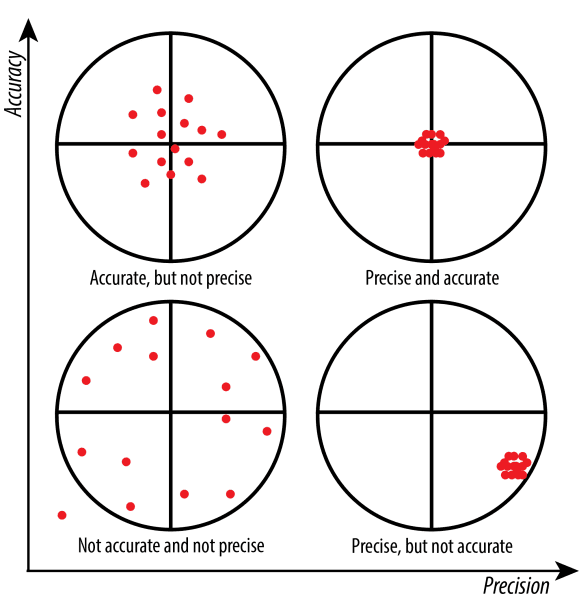
Precision and accuracy are slightly different mathematical concepts, as demonstrated by this image [0]:

[0]: https://wp.stolaf.edu/it/files/2017/06/precsionvsaccuracy_cr...
Re:The Electron Is So Round That It’s Ruling Out Potential N... by rektide on Saturday April 15, 2023 @10:50AM (#35581111)
To be honest accuracy Vs precision has always kind of makes sense to be but also not.

If something is extremely accurate, it will also be extremely precise by necessity, it seems like? The difference between low precision but high & low accuracies is that points are closer to center. If you keep getting closer to center, more accurate, don't you necessarily get more precise too?

Precise has always felt like a shitty alternate of accuracy. It's accuracy but with drift, accuracy to not the right place. But if you're accurate, you're both.

Am I missing something? And, here specifically, if this is a case of very high precision but lower accuracy, can someone explain what the drift from center is about? Isn't a radius a radius? Where is the drift off center in these measures?

Re:The Electron Is So Round That It’s Ruling Out Potential N... by hansvm on Saturday April 15, 2023 @11:10AM (#35581319)
Something is accurate in this sense if the "true" value (ignoring any philosophical implications thereof) is contained in the error bounds of the measurement. What you're noting is that a high accuracy measurement will, upon application of statistics, allow you to derive a new measure which is both high-accuracy and high-precision, regardless of the low precision of any inputs. Not all things being described with accuracy and precision are the result of processing large amounts of data though.
Re:The Electron Is So Round That It’s Ruling Out Potential N... by alexpetralia on Saturday April 15, 2023 @11:06AM (#35581267)
I wrote about precision here if you are interested. You first need precision before you can start even talking about accuracy (otherwise there is no "center").

https://alexpetralia.com/2023/01/31/what-does-it-mean-for-da...

Re:The Electron Is So Round That It’s Ruling Out Potential N... by moron4hire on Saturday April 15, 2023 @01:05PM (#35582429)
I don't like the lower left quadrant of that diagram, because it's not clear that it's not centered on the target. It would have been more clear if the cluster was smaller so it could be moved to not be centered on the target.

Accurate but imprecise means we can throw more and more shells down range and eventually hit the target. Inaccurate and imprecise means we may never hit the target. Inaccurate but precise also means we may never hit the target, but if we could introduce a second, different measurement that was accurate, we could compensate.

Re:The Electron Is So Round That It’s Ruling Out Potential N... by Wowfunhappy on Saturday April 15, 2023 @10:51AM (#35581118)
That's a great image, thank you for that—but I'm not sure what the significance is in this context? I feel like the measurement described would be about both accuracy and precision, unless I'm misunderstanding what we're able to do.
Re:The Electron Is So Round That It’s Ruling Out Potential N... by spiralx on Monday April 17, 2023 @06:12AM (#35598803)
I saw a Greek food stall in town a couple of years back with the statement "Food delivered with mathematical accuracy" which just bugged the hell out of me lol.
Re:The Electron Is So Round That It’s Ruling Out Potential N... by PezzaDev on Saturday April 15, 2023 @10:36AM (#35580983)
No. Precision and Accuracy have very specific definitions in the world of science and engineering. https://en.m.wikipedia.org/wiki/Accuracy_and_precision
Re:The Electron Is So Round That It’s Ruling Out Potential N... by jvanderbot on Saturday April 15, 2023 @10:51AM (#35581131)
So, when one uses statistics to rule out deviations below 1E-17 radians (or whatever), you're all saying that's not accuracy, it's precision.

I'm also surprised, since IIRC precision is a measure of variance from a set of measurements, and accuracy is a measure of deviation of a value from true.

The statistical aggregation to get an estimate should (I think?) increase both the accuracy of that estimate (it will converge to the true value) and it's precision (the spread of subsequent estimates with more measurements converges to zero or some noise floor).

Here we're measuring something like eccentricity, which has a value and error bars. And the claim is we have eccentricity zero with precision high enough to rule out deviations below 1E-17 radians. So yeah, precision seems to be the better of the two, but accuracy matters.

Either way, this is insanely pedantic.

Re:The Electron Is So Round That It’s Ruling Out Potential N... by zmgsabst on Saturday April 15, 2023 @11:19AM (#35581404)
Consider the case where there’s a configuration error — say, a cable not properly seated.

You can have results that are highly precise, but due to cable issue, not baselined correctly and therefore systemically inaccurate. Eg, faster than light neutrinos.

https://en.m.wikipedia.org/wiki/Faster-than-light_neutrino_a...

I think people get confused because they forget that systemic bias can impact precise measurements: if your system is wrong, you’ll precisely come to the wrong conclusion.

Re:The Electron Is So Round That It’s Ruling Out Potential N... by alexpetralia on Saturday April 15, 2023 @11:28AM (#35581492)
Yes, exactly: bias + imprecision = inaccuracy.
Re:The Electron Is So Round That It’s Ruling Out Potential N... by jvanderbot on Saturday April 15, 2023 @05:09PM (#35584542)
You're talking about a specific measurement, not a derived measurement from statistical analysis, though, right? Is there an instrument? If not, we're not talking about precision or accuracy, we're talking about variance about the mean, and the mean is assumed to move towards true.

In that case, the assumption is zero mean error b/c systemic errors average out, so the accuracy is the mean minus true, and the precision is established by the Cramer rao lower bound, and estimated my the posterior variance about the mean. My point is that calling it anything but a statistical certainty (e.g. confidence interval) is just jargon.

Re:The Electron Is So Round That It’s Ruling Out Potential N... by zmgsabst on Saturday April 15, 2023 @05:51PM (#35584919)
You can’t derive the correct value if all your measurements are (eg) +1ns due to inaccurate path length in your model.

Your collection of measurements will converge, just as if you had built the device you intended to — but they’ll converge to the wrong value, because you’re measuring the time incorrectly every measurement, and so averaging that out doesn’t do anything.

Your test is precise but inaccurate.

The whole context of this is about a specific instrument measuring electron properties — or in my example, timing neutrino flights. So… yes, we’re talking about precision and accuracy.

Re:The Electron Is So Round That It’s Ruling Out Potential N... by jvanderbot on Sunday April 16, 2023 @12:49AM (#35587352)
You're explaining accuracy vs precision, which I get.

The answer actually was: Yes, there's only one instrument. So yes, you can't average out systemic biases. So yes, I guess you can say something about

"We measure eccentricity zero with 1 part in 1E+17, which is really precise, but you'll just have to trust us it's also accurate."

Anyway, we know what everyone meant.

Re:The Electron Is So Round That It’s Ruling Out Potential N... by georgyo on Saturday April 15, 2023 @10:54AM (#35581155)
I can say Pi = 3 and be accurate but not precise.

I can say Pi = 3.0000004 and be precise but not accurate.

But that's not where the confusion comes from. It comes from measuring equipment.

Example, if I have a scale that is sensitive enough to give several decimals of precision, it is very difficult to calibrate it so it is accurate.

Anyone who owns a gram scale knows you basically have to recalibrate it after every measurement. It will gladly give you many decimals of precision that is just wrong.

Re:The Electron Is So Round That It’s Ruling Out Potential N... by shagie on Saturday April 15, 2023 @11:12AM (#35581328)
On the subject of scales calibration and really small wights:

Veritasium - How To Measure The Tiniest Forces In The Universe https://youtu.be/pXoZQsZP2PY (it gets into measuring piconewtons and femtonetwons)

Re:The Electron Is So Round That It’s Ruling Out Potential N... by hansvm on Saturday April 15, 2023 @11:03AM (#35581242)
And for today's rant, you can also say Pi = 3 and be precise. Significant figures are a common shorthand for in-band signaling of error, but they're not the only tool and are really only useful insofar as they're pretty easy to do mental math with and relatively well known.
Re:The Electron Is So Round That It’s Ruling Out Potential N... by kgwgk on Saturday April 15, 2023 @10:59AM (#35581207)
When they say "they could detect a bump on the North Pole the height of a single sugar molecule" is not about the accuracy of the measurement?

If my measurement device always measures 42 it may by hyper-precise - but it won't helping me to detect a bump on the North Pole the height of a single sugar molecule nor anything else.

Re:The Electron Is So Round That It’s Ruling Out Potential N... by hansvm on Saturday April 15, 2023 @11:16AM (#35581368)
But the thing being concluded is that it's not very bumpy, and for that conclusion to hold water the data needs to be both accurate and precise within some very small bound. Spitting out precise measures of electron bumpiness isn't very hard without that accuracy. Right this second I used the "gut feeling" measurement device to conclude that the electron is round within 1024 bits of precision, and yet the authors have a publication and I don't. Is their conclusion over-blown?
Re:The Electron Is So Round That It’s Ruling Out Potential N... by AnimalMuppet on Saturday April 15, 2023 @11:52AM (#35581756)
I don't think so. They're not measuring the radius to precision 10^-31 cm. They're measuring the differences in radius against zero, and they know the value of zero to infinite precision.
Re:The Electron Is So Round That It’s Ruling Out Potential N... by hansvm on Saturday April 15, 2023 @12:05PM (#35581885)
Sure, but it's precisely that difference which they claim to be measuring. Why does it matter that they don't also know some other value (the radius) to high accuracy? It's kind of like how a balance can measure the difference in force to high accuracy (and precision), but that doesn't mean we know anywhere near that much about the masses on the balance, and...it doesn't have to; you can just state that you know some delta accurately and not have to explain why that means some auxiliary measurement is probably precise.
Re:The Electron Is So Round That It’s Ruling Out Potential N... by moron4hire on Saturday April 15, 2023 @12:39PM (#35582194)
* * *