Here is the hole. Personally, I don't see any trace of epoxy in or around this hole: https://upload.wikimedia.org/wikipedia/commons/3/3f/Hole_in_...
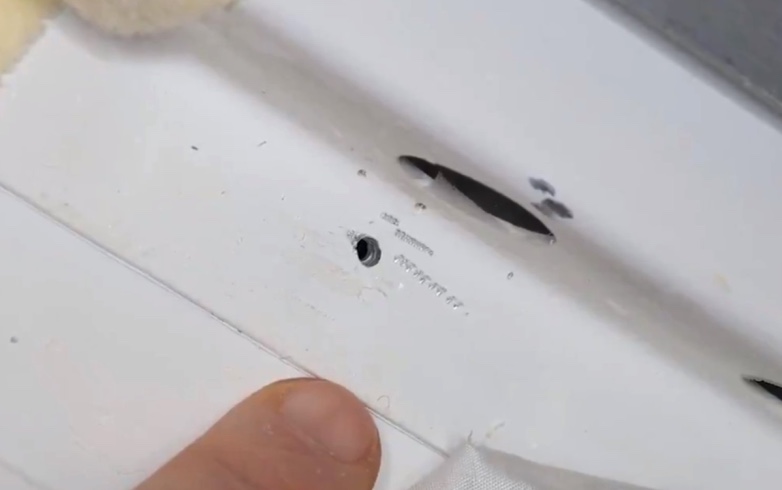
(To be clear, it's the small hole, not the big one next to it. The small hole next to the paint marred by a slipping drill bit.)
Having said that, it’s hard to believe that there wouldn’t be traces of epoxy inside that very rough hole, or in the bare metal exposed by the drill bit. So it seems odd to me also.
Looks like decades of rampant corruption and political violence are not exactly good for high-tech industry. Who would have thought?
Fun fact about the Proton M failure: the sensor was designed so that it could only be mounted correctly, but apparently it had been forced in the wrong way somehow. Possibly with a hammer. From [2]:
By July 13, investigators simulated the improper installation of the DUS angular velocity sensors on the actual hardware. As it turned out, it would be very difficult to do but not impossible. To achieve that personnel would need to use procedures and instruments not certified either by the design documentation or the installation instructions. As a result, the plate holding the sensors sustained damage. Yet, when the hardware recovered from the accident was delivered to GKNPTs Khrunichev, it was discovered that the nature of the damage to the plate had almost exactly matched the simulated version.
[1] https://www.newscientist.com/article/dn9331-crashed-spacecra...
[2] https://www.russianspaceweb.com/proton_glonass49.html#culpri...
They haven't sent an interplanetary science mission in decades, their next-generation vehicles are constantly delayed or unreliable, Nauka was an entire 12 years behind schedule and so on.
Now on top of that, they're under heavy sanctions and are experiencing further brain drain from people fleeing conscription. It's clear that they're having to cut more and more corners to keep up. Plus, for Russia it has only been 30 years, the time under the USSR should not be considered comparable considering that much of their aerospace talent was in/from Ukraine.
In 1991 it was expected that independent Ukraine, a 52 million strong country, will basically be the next Spain.
What did it punch in the space sector in the last 30 years? They did indeed inherit a huge chunk of USSR industry and science and nothing went out of it.
This was expected by who? At independence, Ukraine was one of the poorest countries in Europe, and it remains that way today.
Ukraine fell behind even as far as their immediate neighbours are concerned.
The information about their participation in space programs were enlightening, though.
People have been using bombs and missiles for a while.
Barring intelligence mistakes, look at how different US and its Allies (who use US military tech) strikes are vs others. Shit tons of collateral damage or the guidance doesn’t even work.
Whereas the US can literally shoot a Hellfire R9X from hours away and decapitate a bad guy with blades ffs.
In the past handful of years, on ISS alone, there have been: * Progress coolant leak * Soyuz coolant leak * Nauka module rogue thruster sending entire station spinning out of control * Soyuz hull leak * Launch failure with two crew aboard * Various low-grade problems on older modules especially Zvezda
I might be forgetting something, that’s just off the top of my head. No, this amount of serious issues is not normal “space is hard” stuff, and nowhere near as many problems have happened with any of the other ISS partner countries.
This is not to mention a steady rise in unscrewed launch failures, especially for Proton but also for Soyuz. Russia was pissing away its dominant position in commercial launch long before sanctions.
The once-great Soviet space program is dying with the world’s longest whimper.
I don't think there is an impression of that or really ever has been. Russia has successfully launched humans into space more regularly and at a lower cost than the US for the last 60 years. (Well until the last few years)
I think it's more likely that this is just an occurrence of something akin to the birthday paradox and sometimes things just happen. It's the narrative due to the current (horrendous) political direction of Russian foreign policy that then colours the interpretation of these events.
--
Edit: Your comment has been downvoted significantly and was briefly "dead" I think unfairly, and while I disagree with part of it and don't believe the sabotage hypothesis, you are asking the questions that most people will be asking. The reply's are a worthwhile discussion in my view, and so I vouched for it.