From TFA: "The “builder’s remedy” is a very old law from the 1990s"
Ah, the ancient times!
[1]: https://www.theatlantic.com/ideas/archive/2021/03/signature-...
And if the pressure for a statewide emergenct declaration on the housing crisis bears out, well, a lot could happen without legislative change.
The developers still have to abide by construction laws - safety, and I think environmental impact. All that’s released (AFAIK?) is the zoning-based “no” from cities (and when within a certain distance from public transit hubs, maybe).
https://darrellowens.substack.com/p/yimby-triumph-in-califor...
That article doesn't mention it because that's not correct. It's not tied to transit.
Prior to these changes, so much new housing was forced into the urban-wildland interface that entire neighborhoods regularly burned in our seasonal wildfires. The hope is these rule changes will force cities that use land inefficiently to densify rather than encourage more sprawl.
Probably? I live in Michigan, which (with the exception of two spots) has no meaningful limits on construction. Even the cities that technically have-and-enforce zoning, waive all the rules constantly anytime a developer asks.
And yes -- it means developers can build almost anything they want, almost anywhere they want. (Truly anything, I live next to a 15-story concrete castle apartment building that a developer built on what was once a trailer park).
Unfortunately, it does not mean you get lower cost of housing (prices here are still astronomical, and while they look cheaper in comparison to California, is only because of the severely reduced income locals make -- prices are still at record-all-time highs)
But it does mean, developers routinely cut down entire forests or farmland for new suburbs anytime they'd like. If you want a house made of sticks and cardboard, we have loads and loads of them for 'just' $450k. Years worth of 'inventory' here.
You don't believe in supply and demand? I'm not saying you have cheap housing. I'm saying you would have more expensive housing if there were fewer of them, the same way GPUs are more valuable when there are fewer of them.
The bad outcome is the rich who are looking for alternate investments will buy up all the labor and materials and build construction for themselves and will build rentals. That's the bad outcome.
The awful outcome, and likely outcome is that the labor and materials will be bought by newly formed real estate companies that will build rental property that is ugly and expensive - because they control the market more and more as they merge into 2 super landlord companys.
- Constructing a new building isn't as cheap as when the existing structure was built. For instance, my home cost about $15,000 to build 100 years ago. Today the structure itself is worth more than that. Inflation matters here.
- People maintain and improve their homes. New kitchens, roofs, flooring, furnaces, siding, etc. In essence you are rebuilding a home 1 piece at a time from the day it is made. If you don't then the house gets to a point it can't be lived in.
People who haven't looked at new build prices for 10 years are shocked at what it costs today.
We still have more lumber than land. In a very hand-wavy way we have more labor than land. The limiting factor is always what drives the price.
[1] I chose Philly because of a good clickable property tax browser https://property.phila.gov/?p=881576550, and because it keeps separate land vs. improvement assessments.
[2] This is in no way a statement that Rittenhouse Square should be developed. Parks are good. https://property.phila.gov/?p=885705260
https://property.phila.gov/?p=492129100 https://property.phila.gov/?p=581427500 https://property.phila.gov/?p=212348000 https://property.phila.gov/?p=344136100
1) The nominal land cost has huge jumps up and down. From 2016->2017, all of these properties had their land value lowered 60-70%: $150k->$44k; $166k->$59k; $75k->$32k; $279k->$96k. I find it hard to believe that property prices swung that much, especially since the total appraised value remained constant.
2) The price of the land depends on the zoning of the land. A lot which can't be subdivided further or which can't have multi-unit housing will be constrained by what a single family is willing to pay for the lot. If you compare the last property ($140k land assessment / 19k ft2) to a smaller lot nearby [0] ($50k land / 2.4k ft2), you can see a huge difference in the land price per ft2: $6.7/ft2 vs $20.4/ft2. This price difference reflects legal constraints on what can be done with the lot. If the larger lot could be subdivided, it should be closer in price per ft2 to the smaller lot and would be worth ~$390k. If the total assessed value remained constant, that would be 1.25:1 for land:building.
[0] https://property.phila.gov/?p=344121100
3) Furthermore, the price of the building itself depends on the scarcity of housing. With plentiful land to build new housing, old housing loses value quicker. An old house in a constricted market has more value because it's existing housing on a scarce plot of land. Even though the value is assigned to the building, that building is more valuable because of the plot of land it's associated with.
Induced demand is a thing, as (and much more common) are demand curves that are flat enough that shifting the supply curve to the right by some large fraction of the current market clearing quantity has no discernable effect on the market clearing price.
Real life supply and demand involves more than the simplest Econ 101 illustrative examples of the general direction of the ideal relation.
See e.g. https://www.lewis.ucla.edu/research/market-rate-development-...
A lot of people I know in Colorado found this out when their homes burned down. They had the structure insured for like $500,000 and found out that rebuilding their home that was built 20 years ago would cost around $1,000,000.
A friend recently had a multi story addition put on his house, and of course additions always cost more because there's some amount of demolition and working on an existing site, so the new footings have to be underpinned, etc. It's also a large kitchen and the existing kitchen space had to be demo'd and rebuilt into a new, basic room. The upstairs connected to a hallways but there was some work. Anyways, the cost, all in was over $500k. Even if he didn't use Marvin windows, Wold appliances, nice cabinetry, etc it would have been like $400k. And yes you can go lower. But don't be fooled. A lot of the cheaper construction you see is not only made with awful materials and lazy/inexperienced tradesmen, but is also track housing or similar no modifications allowed type things.
Are you taking into account the inflation we've experienced? If the mental anchor against which you compare this "all time high" is 2015, for example, then we've seen over 20% inflation. Over 33% inflation since 2008.
By these numbers, up about 78% since 2008 and 2015, which almost matched.
Up 50% since the previous peak in 2005, so yeah all-time high.
You are confusing cause & effect here.
The building occurring downtown is insane. I haven't seen anything like it since the booms in Shanghai and Dubai.
Ah, the good ol' Grandville castle.
It boggles my mind every time I drive past that someone decided to spend tens of millions to build... whatever the hell this is. https://cdngeneral.rentcafe.com/dmslivecafe/3/610177/DJI_018...
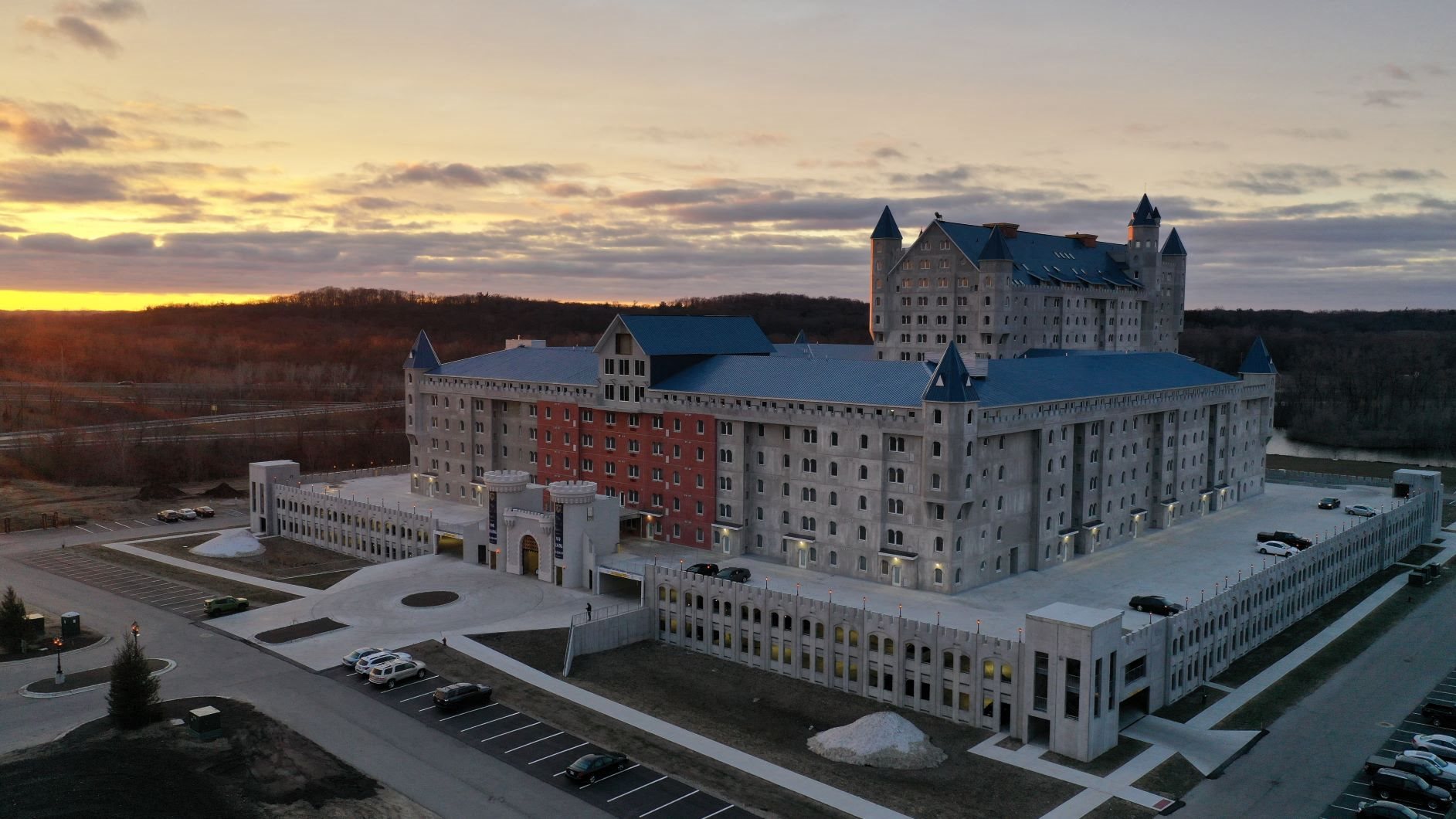
I think that I'm missing something here unless there happens to be an infinite supply of people looking to move to your city.
I'm not sure what you mean by tax difficulties, if you mean the state has trouble raising revenue, that's certainly not the case. CA is running a large budget surplus right now. If they only relied on property tax it could be an issue, but they also have an income tax, so the revenue outlook in CA is pretty good right now.
The nice thing about property taxes is that housing prices change slowly, even in boom/bust cycles -- essentially they are coupled to a dashpot. While income, especially in California with a progressive system coupled with most of the high earners paying cap gains, leading to large swings (further influenced by the Fed).
Also property taxes are the main source of municipal and school funding; with property taxes artificially pulled low, the state needs to step in instead. In addition, the structure of Prop 13 discourages people from moving which reduces the availability of housing stock.
Prop 13 wouldn't be so bad if it excluded commercial buildings (including rental properties) and didn't have the huge inheritance loophole. But neither of those is likely to change.
The reason I mentioned the coupling between prop 13 and exclusion: Californians voided all restrictive covenants in the 60s, which lead to more selective zoning restrictions; Prop 13 came from conservative southern californians and (due to the stickiness mentioned above, including a retroactive valuation reduction and the inheritance loophole) locked a lot of "those" buyers out of the existing neghborhoods.
On the other, I agree that it’s ridiculous someone can be paying 10-20% what their neighbor pays in property taxes, and that this causes an inefficient allocation of resources.
If we ever want to solve this we IMO need some kind of gradual phase out. We can immediately/over a 5-20 year interval move the taxes to what they should be on commercial and non-primary residences. But for actual primary homes probably the only way we can do it is if we let the property taxes be deferred until the current homeowner dies. No matter how much pain the policy causes we must under no circumstances cause a single grandma to lose her home.
Where I live now has a couple of nice options for aging in place – dedicated 55+ apartment building, with government support for low-income; and a co-op where the units are smaller but they have more shared space. A lot of older neighbors have spoken glowingly the latter because it's all ages and it since they see their neighbors more they don't feel lonely the way someone in a detached suburban home might. I wish we'd build a lot more stuff like that where someone has an option which doesn't break the bank and avoids those other downsides.
Prop 19 passed in 2020 IIUC partially solves the problem you mention because people 55+ can maintain lower tax rates after moving, but of course it is just a bandaid. Definitely the better solution would be for the real estate market to not be so expensive that people can’t afford to move/live in the general type of housing they want though.
My knowledge is stale - I moved away from California a decade ago - but I think you’re right about downsizing at least to the extent that they can actually find a cheaper place.
There's a "homesteading exemption" for taxes on a primary residence. This means your property taxes can't shoot up massively if your property suddenly gets more expensive.
This pushes even more of the property tax burden onto investment properties, which sounds good to some in theory, but one affect it has is that rental properties are investment properties. So rents go up a lot. This means renters end up paying a lot of property taxes, which is, uh... a surprising outcome.
Prop 13 is IMO the biggest problem that California faces, because it’s the most intractable to solve (it would be political suicide to try to roll it back now that so many people are paying way lower taxes than they would without it) but is also a major contributor to a lot of other problems in the housing market. I can think of ways to roll it back slowly, but let’s be real, people will freak out if they think they’ll have to start paying 5x what they currently pay in property taxes, even if it’s after they die or in 20 years from now.
https://taxfoundation.org/state-property-taxes-per-capita-20...
California property taxes for $1620 per capita, which is average. How does this translate to “so little tax from property”?
It should have a better mix of tax sources.
Remember the size of the state’s economy and population would make it one of the large EU countries.
IMO Prop 13 is at the root of a lot of dysfunction in CA, but personally I hate it because these extra income+sales taxes put a lot of tax burden on new residents and young professionals.
Mountain View has much more around the San Antonio Shopping Center where it's starting to look like SF.
I'm wondering if there will be random developments that will sink property values because big city blight comes with : homeless camping, property crime, and so forth.
Palo Alto is unique in California in that it is/was legal to dwell in a vehicle because it wasn't criminalized since the law had to be rolled back due to a Ninth Circuit ruling about another law in LA.
China has a lot of options for cheap housing, none at all legal, but rule of law isn’t really a thing there so just keep things quiet. In Beijing, you can rent a windowless sub-basement room for a few hundred kuai a month, mold is an issue, but it’s better than other options. Waitresses also often crash on the floors of the restaurants they are working in, so the windows are all blinded over in cardboard after closing time. This is all working poor, it is really hard to be a vagabond in China because the social safety net just isn’t there for it (and you can’t just crash under an overpass because the police are already in to that).
Prop 13 uses assessed value, but only allows unlimited assessment increases at sales, some other non-exempt transfers, and a few other qualifying events, otherwise, the year-over-year increase in tax basis value is limited to 2% or the rate of inflation, whichever is lower.
But, also missed in most discussions of Prop 13, is that it capped property tax rates at 1%, which (even before considering the value missed by the assessment cap) is not only way below the common rates prior to Prop 13, its way below the national average effective property tax rate.
Prop 13 isn't a result of exclusive zoning, it is—like exclusive zoning—a measure that protects status quo elites at the expense of everyone else.
> For example, Calaveras county has a shrinking population, but the main sources of jobs and taxes is construction. With no constraints on construction will there be a small boom in new development, tearing down virgin forest in order to make empty developments?
Neither Calaveras County nor any city therein has a cnonompliant housing element, so “no constraints” due to builder's remedy is not an issue. OTOH, other places in the state getting more housing is more likely to accelerate Calaveras County population loss.
Palo Alto has fought these rules and I'm glad they will be enforced. When I first moved to Palo Alto in the early 80s it had a very progressive climate: a couple of SRO buildings, lower average income than some of the neighboring towns, a lot of social support programs, and decidedly un-fancy retail. But the flood of gold-seeking people who showed up for the dotcom boom allowed the real estate interests to seize control of the city council and in general made the town much snootier. The SRO hotels turned into boutique hotels and a lot of long term residents were ejected. Well those assholes are reaping what they have sown, thank goodness. Perhaps we'll recover some of the chill experimental vibe thanks to an influx of new people.
I hadn't realised the housing shortage issue stretched back decades. It sets an interesting context for Prop 13 (basing the tax base on the purchase price, not generally on assessed value) since the zoning rules were so exclusionary. Basically, shows that the State's tax difficulties are themselves the consequence of exclusion.
I wonder how this will work outside the dense areas. For example, Calaveras county has a shrinking population, but the main sources of jobs and taxes is construction. With no constraints on construction will there be a small boom in new development, tearing down virgin forest in order to make empty developments?