This is one of those infosec tenets that is technically true but functionally unhelpful. Like correct-horse-battery-stable debates.
The claim is that IPv4 + NAT + bad firewall is better than IPv6 + bad firewall.
Yes, both are insufficient and inferior to a good firewall - but how confident are you that you never interact with a bad firewall?
Sure, big IaaS providers like AWS put you in a VPC by default. But most servers on the net are not hosted in an IaaS; they're hosted using a VPS or bare-metal hosting provider, or just coloed in a DC by their owner. And in all those cases, what that kind of deployment gets you, is a public IPv4 per VM/machine, that anyone on the Internet can march right up and talk to, where it's the responsibility of the machine itself to reject incoming packets (i.e. at the OS level with a kernel firewall.)
NAT on IPv4 is only really a default assumption for residential networks. Anywhere else, it's pretty much like the movie WarGames: even the mainframe has a phone number you can call. Staying on IPv4 isn't making anyone safe.
From your very last statement, I think you've confused self hosting (like buying a VPS from Digital Ocean and hosting your own blag) and how the real world works (like going to Dell.com and ordering a new laptop). "The mainframe" these days is almost always behind a L4/L7 load balancer or other network device and very rarely directly addressable.
On some ISPs, all the customer routers in a given area are placed in a large legacy subnet, so if another customer adds a manual route to RFC1918 space using your router as next hop - the traffic will arrive on the WAN interface of your router. Some routers will actually route this traffic inside.
Have you ever tested this and verified that your router doesn't do this? Probably not, because most people haven't. They just assume that it can't, and get a nasty surprise if someone demonstrates that it can.
By and large, our very-much "real world" customers are "self hosting" — usually on bare metal rather than a VPS, and usually with providers you've probably never heard of (ColoCrossing and ServerMania seem to come up fairly often among our US-based customers.) These hosting providers are all very much in the style of "you lease each machine as a separate contract; each machine gets one public IPv4 address included in the cost; private networking [i.e. an explicit VLAN] is an extra optional feature you can enable after the fact, and only works between higher-end machine types, rather than being a given, because our lower-end machines only have a single NIC in them [besides the one that's part of the BMC used for IPMI]."
What I assume is happening here isn't literal "self hosting" — these random non-IT-oriented customers wouldn't know the first thing about it — but rather that a given customer of ours has paid some "vertically-integrated IT consultancy" to both build and host their service for them; and said consultancy has chosen to use bare-metal hosting to host the resulting service, to minimize their own OpEx, and therefore maximize their margins. (In fact, I bet they're often packing several such customers onto a single box.)
---
Also, in a more professional capacity, I investigate the hosts behind IP addresses behind bulk-registration / DDoS attacks against our platform, in order to create signatures for them. Given the way some of these attacks seem to work, a large number of machines on the Internet — especially in Russia and [some parts of] Africa — seemingly aren't only un-NATed, but in fact have a public /24 or even /22 directly attached to a single box! (If traffic was originating from a random subset of a /24, it could just be someone spinning up a hundred VMs on top of some small colo's OpenStack deployment, sure. But tandem traffic from every IP in a /24, and only exactly said /24? That looks pretty much exactly like the sort of tandem IPv6 traffic that is generated when a box has a /48 or /56 assigned to it.)
Even that is not true:
- It takes half-minute to scan an IPv4 public IP (NAT) for vulnerabilities.
- Good luck and have fun to scan a /64 for a potentially vulnerable machine. See you next century.
- And if it is not enough: most internet box support UPnP/NAT-PMP that allow any malware to get your NAT wild opened.
So say Alice is behind a crappy NAT and wants to talk to Bob. Alice's router opens a port on its edge, lets say 1234, and sends traffic to Bob on port 80.
Let's say Charles knows Alice's IP address. Charles starts spamming Alice's router, eventually hitting port 1234 with bad data.
Alice's router is dumb. It sees traffic on port 1234, checks its NAT table, and sees that data is supposed to go to Alice. It happily rewrites that packet and passes it along to Alice. Now Alice is getting traffic from Bob *and* Charles. Uh oh!
Many game consoles are explicitly designed around this bad, broken behavior. You'll open a port to the matchmaking server and then the matchmaking server will tell people to connect to that IP address and port combination. Crappy home routers will happily route that data through its NAT configuration to the console despite the console never explicitly opening up traffic to those other parties. This is why some game consoles will complain about closed NAT versus open NAT.
While in principle that is possible, in practice almost all home routers are based on Linux, and Linux netfilter NAT implementation distinguish connections based on port and IP, not just port, so this would not work.
The poke a hole to outside world to a random server, log the port allocated to you by your router and have someone else use this to connect to you is the basis of STUN protocol.
BT, one of the largest ISP's in the UK, only allow the configuration of destination IP and external/internal ports[0].
I've never expected my NAT to do anything other than map ports. I can see why the ability to map source IPs to different ports would be useful but relying on that as a security feature feels like a foot-gun. I wouldn't feel comfortable exposing an application that doesn't have some form of authentication and/or blacklisting.
[0] https://portforward.com/bt/home-hub-6/Port%20Forwarding.jpg
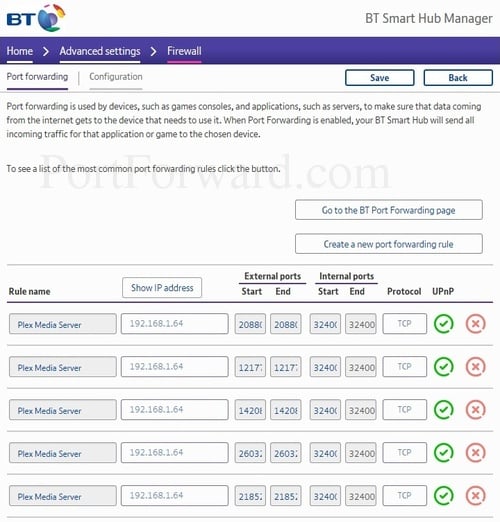
A naive NAT implementation can allow an attacker to bypass the firewall.
NAT is not a substitute for a firewall.
I don't understand why you'd need a firewall if
- you trust devices on your network (yes, big if, but even then: the only reachable ports of a machine from the outside are those explicitly open to the outside, most stuff listens to 127.0.0.1 anyway)
- you only configure your NAT to forward ports you would open on your firewall
I didn't think of my cable modem as a firewall. Maybe technically it has one to provide the feature of blocking access to its web interface from the world, or maybe it just listens to the right network. I don't know, but for all intent and purposes, setting up a firewall myself does not seem necessary.
To be fair, I was also a bit annoyed by staringback's phrasing.
I make sure what I build supports IPv6 (and I'll use tunnels if it's what it takes) but I can't make the only cable ISP available at my place support IPv6. I wish it did. I wish I didn't have to use its garbage hardware.
NAT is absolutely not in any way a substitute for an actual firewall, despite the side effect of 'blocking' ports.
And how is "You have to think about which ports you want the NAT gateway to forward." any different from thinking about firewall rules?
And most consumer CPE devices (i.e. 'router' etc) are perfectly capable of running a firewall, and often do.
And any firewall that doesn't drop inbound traffic by default is not really much use at all.
And lastly, if you want you can still do NAT66 if you really must, or IPv6 network prefix translation, which is a slightly improved version.