That still has to be in the millions or billions of acres globally. No?
While local conditions don't perfectly extrapolate to the world, remember that 100% of my acres grow human food when observed over the span of more than one year. The 35% animal food production seen in a single year is the outcome of the crop rotation.
Certainly, I'd be far more profitable if I could reliably grow beans for human consumption over and over and over, but Mother Nature is a harsh mistress.
Technically it can be extracted from the same seawater it's running off into, but IIRC that hasn't been demonstrated in a cheap enough way yet.
Your split of 60/40 human/animal split for soybeans is accurate on a calorie basis. I just though I would add some color as to why it is the case… the beans are split.
That's the 40% I referred to. Crushers, while less profitable, are a better fit for my poorer ground. I lumped this in as animal food to keep things simple, but you're right that there is also human uses. You could write books about the subject if you want to capture all the details.
The 60% are food grade (IP) soybeans, which generally end up as tofu, soy milk, and other foods where the soybean seeds are eaten whole (more common in Asian countries).
Are IP beans kept moist or sold dry?
https://ourworldindata.org/land-use-diets
Half of the world’s habitable land is used for agriculture ... and 77% of it is used for livestock: meat and dairy
https://ourworldindata.org/land-use
More than three-quarters (77%) of global soy is fed to livestock for meat and dairy production. Most of the rest is used for biofuels, industry or vegetable oils. Just 7% of soy is used directly for human food products such as tofu, soy milk, edamame beans, and tempeh.
While true, we are talking about cropland, not agriculture land (e.g. pastures). Nowhere near 50% of the world's land area is suitable for cropland.
Other arable land is used for animal feed production, and together with grazing land represents the other 77% of agriculture land (37 mil. km2), which supplies 18% of global calories and 37% of proteins.
Those 23% (11 mil. km2) of agriculture land, crop land, is capable of producing 82% of global calories and 63% of proteins.
https://ourworldindata.org/uploads/2020/01/Global-land-use-g...
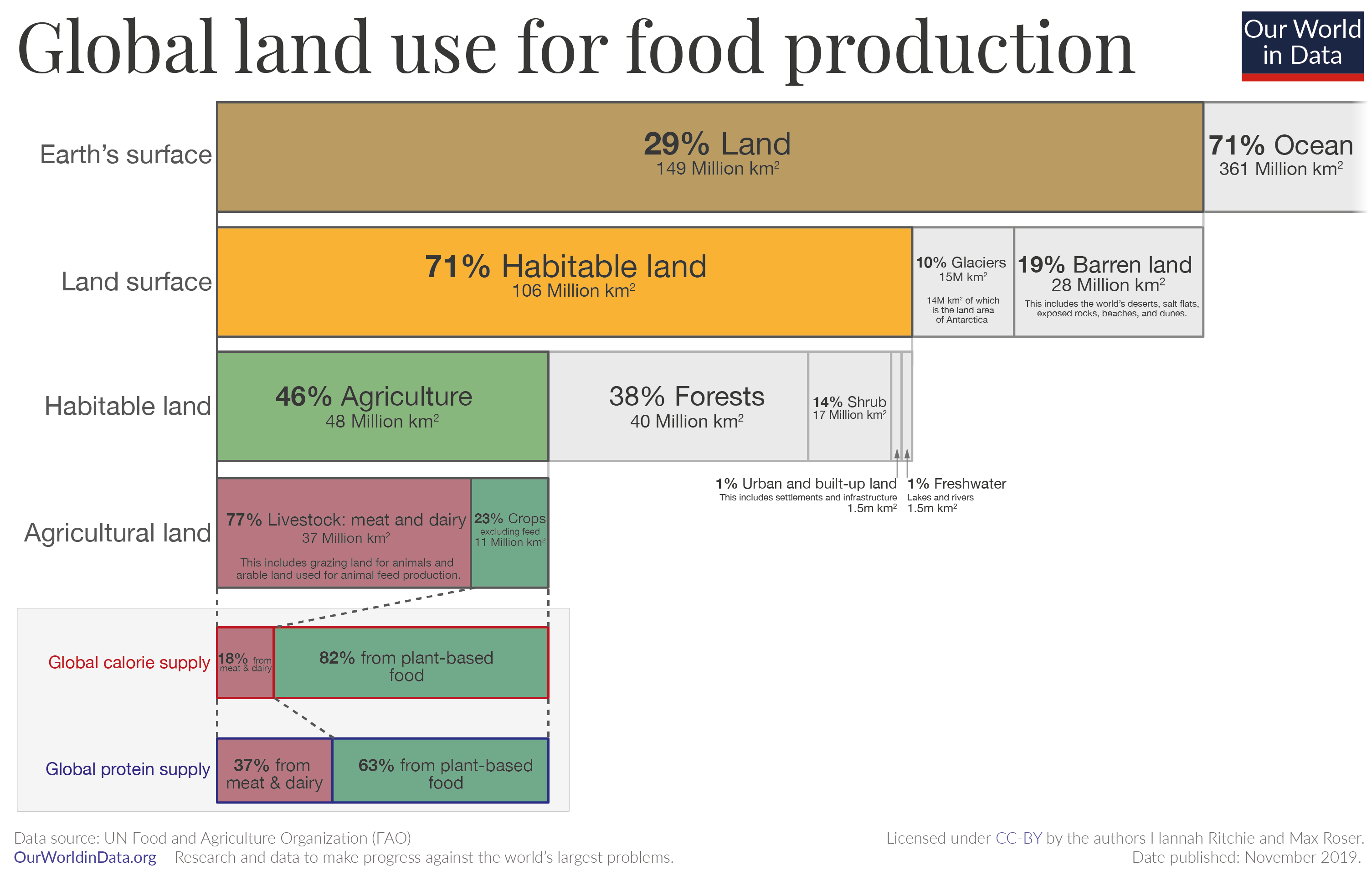
Right, and since we're only talking about cropland, that 77% has no relevance to the discussion. That it keeps coming up is rather bizarre. Indeed, if you keep pounding a square peg into a round hold hard enough it may eventually go in, but one sure does look silly for doing it in the first place.
https://www.renewmethod.com/post/what-is-arable-land
"Arable land is classified as land that can be plowed for the purpose of growing crops."
Please, look at the graph one more time.
Wrong.
> ~60% of the soybeans are intended for direct human consumption and ~40% for animal consumption. I imagine that is not atypical
Wrong.
> around 35% of the output ... for animal consumption, which is effectively what the real world data also shows ...
Wrong.
> Nowhere near 50% of the world's land area is suitable for cropland.
Wrong.
> Your own link suggests that only 23% of agricultural lands are suitable for cropland.
Wrong.
> Arable land includes meadows, pastures, etc. Animals can (and do) eat from those lands, but cropland is more specific
Wrong (in the context of) https://ourworldindata.org/uploads/2020/01/Global-land-use-g...
> Your weird tangent ...
It's called logic. I give up.
> Eloff: ... won't need to raise animals or food for animals ... we could rewild huge parts of the Earth
> randomdata: probably not ... 36% of the cropland is used for animal food ...
Even if we kept all the arable land for human consumption (to compensate for missing meat, assuming the lab-grown meat will take some time to scale) we'd have 3.3 billion hectares of pastures to rewild/reforest. Or we could reforest those 35% of arable land we use for growing animal feed and instead use a fraction of pastures for nuts/fruit production.
https://ourworldindata.org/grapher/global-pasture
Forests cover 40 mil. km2, and animal agriculture takes 37 mil. km2. Majority of plant-based foods is produced on 11 mil. km2. By switching to plant-based we could increase forest cover from 40 mil. km2 to 70+ mil. km2.
"We might even address the very real disaster scenarios presently threatening the world with questions like these: "What if you could make a simple and compassionate change in your life that would increase available farmland, increase available clean water, reduce rainforest destruction, reduce greenhouse gas production, reduce the threat from antibiotic-resistant bacteria, decrease land and waterway pollution, prevent creation of ocean dead zones, end your participation in the deaths of sentient individuals and increase overall human health by switching to a plant-based diet? Would you do it?” This is the reality we actually live in, and this is the choice each one of us faces."
https://yourveganfallacyis.com/en/vegans-would-eat-meat-on-a...
OFF-TOPIC: we should reforest some deserts/barren areas as well
Probably not without radically changing how we grow plants for human consumption, assuming we still eat plants and don't move to an all-meat diet.
Looking over the data for the area I farm, according to government figures, 36% of the cropland is used for animal food. Most farmers here grow a rotation of soybeans, corn, edible beans, and wheat. The edible beans and wheat are intended for direct human consumption. I couldn't find an exact breakdown for soybean use, but on my farm ~60% of the soybeans are intended for direct human consumption and ~40% for animal consumption. I imagine that is not atypical. Corn is primarily intended for animal consumption.
A little back of the napkin math and you get somewhere around 35% of the output after a four year rotation on my farm being intended for animal consumption, which is effectively what the real world data also shows.
The rotation is important to maintaining soil health and keeping disease at bay. I don't see that going away, save further technical advancement, so you'd probably just see the corn shift to something like biofuels if animals weren't eating it to maintain the rotation to grow the human food.