Can I have transcription that can then turn my rambling into neat and concise prose?
The story for the most mainstream-popular dictation softwares is kind of funny. Back in the late 90's there was Dragon NaturallySpeaking and IBM's ViaVoice. In early 00s, after a financial fraud and bankruptcy involving both the then current Dragon owners and Goldman Sachs, they got bought by Scansoft. Scansoft bought Nuance, began to use its name, and then got exclusive rights for ViaVoice (!) from IBM.
Now, in March this year, Nuance has been acquire by Microsoft.
Training data is now abundant compared to twenty years ago, and so is computation power. That means training can be much more complex now.
The underlying technology is now typically neural networks (broadly speaking), whereas twenty years ago it might have been Hidden Markov Models.
Overall, recognition quality, even without speaker-specific training, is now on a very different level than back then. Whether it’s considered good is a matter of opinion. But it’s significantly better than twenty years ago.
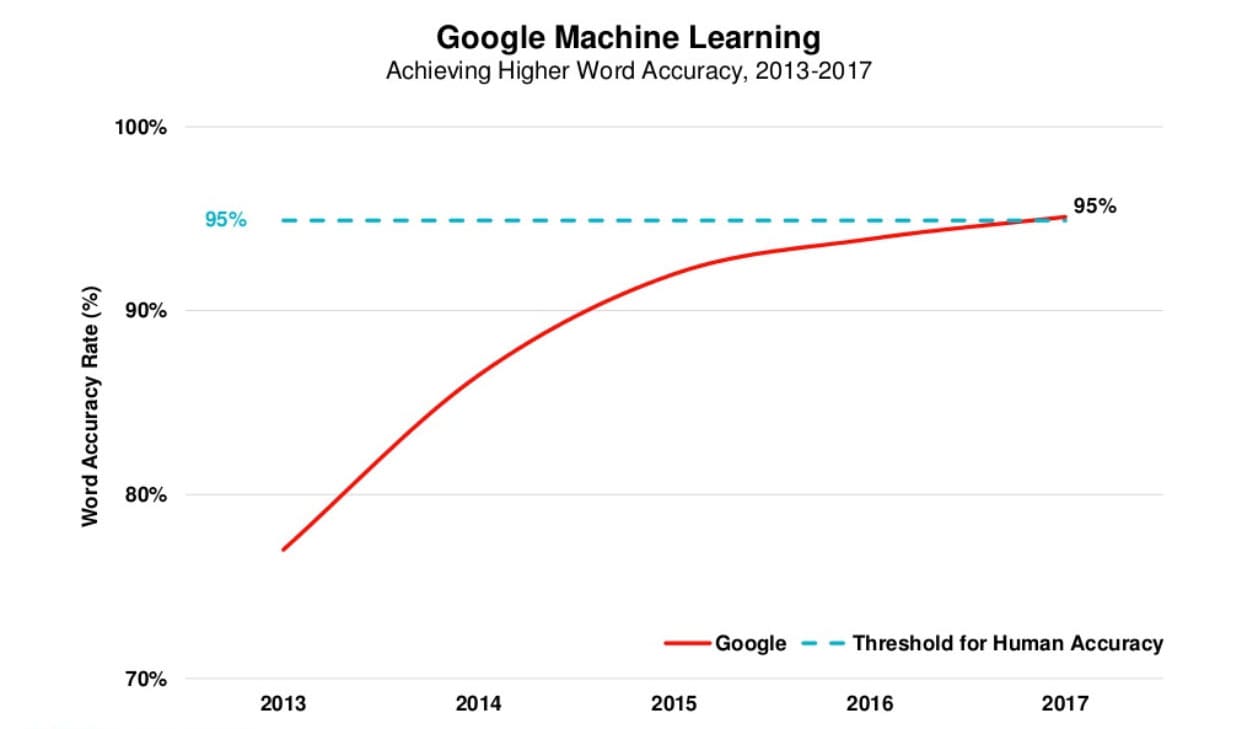
It's hugely significant - look at this graph of Google's speech model accuracy across 2013 to 2017:
https://sonix.ai/packs/media/images/corp/articles/history-of...
Or this that shows a similar pattern:
https://cdn.static-economist.com/sites/default/files/externa...

1) Improvements in speech to text, as others have mentioned
2) Improvements in language models (and model size) allowing for more flexible interpretation of speech. This isn't dictation anymore. It's more like instruction. You don't have to tell the computer exactly what to write, you tell it in much more broader terms. Eg "pull this out into a function". Or "delete the cookie before creating the transaction". Or "lint the file".
That's my guess anyways! This mostly feels like a voice interface to Copilot in a lot of ways. Can't say whether it'll be effective, but I'd love to be able to program while I'm e.g. on a stationary bike!
Then it seemed to just die off. I don't think it was bad technology, because I don't think novelty value was enough to account for its popularity - you had to put hours in to get it to work well, it wasn't a casual toy.
What's changed since then in terms of technology? Unless it's very significant, I suspect it will go the same way. Apart from an assistive technology viewpoint, my gut instinct is that it's not that satisfying or rewarding talking to a computer all day.