They just pushed pollution elsewhere, by outsourcing manufacturing.
The same goods (and better goods) take less energy and pollution to produce than in 2000, and a lot of physical goods have been effectively replaced with features in digital devices; and the main part of GDP growth for developed countries does not involve any growth in consumption of goods but rather the consumption of services - the shift from an industrial economy to a service economy has quite fundamental impact on the nature of growth.
But thanks to the rebound effect we make/sell/trash more of them
Like with airplanes, it doesn't matter that Rolls-Royce make their engines 5% more efficient every 10 years if in the meantime you have 4 times as many plane flying.
That's a good trend if true.
> The amount of greenhouse gases linked to goods and services consumed by UK households, including emissions from the foreign manufacture of imported products, rose by 3% between 2012 and 2013, the most recent data shows. But the figures are almost a fifth (19%) below the peak seen in 2007, when UK consumers were responsible for nearly 1.3bn tonnes of greenhouse gases.
[0] https://www.theguardian.com/environment/2016/aug/02/uks-carb...
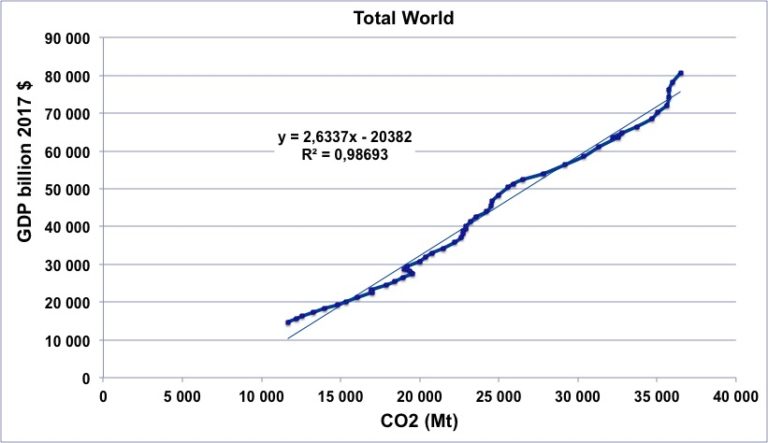
Only because we delocalised all the industries to Asia, globally co2 = gdp, before and after 2010
https://jancovici.com/wp-content/uploads/2019/02/GDP-CO2-wor...
https://www.researchgate.net/profile/Gabe-Scelta-2/publicati...

https://eeb.org/wp-content/uploads/2019/07/Decoupling-Debunk...
In theory. In practice GDP growth is strongly correlated with things like energy use and waste/pollution generation. There will come a point when either that correlation has to be broken or growth has to halt.