I don't think computer-generated works will be easily distinguishable from human unless they're desired to be or shipped with metadata. It's already hard enough to distinguish human artists from other human artists without having names attached up front.
Yes, and tracing counts as art fraud.
Collage is a bit different, because you are mixing many clones of many other objects such that you create a new object; additionally the way you assemble the clones may transform them (a photo of the mona lisa has different surface texture than a painted version, even more different if it is clipped from newsprint), but while the borders of this are not clear, it is clear when people are far enough over the border. Think of hip-hop, sampling, and remixing music, and some of the legal battles which have come out of that.
I just spit out my coffee, turns out I'm not a bad artist, I'm actually a fraudster!
Yeah I am sure a lot of lawyers are going to have a lot of fun arguing every way imaginable.
Deep learning is very powerful and impressive in its applications to date. However, it’s so saturated with hype (and humans are so prone to anthropomorphizing things) that it’s often viewed as something much more profound than it actually is. Neural networks, despite their name, don’t model the brain. And they lack a whole array of “intelligence” features that humans possess and use constantly.
All of this is to say that there are very significant differences between computer algorithms and human cognition, and I tend to think the legal system will be unpersuaded by arguments that ignore those differences.
Also, this is to say nothing of the public policy interests that shape the law. Regardless of what’s “under the hood,” the law can simply treat human and machine output differently. I’m not a copyright lawyer, of course, so I can’t speak to the norms or technicalities of copyright law itself.
There are a lot of things we don’t know, but it is not magic. There is no discussion that artificial neurones don’t have much in common with the real ones, which are very non-linear and much more connected. But in the end it’s all electrochemistry.
> Neural networks, despite their name, don’t model the brain.
But that’s not directly related to my point. My point that even in the case of a ML model, you cannot get an exact reproduction any more than you can get from a human’s memory. In one case it’s scrambled somewhere in someone’s brain, in the other on a hard drive but the difference is not really relevant. Subjecting an AI’s production to the copyrights of all the things it’s been exposed to is very similar to subjecting a painter’s production to the copyrights of all the painting they have seen.
That’s an element of a belief system you may choose to subscribe to, not a fact. It can’t be a fact because there’s no way to prove or disprove it.
> “My point that even in the case of a ML model, you cannot get an exact reproduction any more than you can get from a human’s memory.”
Not quite. ML models can and do memorize and regurgitate near-exact features of the inputs. It’s not the goal, but it happens.
Will the same image be legal if a human made it but not if it was created by Stable Diffusion? How will someone even know, short of a legal discovery process?
The model is open source and free for people to make their own modifications. I don't see how any watermark can survive in those conditions.
All this is super, super interesting to me. I don't think anybody really knows how it will play out, there's a lot of good arguments floating around.
In the (actual) neurons, is there a representation of real numbers? Where are the numbers in the brain stored?
I feel like people who assert this neither understand what neural networks are and how brains work.
None of these details are relevant to the bigger picture similarities of non-hardcoded learning from training data. None of these details change the ethics of what's being discussed here.
> I feel like people who assert this neither understand what neural networks are and how brains work.
That's just your bias showing.
Don’t they, though? What else do you think is behind the curtain if not mathematics?
We don't actually know exactly how human artists learn, and human artists are capable of innovation, nobody knew pointillism or Bauhaus before they were invented.
A little know fact is that for humans it takes a long long time to learn, while they learn, they develop a style, if they don't they are not "real" artists, but merely executors, artists evolve, sometimes dramatically, in unexpected ways [1] [2].
So for us humans learning is an experience, not just recombining parts of features of other things.
We are also highly influenced by feelings, unfortunately, so sometimes we do things a certain way because we felt that way, not because we wanted to paint that thing that way, or because we are not good enough to do exactly what we wanted to do.
Is Mona Lisa happy? Who can tell?
Was Leonardo happy when he painted it?
What was Leonardo thinking when he painted it?
What was happening in his life?
Is that the best smile Leonardo could paint or it's an enigma he put there for future generations?
These questions are more important for an artist than the mere features of the painting.
The philosophical question is: is art discovered or invented?
If it's discovered, then SD can generate art, if it's invented, than SD it's not even generative work, because to invent something from something else, you need inventiveness.
[1] Picasso 1896 https://mymodernmet.com/wp/wp-content/uploads/2018/01/pablo-...
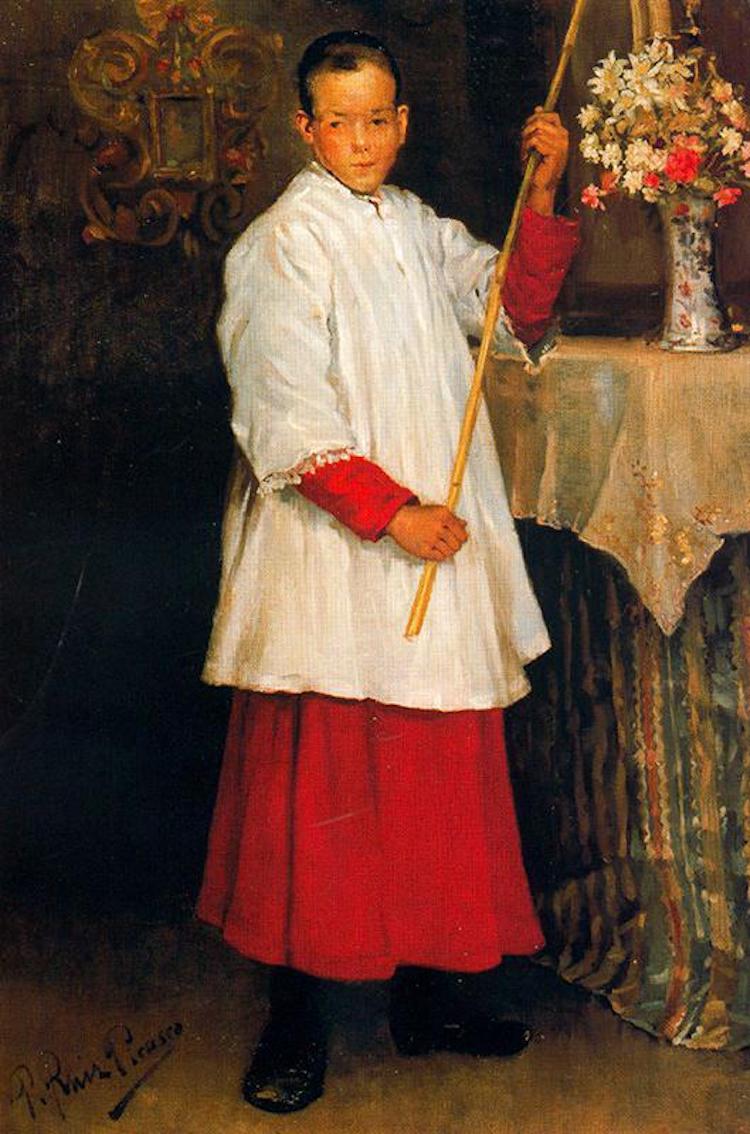
[2] Picasso 1946 https://www.photo.rmn.fr/CorexDoc/RMN/Media/TR1/MS4GY/16-515...

The fun part is, this is how human artists learn too.