News for hackers. Stuff that matters.
Re:Silicon Valley bets on new transport to counter the rise ... by dekhn on Wednesday July 13, 2022 @08:14PM (#32090372)
This article (https://archive.ph/G6V9m) is a joke. New transportation in Silicon Valley? Downton SJC and Diridon BART isn't expected completion in 2030 and at best, it opens up commute options for some employees.

What I would like to see, impractical as it may be, would be a full BART ring around the bay with trains constantly running (15m interval) 20 hours a day. While we're at it, please take the fentanyl sleepers off the train, thank you.

Re:Silicon Valley bets on new transport to counter the rise ... by ceeplusplus on Wednesday July 13, 2022 @08:43PM (#32090585)
Trains already run 15-20m interval at peak hours. The issue is not the interval but rather the average speed of the trains. In China the subways run at max speed everywhere. In the Bay NIMBYs complain so the only places it runs at 80mph is in tunnels and in places where nobody lives (like Union City - Milpitas). There's a section in Oakland where the train is next to a freeway and you can literally drive faster than the train because the train is going 25 mph.

Agree with you about the fentanyl sleepers though. And take the aggressive beggars and people smoking weed off as well, then it'll be usable for actual transport like the subway is in China.

Re:Silicon Valley bets on new transport to counter the rise ... by dekhn on Wednesday July 13, 2022 @08:51PM (#32090647)
Fair point about the speed, but what I care about is minimizing travel time variance, not minimizing total travel time. I thought "setting your watch to a swiss train clock" was a joke and then in Zurich, the train literally stopped in front of my on the second it was supposed to arrive. The leadership in SF has not the will to make such a thing happen.
Re:Silicon Valley bets on new transport to counter the rise ... by eek2121 on Wednesday July 13, 2022 @08:47PM (#32090618)
What do you have against weed?
Re:Silicon Valley bets on new transport to counter the rise ... by ceeplusplus on Wednesday July 13, 2022 @08:48PM (#32090627)
The smell, mostly. I dabble too but in my own home where I'm not stinking up a train car with 20 other people in it.
Re:Silicon Valley bets on new transport to counter the rise ... by compiler-guy on Wednesday July 13, 2022 @11:37PM (#32091715)
The same thing I have against tuna salad sandwiches. It’s fine if you want to stink up your own home. Knock yourself out (so to speak). But don’t make others deal with your stench.
Re:Silicon Valley bets on new transport to counter the rise ... by WesternWind on Wednesday July 13, 2022 @08:32PM (#32090494)
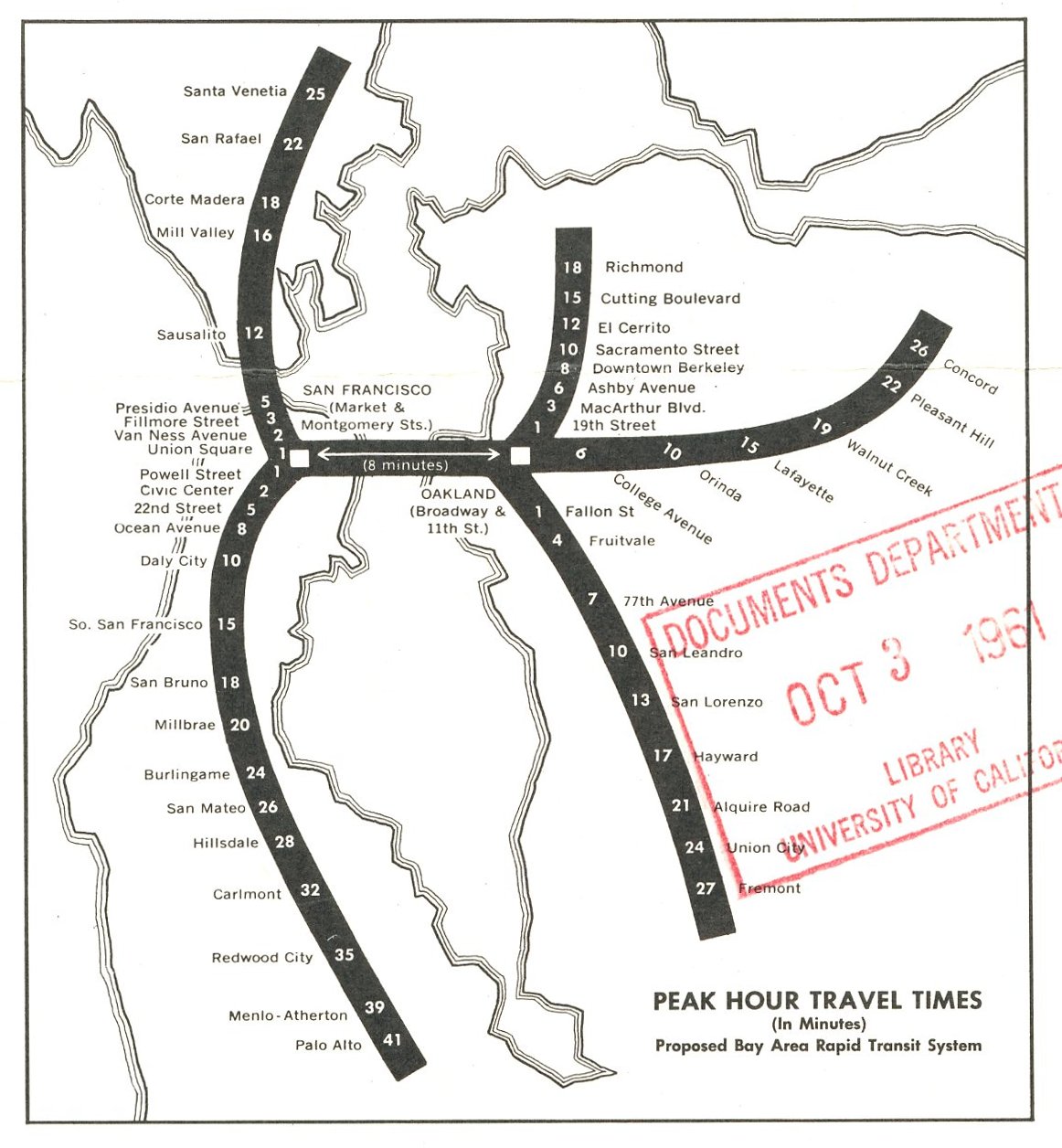
Here's a document from 1961 that shows planned bart stops. Not quite a ring, but it's interesting how many of these places ended up as caltrain stops instead.

Of course the north bay just noped out on anything like that.

https://farm6.staticflickr.com/5057/5423961825_2d5af7cef4_o....
Re:Silicon Valley bets on new transport to counter the rise ... by junar on Wednesday July 13, 2022 @08:35PM (#32090518)
Caltrain wasn't created out of thin air. They took over an existing train service that operated well before BART was even contemplated.

https://en.wikipedia.org/wiki/Peninsula_Commute

Re:Silicon Valley bets on new transport to counter the rise ... by dekhn on Wednesday July 13, 2022 @08:46PM (#32090610)
It's kind of funny to walk around car-saturated streets in Berkeley and think "there was once a streetcar running on this street and another train that crossed the bay bridge" https://en.wikipedia.org/wiki/Key_System
Re:Silicon Valley bets on new transport to counter the rise ... by FunnyBadger on Wednesday July 13, 2022 @09:01PM (#32090714)
I grew up in Marin and was a teen when the BART tax referendum occurred in the 1970s to extend BART into Marin. I remember the arguments against it (which carried the election):

"We don't want people from Richmond and Oakland being able to come into Marin!"

Well back then just like today, there is a distinct ethnic group this obviously refers to.

That was the primary argument against it - we don't want blacks in Marin (unless they are "house blacks" living in Marin City which used to 99% black in the 1970s - it's been gentrified a lot since then).

Even as a teen I knew exactly what they were really saying and I found it disgusting but it also made me aware of the fact that the most racist people are not Klansmen in white robes - it's progressive liberals and this was only my first experience with that. I've had plenty more since then over the decades.

Marin county is full of racists. It's a large part of why I'd never live there despite how I will partially inherit my mother's house there (it will be sold off instead). You can talk to black folks driving through Marin about how they get followed by the police and often get warned to get out of the county ASAP if they want to avoid trouble.

It's a large part of why I always lived on the east side of Silicon Valley (East SJ, Milpitas, Fremont, etc. where being "white" made me a minority) instead of the whiter west cities like PA, MV, SV, Cupertino, etc. You still hear to this day comments like I heard in Marin from people in these cities! We don't want "those people" from "over there" around here!

It's a large part of why I no longer live in California and have no intention of returning despite being a native born California with all my remaining family still in California.

Re:Silicon Valley bets on new transport to counter the rise ... by dekhn on Wednesday July 13, 2022 @09:15PM (#32090807)
I'm glad the people in who lived in Berkeley/Albany voted to have BART (although I curse them for not paying to have it undergrounded. The whoosh and squeaky wheels used to wake me up every morning.

Speaking of racism, I found out recently that my ex-landlord's grandfather was also a landlord in San Mateo, in the 1950s implemented racial exclusion deeds: https://www.nytimes.com/2020/08/14/opinion/sunday/blm-reside...

and as a coincidence, while looking that up, I found: https://www.foundsf.org/index.php?title=Bohannon%E2%80%99s_C...

which suggests he may have also opposed BART in San Mateo on racial grounds.

Re:Silicon Valley bets on new transport to counter the rise ... by pyinstallwoes on Wednesday July 13, 2022 @09:09PM (#32090783)
Where did you move to or where abouts? Thinking of getting out of Cali myself. It’s hilarious and sad how true it is re: progressive liberals being racist. Do they not see their hypocrisy? Oh well.
Re:Silicon Valley bets on new transport to counter the rise ... by Lammy on Wednesday July 13, 2022 @10:58PM (#32091492)
> a full BART ring around the bay

They took this from you: https://i.imgur.com/hon9nEf.jpg (1956)

Re:Silicon Valley bets on new transport to counter the rise ... by pj_mukh on Wednesday July 13, 2022 @09:51PM (#32091060)
And Marin, Please!

Also is there any reason the 15m can’t be popped down to 5min? Plus regular weekend service.

I would dump my car in a heartbeat (voila, traffic problems solved!)

Re:Silicon Valley bets on new transport to counter the rise ... by IIAOPSW on Wednesday July 13, 2022 @08:48PM (#32090626)
What a sad indictment of the situation that your wild fantasy system has 15m headways. 4 Trains Per Hour. That's borderline unusable. 10 TPH is what I'd consider tolerable. 18 TPH is what I expect from first class cities in developed countries.
Re:Silicon Valley bets on new transport to counter the rise ... by dekhn on Wednesday July 13, 2022 @09:06PM (#32090751)
Remember, the United States already built a full train infrastructure with excellent times almost a hundred years ago, and removed it because at the time cars were a good alternative. I've seen that many rapidly developing countries are seeing massive increases of car purchases by a new middle class. So I figure we just are about 50-75 years ahead.

To me 15m with a 1m variance is pretty usable. A typical trip on BART (it's intercity) is going to be 30-40 minutes, and in many parts of the system you have multiple train options, which also reduces the wait time.

To build some new train that works in SF, here's what you gotta do. https://en.wikipedia.org/wiki/Central_Subway Now that is about $1B-2B in building prices to go underground 1.7mi. Oh, that was built to replace a freeway that was torn down in 1989 after an earthquake. So we're just about to see the infrastructure replacement about 30 years later.

You can stop nearly any public transport project by using the state's EIR (IIRC the BART extension to the airport was slowed because of some endangered frogs).

Another issue is that many PT projects are pork-barrel. The route of the "high speed train from LA to SF" is a nice example of this; the train will not be high speed for the popular sources and destinations, because the central valley obtained concessions about the routing. It will probably never see ridership to justify its costs, and major contribution to that is that it can't bring people from downtown LA to downtown SF quickly. I dunno. does the shinkasen make a detour to rural agricultural areas? What about high speed trains in China? Do they go through second-tier cites?

My point is that while the US/SF is a first class city in a developed country, it lacks the political will to make great public transport, has trouble raising the funds to pay our very expensive building costs, and the alternatives are "just good enough" that the populace isn't super keen on large amounts of spending of PT without seeing some sort of benefit from it. Addressing all three of those and making change that makes the US a better place seems pretty implausible at this point.

Re:Silicon Valley bets on new transport to counter the rise ... by majormajor on Wednesday July 13, 2022 @09:45PM (#32091017)
The alternate take on "the US is ahead by enabling car ownership by a huge chunk of the population earlier" is that the US tried it and is a cautionary tale for how it breaks down once the population gets large enough. It's still "good enough" for now that it would be extremely hard to justify the cost of undoing it - though Lagos would be the even more extreme version of that tale, if US cities ever want to get significantly denser. I'd say no other country would want to follow it, but it's not like it's purely a planned thing there either (see Lagos again). But the more developed places that already/still have the trains are unlikely to decide Atlanta or Los Angeles traffic is what they're missing.
Re:Silicon Valley bets on new transport to counter the rise ... by actionablefiber on Wednesday July 13, 2022 @10:37PM (#32091372)
Can you explain your point about Lagos to this poor soul who knows virtually nothing about it?
Re:Silicon Valley bets on new transport to counter the rise ... by lovemenot on Thursday July 14, 2022 @12:08AM (#32091908)
>> does the shinkasen make a detour to rural agricultural areas?

They generally follow the natural route between large cities. This route is in the valleys which are already relatively populated because they are not the mountains which comprise most of japan. There are two, three or more types of high speed rolling stock on the same lines. The older, slower trains are cheaper between cities and have more local stops.

Re:Silicon Valley bets on new transport to counter the rise ... by dredmorbius on Wednesday July 13, 2022 @10:30PM (#32091331)
US rail transit infrastructure was intentionally destroyed by automotive, oil, and tyre companies, as determined in an anti-trust suit.

The fine exacted: $5,000 against General Motors, and $1 against its treasurer.

https://en.wikipedia.org/wiki/General_Motors_streetcar_consp...

Re:Silicon Valley bets on new transport to counter the rise ... by akira2501 on Wednesday July 13, 2022 @09:35PM (#32090966)
> it lacks the political will to make great public transport

It has enough space to continually and affordably reduce population density. I'm sure other countries make greater public transit investments because they do not have this convenience at their disposal.

Re:Silicon Valley bets on new transport to counter the rise ... by actionablefiber on Wednesday July 13, 2022 @10:32PM (#32091344)
Er, that's not really true. Lots of places that have good public transportation are not short on landmass. And the U.S., despite its large landmass, developed its own cities in very dense styles right up until the car became dominant. You can see this in every American town that has a "historic downtown". Prior to the car, the development pattern was large numbers of fairly dense developments, which were internally navigable by streetcar if they were large enough to require it, and which were connected to each other by railroad.

American cities _did_ make large public transit networks in the past - L.A. once had the largest streetcar network in the world - the thing was that it subsidized cars and made preferential rules for cars to the point of bankrupting the alternatives and then ripped them up. Those streetcars also supported lower-density developments on the periphery - "streetcar suburbs" - which today are still valuable and prized places to live because they are far more walkable than your typical cookie cutter car dependent suburb sprouting up today.

Re:Silicon Valley bets on new transport to counter the rise ... by akira2501 on Thursday July 14, 2022 @04:07AM (#32093337)
I feel that almost every city that has an "historic downtown" is now also quite a bit larger than what that area defines, and that prior to the car, most cities were developed to take advantage of geographical features that could make certain types of business more profitable or even just possible. If the density was mostly a function of timely access to these features, then it's entirely understandable why we abandoned it as soon as we had the option. And why city boundaries started to grow around the same time.

In what years was that system operating? Los Angles wildly expanded in size from 1912 to 1915, and it looks like most of those systems struggled to be profitable before this point and were only further hampered by the expansion in size and the low ridership of rural lines. It seemed they were unable to accurately match rail with demand in most cases.. and most rural/suburban people were already beginning to prefer cars.

Re:Silicon Valley bets on new transport to counter the rise ... by actionablefiber on Thursday July 14, 2022 @06:49PM (#32102333)
> prior to the car, most cities were developed to take advantage of geographical features that could make certain types of business more profitable or even just possible.

Isn't this self-evident for any town? If the local geography offers nothing in the way of convenient mobility, natural resources, easy access to trade routes, or anything else worth taking advantage of, there's no point founding a town there. Towns need to build wealth to survive and grow. One distinct drawback of ripping up streetcars and making everyone depend on the car is that you have to level massive portions of your downtown to create parking, and you have to take away tons of public space from people to make room for all the traffic. LA did both of those things and it's why it's unique among U.S. cities of its size for being horrifically sprawly and difficult to navigate.

You also need to bear in mind that car-centric development is incredibly, wildly unprofitable, and is subsidized by taxpayers. Modern low density suburban developments require absolutely enormous quantities of expensive infrastructure - pipes, asphalt, power lines, waste collection, wastewater treatment, fire, police - massive upfront capital expenditures with massive long-term liabilities. The U.S. has collectively spent many hundreds of billions of dollars building and supporting infrastructure for the exclusive use of cars. The local taxpayer base rarely if ever is actually able to offset that cost which is why A) much of the funding is from state/federal grants and B) public debt is increasing without end.

Re:Silicon Valley bets on new transport to counter the rise ... by CaptainZapp on Thursday July 14, 2022 @12:28AM (#32092010)
The Zurich S-Bahn network runs 2 - 4 trains per hour, depending on the route and is very successful.

It complements trams (streetcars) and trolley buses in the larger cities - Zurich and Winterthur - which run in 6 - 10 (maybe 15 in Winterthur) intervals.

It further connects to a rural network of buses that serve literally every tiny village in the Canton and are timed to connect with S-Bahn trains.

The whole system is very successful and utterly useful with those frequencies.

Arguably, the city of Zurich runs one of the best public transportation networks worldwide.

You don't need a 3 - 4 minute interval if you're not connecting Tokyo with Osaka, or inner city Paris.

What you need is a well designed network, with guaranteed connectivity and predictable travel times with a simple ticketing system (independent of mode of transportation) and maybe not the fetish that it needs to be financed by ridership alone.

Re:Silicon Valley bets on new transport to counter the rise ... by throwk8s on Wednesday July 13, 2022 @10:29PM (#32091326)
> 18 TPH is what I expect from first class cities in developed countries.

Silicon Valley isn't arranged like a city at all, it's almost rural except for the traffic jams. (San Francisco is another story, but even SF is a very small "big city"). Four trains per hour seems fairly frequent for that type of suburban/exurban environment.

Re:Silicon Valley bets on new transport to counter the rise ... by metadat on Wednesday July 13, 2022 @08:50PM (#32090643)
That's a train every 3 minutes.

What country has this? Definitely not USA, Canada, Mexico, Australia, Spain, France, Italy, or Portugal.

EDIT: My mistake, thank you folks! Your experience traveling abroad is different than mine. For a proper train in especially Spain or Italy during off-peak hours, there were often only one per day for many routes.

Caltrain and BART are both still utter disgraces.

Re:Silicon Valley bets on new transport to counter the rise ... by BlargMcLarg on Wednesday July 13, 2022 @08:57PM (#32090685)
Popular intracity buslines in bigger Dutch cities drove every 5-10 mins at peak times pre-COVID. It's really not that high of a standard.
Re:Silicon Valley bets on new transport to counter the rise ... by josegonzalez on Wednesday July 13, 2022 @09:02PM (#32090720)
During peak hours, NYC has subways running every 2-5 minutes. It’s usually a 5-10 minute wait during the day otherwise (and it’s about a 20 minute wait off-hours).
Re:Silicon Valley bets on new transport to counter the rise ... by dredmorbius on Wednesday July 13, 2022 @10:27PM (#32091311)
From some recent HN discussions, a 2 minute headway for tracked transit seems to be the minimum based on both safe stopping distances and dwell time.

BART achieved 4 minute headways through the San Francisco subway portion. That also effectively limits headways on branch lines (absent additional trackage through SF) as when multiple 15m headway lines are combined the net headway is reduced.

For longer-haul commute service, 5--10 m headways aren't unreasonable, and a dedicated East-bayshore or Peninsula bayshore BART line might be able to accomplish this, with either a transfer or dedicated trackage in SF itself.

(Muni Metro runs on what was intended to be additional BART trackage.)

See:

https://news.ycombinator.com/item?id=31774765

https://news.ycombinator.com/item?id=31834413

Re:Silicon Valley bets on new transport to counter the rise ... by vladvasiliu on Wednesday July 13, 2022 @09:05PM (#32090747)
> What country has this? Definitely not [...] France

Many metro lines in Paris run at less than 3 minute intervals during peak times (when there aren't any "incidents"). Even the aging line 6 has around 3 minute intervals during rush hour.

I'm not very familiar with the Bay Area, so I don't know how these would compare to the line described by OP distance-wise. Longer distance trains in Paris (RER and other suburban lines) don't run at 3 minute intervals either.

Re:Silicon Valley bets on new transport to counter the rise ... by gcharris on Wednesday July 13, 2022 @08:54PM (#32090673)
The skytrain in Vancouver, Canada has 3 minute frequency at peak.
Re:Silicon Valley bets on new transport to counter the rise ... by alephxyz on Wednesday July 13, 2022 @10:55PM (#32091474)
The o-train in Ottawa and the greens and orange lines in Montreal too.
Re:Silicon Valley bets on new transport to counter the rise ... by jamesmackennon on Wednesday July 13, 2022 @08:56PM (#32090684)
Hong Kong and Singapore do. It's quite nice, really.
Re:Silicon Valley bets on new transport to counter the rise ... by siquick on Wednesday July 13, 2022 @09:42PM (#32091001)
The new Sydney Metro has trains every 4 minutes in some areas. Can’t really remember ever waiting long for a train in Barcelona when I lived there.
Re:Silicon Valley bets on new transport to counter the rise ... by philbert101 on Wednesday July 13, 2022 @09:01PM (#32090716)
Subways in London, Tokyo and Moscow. Probably not on all lines though and maybe not at all times.
Re:Silicon Valley bets on new transport to counter the rise ... by blibble on Wednesday July 13, 2022 @10:29PM (#32091318)
the Victoria line in London has 36 trains per hour

or a train every 1 minute 40 seconds

(2 track railway, all station stops)

Re:Silicon Valley bets on new transport to counter the rise ... by beepbeepcabbage on Wednesday July 13, 2022 @10:25PM (#32091294)
I can catch a tram every 4 minutes during peak times a block from my apt in NL. I haven't had to drive in years.