Re:James Webb first images – complete set of high resolution...
by buildbot on Tuesday July 12, 2022 @01:13PM
(#32072968)
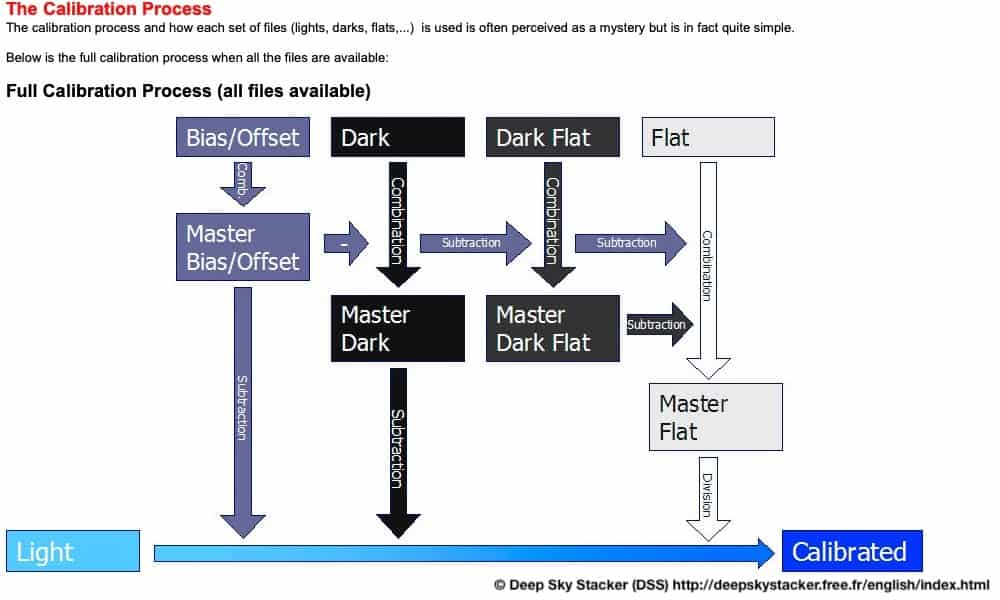
To point 3, they are absolutely keeping many, many maps of the pixels and dark current for all of their sensors - this is a good picture of the process for a standard astronomical CCD: https://cdn.nightskypix.com/wp-content/uploads/2020/06/calib...
Re:James Webb first images – complete set of high resolution...
by dmead on Tuesday July 12, 2022 @03:37PM
(#32074657)
which reminds me, i need to update my dark library and get a light for flats.
Re:James Webb first images – complete set of high resolution...
by willis936 on Tuesday July 12, 2022 @01:02PM
(#32072804)
Thanks for 3. Without the explanation it really did come off as doctoring data to be more artistic.
Re:James Webb first images – complete set of high resolution...
by dmead on Tuesday July 12, 2022 @03:35PM
(#32074642)
But they are doctoring it to make it more artistic/presentable. I have no doubt that real astronomy presentations/papers want to see the undoctored data at some point.
Did you mean you thought they were adjusting the content and not just fixing noise?
1. photoshop is really good at composing different (spectral) layers together. There is alternatives to this like pixinight that are more geared toward deep sky astronomy work but I'm sure it's easier to hire people that can just take a Photoshop class.
there are many layers/masks involved for different filters. the filters accept or reject certain wavelengths of light and may be designed for specific elements on the periodic table. people often talk about hydrogen filters or oxygen filters, sulfer filters etc. the color distinction you see is actually indicating elemental composition much of the time. I'm not sure what filters webb is using.
2. modern telescopes clean up their images by taking a "master dark frame" that is a stacked frame of many frames taken with the lens cap on. The goal there is to compute the noise profile of the sensor. I'm sure before launch the darks for the sensors were determined and are at the ready to correct and calibrate images coming from the telescope. think of it as applying a bespoke noise filter for that sensor. It's a fast process to apply it, but not to generate it. If they really make the raws available I'm sure we'll see more noise there.
3. the touch up you see them doing is the removal of a hot pixel which survived the calibration process with the dark frame. no doubt on space telescopes they still get errant hot pixel of some kind of particle or cosmic ray they don't want makes it to the sensor and flips a bit (and is therefore not account for in the master dark). happens all the time. they're probably keeping a map of where they're getting hot pixels.