There are many jobs that are now obsolete, or will be due to technological progress. Not only are many 'labor' jobs being rendered obsolete, but so are many 'mundane' white collar jobs.
Toll-booth operators are obsolete (or will be)
Bookkeepers are obsolete (or will be)
Many back-office support-services can be automated or re-located
All cashiers could potentially be made obsolete
Many retail sales could be made obsolete (as people shop online)
Where do all these people go? During the last technological revolution, there was a relatively smooth transition from farming to manufacturing. But I honestly don't see how large swathes of the population that don't have specialized skills will fit in in the new economy.
Most of the people reading this comment will do just fine. But we face the really tough questions when dealing with the increasingly large number of people who don't have skills that are in the demand. And even if they all got the skills, employers simply wouldn't need all of them as labor becomes increasingly leveraged.
A couple professors fro MIT just wrote an e-book called 'Race Against the Machine' discussing this phenomena.
http://www.amazon.com/Race-Against-Machine-Accelerating-eboo...
In fact, developed nations in Europe and the Americas are importing vast numbers of low wage workers to do low value per hour jobs where humans are still better than machines. It continues in the face of a prolonged severe recession.
So the emerging problem of no available work to do does not seem to be materializing. In fact, it's hard to imagine. Does every public park and private garden in your city look as clean, inviting, and pretty as it could possibly be? Is every street paved smooth without cracks and potholes? Does a bumper crop of fruit never go bad for lack of harvesters? Is every home clean and freshly scrubbed all the time and is a freshly cooked meal always waiting? Does every corner have a crossing guard during school hours?
There's a lot of intellectually undemanding work to be done in a utopia if we want to pay for it.
Right now, we import foreign workers to do cheap labor but we could take unemployed citizens and subsidize their wages to have our own do those jobs instead. The unemployed citizens are living on private or public welfare and social insurance today but they could be working. We could kick in public money to make it possible to pay a legal wage with benefits for the jobs undocumented workers do and the employers would prefer to stay legal by hiring citizens. We could even document the undocumented and add enough subsidies to employ them too.
Economic change driving social change is disruptive. But let's remember that technological productivity is a positive change that makes us wealthier.
Unemployment that follows from energy shortages or global climate change, if those ever get serious, would be a much bigger worry.
That seems to be the trend, long-term. But you can't say 'most', not yet.
There are still many manufacturing jobs available in the US. My employer has an open reqs out for our six manufacturing sites in the States. We're not the only ones in our industry.
Why does this myth persist? It might be that these jobs are no longer in traditional manufacturing areas. A decaded ago we had two sites in traditional blue-collar areas: one in Mass, one in Washington. We closed them down and relocated the work to existing sites in Idaho and Wisconsin, expanded there.
Because the labor and other costs in the old sites were higher than the drive-past states.
So ... a guy in Mass sees a shuttered factory. A guy in Wisconsin sees new construction. Perhaps the guy in Mass needs to move to where the jobs are. We're hiring.
The fact that maid/cook wages have not dropped to $7.25/hour is strong evidence that unemployment is caused primarily by the unwillingness of many Americans to take available jobs. I'd happily pay $10/hour for a maid, but you simply can't find people this cheap where I live.
We don't need to subsidize people's wages to solve this problem. We just need to stop paying people not to work. After all, why clean people's houses for $7.25/hour when you can just collect unemployment for 99 weeks?
Note that where I used to live (Pune), plenty of people were employed as maids/cooks/etc without subsidies. They weren't paid not to work. Instead of welfare, they had the Gandhi Rural Employment Guarantee (styled after the New Deal).
http://en.wikipedia.org/wiki/Mahatma_Gandhi_National_Rural_E...
Relative to what, exactly? That transition was only smooth in retrospective. It took many decades and (among other things) spawned a major political ideology and a superpower based on it dominating a century.
Did you see that thing the other day where some people decided to make an entire music video in stop motion using Jelly Beans[1]? It took 30 persons 22 months. That is possible because "globalization combined with rapidly advancing technology" can drastically lower the amount of economic output each person needs to produce to sustain him or herself.
This also means that a person who is capable of filling an entire day with production of economic output has a drastically higher amount of wealth to spend on things not specifically "necessary" - such as feeding people making stop motion Jelly Beans films.
While I acknowledge how far capitalism has taken us in wealth creation, it has a blind spot: some forms of wealth are invisible, and either hard to measure, or hard to capture. Every person making a living with YouTube videos is a person who is not teaching in an inner-city school, or rehabilitating the homeless, or building a power grid in Somalia, or a thousand other useful things which don't dangle a direct profit motive (or enough of one to meet a threshold for action).
I'm as loathe as anyone to see a top-down "government" approach to these problems; setting aside the issues of corruption and perverse incentives, even the most well-meaning social programs tend to suffer from insane bloat with no metrics or feedback loops, and therefore mixed efficacy at best.
The only way I see to create this invisible wealth is to supplement markets with new bottom-up community-oriented economies, whether based on money, gift economy, reputation, or something entirely new. We have some precedent for these kinds of distributed institutions (Wikipedia, Linux, Anonymous), but when you compare these to the scale of Microsoft or the U.S. Army, you can see how far we have to go in giving people useful work that also lets them pay their bills.
(Side note: there is a case to be made that pure libertarianism would result in more wealth for everyone, meaning more people could afford voluntary charity and community spending. Bluntly, I don't have that much faith in human nature. At minimum, I could only see that working when coupled with the right sociocultural value system, which emphasized a balance between selfishness and community, rather than an adulation of greed.)
I'd argue that's a fallacy. Show a pre-industrial revolution subsistence farmer a car factory, and he'd throw his arms up in horror over the frivolity. Imagine his reaction to seeing a airplane factory producing billion dollar vehicles that are meant to freight hundreds of so-called "workers" to spend a week out of their FOUR annual vacation weeks drinking and dancing in southern Spain (where? the furthest this farmer has ever travelled is the next county over where his sister lives).
> (Side note: there is a case to be made that pure libertarianism would result in more wealth for everyone, meaning more people could afford voluntary charity and community spending. Bluntly, I don't have that much faith in human nature. At minimum, I could only see that working when coupled with the right sociocultural value system, which emphasized a balance between selfishness and community, rather than an adulation of greed.)
Governments enforcing sociocultural values only works when those values exist. In the old east-block, governments were hard at work enforcing a set of values it's citizens didn't share. It didn't work. The UK doesn't have a constitution, but it was much better at protecting it's citizens than these east-block countries whose constitutions, on paper, were vastly superior.
If the people broadly didn't care about inner city schools or the homeless, nothing would be done for them, government or not.
http://www.fee.org/library/books/economics-in-one-lesson/#0....
Please read that. It is a 40's era book that disputes several economic fallacys, specifically the "Curse of the Machine".
Both of these assumptions are quite untenable given our understanding of human biology and technological progress.
Or maybe some people can move to farms, supplying more farm labor, sending farm worker wages down, and lowering the price of food to close to nothing? Ohh wait... minimum wage laws stop that from happening.
1. computers replace people's minds, not their muscles
2. the machinery discussed in the article was physical machinery, which takes time and effort to manufacture and trnasport around the world. But software isn't a physical object, and it costs nothing to replicate a useful program a billion times and put it on every computer; therefore the extent to which software can concentrate wealth is a lot greater than machinery could.
We keep falling for the same mistakes. It makes me wonder why people hold their convictions for their theories of economics so strongly as opposed to, say, the theory that the speed of light can't be surpassed.
If we can approach physics with humility and admit ignorance until further study, why do people not adopt this attitude with things like economics? :(
This hasn't happened to humans yet because technology has not replaced all possible jobs humans can do. That doesn't mean it can't happen, it just means it hasn't happened yet.
I'm long past the point where someone was ignorant of something and it upset me. I've come to realize that I, myself, am ignorant of many things. I no longer see it as a crime. What I see as a crime is people acting and opining on things they haven't given plenty of thought to. We all need to be careful to not spout-out answers and opinions that we always carry at the tip of our tongue. It's worth it to be humble and skeptical all at once, but it's tough.
I think a key observation missing in all of these analyses is the most obvious one: that bottleneck is energy. What's different between 1995 and today? Well a barrel of oil cost about $25 2010 dollars back then, and costs almost $100 dollars now. We have an economy that is entirely driven by oil. When the cost of that goes up, because we've run out of the easy-to-reach stuff and have moved to expensive and difficult methods, then it's no surprise that the economic equilibrium shifts to a point with lower activity.
It was illustrative to me while reading the other HN articles on wealth. Some of those who have already sold their companies for millions haven't changed their life style much. They still buy the same things, still live pretty much the same way. Maybe travel more. Otherwise, the extra capital just goes into more investments that help to further inflate the established capital markets.
http://blogs.law.harvard.edu/philg/2010/08/08/unemployed-21s...
A quick google seems to show that the cost of milk has increased over time.
http://www2.census.gov/prod2/statcomp/documents/CT1970p1-06.... (page 31)
Data from 1890 - 1970.
That's not why.
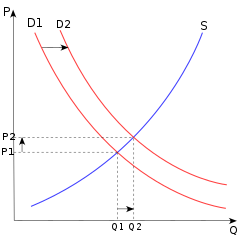
When costs go up, producers become less willing to supply product at a given price. This shifts the supply curve left, and establishes a new equilibrium at a lower quantity but higher price. Of course, with regards to oil, demand has been exploding in developing nations, which has pushed the demand curve to the right. Now, picture pulling the supply and demand curves to the left and right, respectively, at the same time to see how that causes the equilibrium price to spike.
As for speculation, it's hard to tell what speculation is really doing here. Speculation is, to an extent, the mechanism through which the market incorporates knowledge about the future scarcity of a good into the price of the good. Whether or not we've hit "peak oil" we're clearly in a situation where oil extraction is getting more complex and expensive and demand is exploding. And oil resources are clearly finite and we'll run out sooner or later and there is no alternative in sight. Given these factors, the price of oil should be exploding.
But the insane volatility of the market, and rising prices completely out of proportion with the slowly, steadily increasing cost of extraction, is most definitely because of speculation.
And come on, how is that even slightly controversial? When someone with the capital to affect the price is in a position to profit whether the price goes up or down, what do you expect to happen to the price?
http://en.wikipedia.org/wiki/Lump_of_labour_fallacy
You are looking backwards. That is your first mistake. If you only look at what jobs exist now, then you are forced to look backwards and everything looks dark. Try to imagine what the future might actually be like.
Let's take a hypothetical example of some future industry:
It is well know that by the year 2050, the urrgh industry was central to the USA economy. Conceptually, the idea of urrghs was developed by Lisa Simon Beckworth of MIT, late in 2014. Michael Ardossa of Stanford developed the first working urrgh in the summer of 2016. However, urrghs remained an academic toy until 2019, when Herbert Boink of Cambridge developed a technique for mass production. Early in the 2020s it seemed like a number of old names from the tech industry were also going to dominate the urrgh industry: Sony, Samsung, IBM, Lenovo. However, it soon became clear that the old tech companies had the wrong kind of management structures for pioneering the new industry. A host of newer companies sprang up. The public only gradually became aware of urgghs. Many people point to 2026 as a turning point. If you measure the number of articles being written about urrghs in the popular press, there is a 10x jump between 2025 and 2027. By 2028 there were young people confidently describing themselves as "urrgh professionals", the implication being that they were going to make their whole careers in the new industry. The early 2030s saw explosive growth in the industry. After the recession of 2038, economists pointed out that the urrgh industry had been the leading cause of economic growth during the last business cycle, and would likely play a major role in the next business cycle. On the eve of the next recession, in 2046, the urrgh industry was employing 1 million people in the USA.
We all know at some point in the future there will be some new industry that sweeps the world and generates a lot of economic growth. The only question is how much any one given nation will dominate that industry. But that raises a different issue, an issue about national competitiveness, which should not be confused with issues of one nations unemployment, unless you want to make the explicit argument that some nation is stealing jobs from some other nation. Which can be true in some circumstances, but those circumstances need to be made explicit, for the conversation to have any meaning.
The thing is, it's hard to know what the next big thing is. Generally, those countries that have the fastest growth in productivity also have the lowest unemployment rates. That might seem counter-intuitive, until you think about what productivity allows: it means you can produce more, at the same or higher quality, than you did before. If your productivity goes up at 10% a year, and your competitor only goes up at 5% a year, then pretty soon you can make more of whatever you make, at higher quality and lower cost, than your competitor. This applies to nations as well as companies. Back when Japan had 7% productivity gains every year, and the USA had 2% productivity gains every year, Japan had close to 0% unemployment. But if you believe, as you suggest, that rapidly rising productivity increases unemployment, rather than reducing it, then you would assume that Japan would have higher unemployment than the USA, back when its productivity was higher. But we know the opposite was true.
Even worse, if you took your own argument seriously, then you would have to argue that falling productivity is a good thing since it would mean more jobs for everyone. But I assume you are smart enough to avoid doing that.
The economy is a complex adaptive system that is not well-understood; are you so sure that there is no such thing as too much efficiency? After all, life itself is inefficient---if we want to get to our ultimate destination faster, it would be most efficient to kill ourselves. But I assume you are smart enough to avoid doing that.
I remember reading a comment from Steve Jobs to Obama that he would never build a factory in the US due to overly burdensome regulations and the like.
When the dollar started collapsing around 2008, I asked some friends who ran operations for the big manufacturing companies as to why they wouldn't bring the jobs back stateside. It made intuitive sense to me: wages rising in China, cheaper dollar, higher fuel costs. Not to mention its always harder to run things when your employees are half a world away.
The universal reaction was no way they'd bring manufacturing jobs back. Reasons: 1. Don't want to deal with unions. 2. Don't want to deal with hidden costs like healthcare etc. 3. Too many regulations. 4. Just too hard to scale up or down. Apparently in China if you need to scale up your factory, you send a bus into the countryside to pick up villagers. Train them for 3 weeks and bam you have a factory worker. Who's living in your factory dorm, so they're available for over-time etc.
It sounded insane actually, I can't imagine any normal person wanting to work like this.
But its great if you are running a factory.
What you describe is much more an effect on the developed work of the migration of manufacturing jobs to emergent economies than that of technology, which, on the contrary, helps the developed world itself to slow down the loss of manufacturing jobs through higher worked hour productivity.
Technology's leveraging power has become so severe that a company like Apple can reasonably expect to supply the entire world market with smart phones. Another example is SpaceX, which is pioneering the future of space flight with a team of only 1300 employees.
Globalization depresses wages for traditional labor, while technology facilitates an extreme leverage for talent. These two forces are enough to obviate the vast majority of the domestic work force. As long as this reality is ignored, the discussion of potential solutions is futile.
Further reading: http://www.thelightsinthetunnel.com/