- EFI is a bit difficult with distributions when Secure Boot is enabled. Ubuntu and Fedora support it, if you choose a different distribution you may have to tinker, as evidenced in the post;
- camera: Well, Microsoft was doing fancy stuff here; and most distributions just don't support anything but UVC (https://en.wikipedia.org/wiki/USB_video_device_class) style webcams. It's a pain point now, but may not be in a year or two. Also, depending on the lifestyle and the devices one uses, a non working camera may not be an issue at all;
- SSD: Yes, this may be painful, but... for me personal it works well enough. Networking does wonders ;-)
- Lap friendliness... I have had a Surface Pro 3 years ago, and with that device I would agree. With the Surface Go 2 it's way less of an issue. The device is just so much lighter. Works on the subway for me without fear or trouble so far.
Now on the "Why would anyone want this experience" point: I just love desktop Linux, and it's nice to have some full desktop Firefox or apps like rNote [1] on a small, portable device. It's nice to run the OS you know, be able to replicate the same experience on a small form factor device so that you can have it, when you need it, while also being able to use it as tablet - more and more touch friendly apps are available.[2] With GNOME Shell adapting to mobile [3], this experience is only going to get better.
[1]: https://flathub.org/apps/details/com.github.flxzt.rnote
[2]: https://linuxphoneapps.org/apps/
[3]: https://blogs.gnome.org/shell-dev/2022/05/30/towards-gnome-s...
Yes, but not with a laptop mentioned in an article called "I Finally Found a Solid Debian Laptop".
This is not a solid debian tablet, it's a shitty unsupported tablet. Thinkpads (t series) are solid linux laptops, with occasional mini quirks, this tablet is far from anything "solid".
Touch works, the Pen works (with pressure sensitivity) rotation works, WiFi and Bluetooth work, Standby (deep sleep, I put to sleep for 8 hours and it only lost 5%) works (including wake-up).
Non working: Webcams.
All that OOTB, without switching to a special kernel or similar. If that’s "shitty unsupported tablet" in your book that's ok, but in my book it's pretty cool and way better than what I've seen on my last ThinkPad (L380 Yoga) when I got it, where standby wouldn’t just work.
  # cat /etc/modprobe.d/tiny-modprobe.d-zfs.conf
options zfs zfs_arc_max=2147483648I thought the whole point of Android is to make a curated touch friendly Linux experience. If you want a more traditional distro, wouldn't a touchscreen laptop (yoga etc.) be a better choice, if only for x86 support?
The Surface Go 2 that the article is about, is an x86_64 device - I recently aquired one and it's really quite nice with Linux in my limited testing. The biggest difficulty with a standard desktop GNU+Linux on a tablet is that most distributions are not optimized for easy tablet use - KDE Neon User Edition e.g. does not come with a virtual keyboard preinstalled.
On Yoga style laptops: Well, they are easier to get started with, but they often are quite a big bigger and having those keys on the back all the time... It's doable, but if you want a "nice 10" tablet" experience these devices are just not what you will want: Too large, too thick, too heavy.
Ubuntu 22 on a Lenovo X1 Fold gave me the OSK without installing anything - though the touchscreen was not supported by default, the driver is under work cf https://github.com/quo/ithc-linux
But by doing that you get to maintain all the malware that comes builtin on the mobile OSes.
The OP wants to replace the kernel. But most mobile devices use very specific hardware that do not have drivers compatible with the standard kernel you get from your distro. Technically, the manufacturer should have to supply you the source of the drivers they use (so you could port them), but good luck enforcing any right of yours against a large company on the legal system (any country's one actually).
It’s just like cars, there are people who are super comfortable just tinkering around with cars and fixing crap and say “this car is great” and if I tried to drive it it’d break down 5 minutes in and I would consider it a total loss.
Choosing a Microsoft laptop to use Linux is asking for trouble :) I had two of them, and Microsoft had this awful idea of the connected standby, which caused standby/suspend problems (power-hungry standby, which is a very serious problem on a laptop). At least the older machines should now have a good upstream support, in other words, everything working out of the box, with the exception of touch (Linux is just not there).
Regarding other brands, it depends. I remember IBM/Lenovo (Thinkpads) as always just working out of the box. Dell used to be also very compatible, but paradoxically, the Dell XPS developer edition is marketing garbage (it's not very compatible as they claim).
I've installed Linux on a couple of budget computers and they worked fine. I suspect that low-end laptops tend to be much more compatible, since they use more common/cheap components.
Bluetooth has started to be compatible just in the last couple of years - bluez is poor software (and Ubuntu has been sloppy in handling it), but it finally reached a usable level.
I don't remember having to do any tweak on desktop machine, except the time where I had a very modern Ryzen that was supported by very recent kernels only.
Hardware designed to run one operating system isn't necessarily going to perform well with a different operating system, and expecting otherwise of every arbitrary machine on store shelves is unrealistic. Prospective buyers need to do research beforehand.
It had all the problems your average Linux install will encounter without the enthusiast-written drivers to work around manufacturers' lack of support.
That said, the Steam Deck seems to be the first non-enthusiast device where the manufacturer actually cares. Even laptops that get sold with Ubuntu preinstalled from the factory don't seem to receive that much support over the years.
Not true anymore.
> I had two of them, and Microsoft had this awful idea of the connected standby, which caused standby/suspend problems (power-hungry standby, which is a very serious problem on a laptop).
When? Which models?
ACPI S01x when well done works better than ACPI S3, and Linux support for S01x is now getting quite good.
On a X1 nano, I've got less than 0.2%/h of power draw: so 10h of sleep consumes about 2% battery
On the X1 Fold, I was able to reduce that to about 0.5%/h after some workaround for Intel drivers bugs: cf https://csdvrx.github.io/ or just the graph https://csdvrx.github.io/X1_Fold_(20RL_20RK)_Optimization/pa...
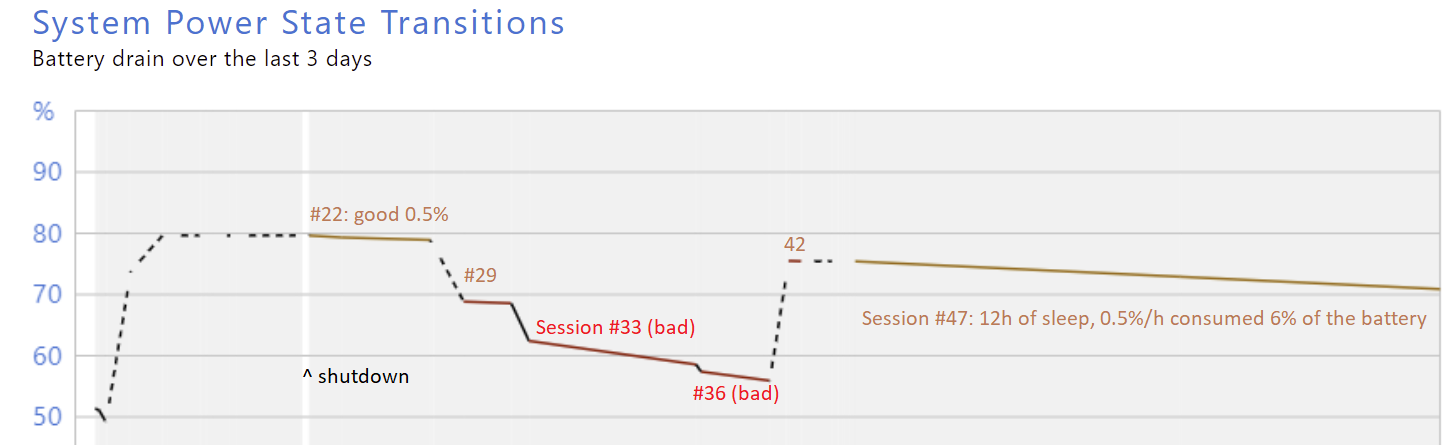
It's still a work in progress, but I can't remember ACPI S3 consuming less that 5% overnight and resuming instantly.
> I don't remember having to do any tweak on desktop machine, except the time where I had a very modern Ryzen that was supported by very recent kernels only.
Laptops often need more tweaks than desktops.
I have a windows running Lenovo t14 for work, and it’s a decent enough laptop but it’s sort of like the stone ages compared to my personal MacBook. It has a terrible mousepad, it’s bulky, it runs out of battery after a two hours even though its factory new (developer specs in non-tech enterprise), the screen isn’t very nice and it’s actually more expensive.
I ask because I kind of want to get out of the closed ecosystem. Not so much because I dislike Apple but because I figure that with the way things are going for big American tech companies I’ll likely dislike them sooner or later. But I’ve never found a Linux (or windows) laptop that came close to the daily usage of a MacBook Air. Obviously I’m not in need of a powerhouse or a computer, weight, battery life and a good mousepad is my primary requirements, but yeah.
- extremely light (my 14 inch is a little under 1kg), you'll absolutely feel the difference when holding it vs holding a macbook air M1, and it is very significant.
- great screen
- amazing keyboard
- the fan is very quiet, but the laptop can get a bit warm under load
- the touchpad is lacking on windows but is amazing on linux (I mainly use ubuntu / pop os)
- expect 9-10 hours battery life in most use cases, it sometimes goes as high as 14h+ if you're simply surfing the web/reading or as low as 6 hours on heavy use
When installing a linux distro, in some rare cases you might need to tweak a few bios option just to start the installation, but everything after that works out of the box.
But, as great as the screen is, looks like it falls short of the 12" MacBook screen. Same 8GB of RAM in the base model as the M1, but memory bandwidth not the same. And the processor isn't going to keep up.
I mean, it's nice, but I picked the base model M1 Air about a year ago for $750 - still seems like the laptop to beat, if you can live with MacOS.
Having 16GB and up, though, an M1's fantastic. If I had to be resource constrained, though, I think I'd prefer something that handled Linux well.
Putting Linux on Windows hardware is a mug's game.
Future Apple hardware being usable with Linux is not a bet I would make. I used to run Linux on a PowerPC iBook, and it's been downhill from there.
Consider that even the best Windows laptops are worse than MacBooks (and I would say this was true before the M1 but is inarguable now), despite the billions of dollars of investment from Intel, AMD, Dell, Microsoft, etc. I think the Surface line has historically had the closest experience for Windows, thanks to Microsoft's investments, but battery life and heat have been an issue on all x86 laptops for at least 5-7 years, with very recent improvements only coming from AMD and now on the 12th-Gen Intel processors. But nothing exists that matches the battery life and power/performance of the M-series. You can get a more powerful machine, but not one that will have battery life worth a damn.
And even as trackpads have improved with the Precision Touchpad drivers, Macs are just better here. Period.
If you don’t count Chromebooks (and I really don’t), there is no one investing anything close to what Microsoft and OEMs are in Linux, not just in software, but hardware, so even the best scenarios are going to fall short. It doesn’t help that the latest and greatest hardware takes to hit the kernel (understandable, of course), meaning you’ve got a lagging timeline from when the stuff is new/hot and when it works.
My Framework is quite good and with Linux, but it took a few months for drivers to be included in most distros (Fedora being so bleeding edge made it a real hero), and now 12th-gens are coming out and I don’t know the status of those chipsets (though WiFi 6E and the like are supported), and Framework cares about Linux and that community.
System 76 and Tuxedo basically just buy Chinese or Taiwanese laptops from Clevo or Tongfang and can make some adjustments to the firmware and hardware config, but they don’t control the whole stack. And even Purism, who sells itself as offering an Apple-like experience, falls embarrassingly short (like, their own firmware updates are bricking $2000 laptops running 2019/2020 specs. And the keyboards are terrible and their own Debian spin distro is not great).
So it’s amazing we have what we have. That we can buy pre-configured Linux laptops. But unless you want to do a Chromebook and tweak into run Linux apps, nothing has the experience you have on Windows, let alone Mac.
Someone will try to refute what I’ve said, but unless the hardware is very specific and the distro is very specific, you don’t get anything close. And it absolutely won’t have the power or niceties of a Mac. It just won’t.
1. sleep draining batteries: https://bugs.launchpad.net/ubuntu/+source/linux/+bug/1808957
2. keyboard lights turning on even when disabled: https://ubuntu-mate.community/t/keyboard-light-keeps-turning...
The second is just annoying; the first is serious (for a laptop).
My biggest gripe is docking station compatibility with the Dell TB16 which, to be fair, is largely own fault. Suspending the laptop while connected to three ext displays and input devices, then spinning it back up before re-connection produces some gnarly results.
Also had to tweak kernel with a recent Ryzen GPU a few years ago on a desktop, but after that it worked. (Now the tweak isn't required anymore.)
I’m looking for an alternative when Apple stops supporting Mac OS on this machine, and I was surprised at how flakey the hardware was in Linux on a 7 year old machine.
What is graphics switching, there is one (integrated) GPU, no?
Of the 35 students in my class, 25 completed the installation without issue, with all hardware (never asked about fingerprint scanners) running fine. The rest required some help from expert googlers like me and some patience, in most cases related to Nvidia drivers. We got all but two to work fine or well enough in the end.
Having 5 to 10 consecutive bad experiences sounds like a fluke to me, given the 70% instant success rate I've seen.
Can’t they use a normal cloud instance or a VM?
A few students (those whose laptops we could not convince to run Linux) work within a VM, but that experience is comparatively miserable.
On one hand that’s kind of the whole point of open-source. Because it can be extended to support almost anything it usually is extended over time by someone else that has already had the same problems you do getting a thing to work. That’s not the same as just assuming everything already works without checking though.
There are some very suitable laptops that would have had support out of the box.
But I bought the (perhaps unspoken?) promise that it would be an easy test drive to find a crappy old laptop and throw Ubuntu on it… and those test drives ended up with me not wanting to switch to Linux.
It's not my experience at all. When I buy a computer to run Linux I normally get one with Linux preinstalled (normally the latest LTS Ubuntu). Then if I ever need to upgrade to a more recent version of Ubuntu it generally goes smoothly.
Desktops are somewhat more hit-and-miss, as are discrete GPUs (I hear the newer AMD GPU drivers are much improved, but have no personal experience with them).
It’s only a matter of time till one of the linux-first companies does it, and it’s been a 30 year wait already, what’s 1/2/3 more.
Well actually I guess there’s PineTab[0] but something with better specs is bound to come around
I monitor their news section almost daily to follow the development of their devices, especially the PineNote and PineTab. I've almost given up about the PinePhone however because of my reading difficulties with smallish screens; Having no needs for a smartphone, I've found that a 4G capable dumbphone working as hotspot plus this Thinkpad are the perfect pair.
Reminds me of that meme that shows Brits using "it could be worse" to mean anything less than average, and "not too bad" for everything else, while Americans say "awesome!" for any kind of sentiment, good or bad.
I'm not saying OP is American, just that adjectives in reviews have lost most of their meaning.
Virtually every thread about linux on laptop starts out with someone claiming that it runs perfect on this or that hardware, then 20 other people chime in with all the things that actually don't work on the same same machine, and finally the original poster concedes with some weasel statement along the lines of "well it works for me". And the year-of-linux-on-x circle of life continues...
Distro choice also has a big impact. Like I tried Guix on my P14s and haven't been able to get Wifi working even with the latest non-libre kernel among other issues. Literally EVERYTHING works perfectly on Ubuntu 22.04 despite in theory non-libre Guix having a newer kernel so something must be going on there.
Soooooo sad there hasn't been much news on a new Pixelbook, was such a great device.
It’s been a while, but updating a DELL laptop ended up with flacky sound that wouldn’t work for video calls, and the video card drivers sometimes crapping the bed and bringing the system down with it.
Tbh the surface pro 3 and sp4 were about at the same level of fiddlyness, but the battery life was just up there with a normal laptop, definately not ipad territory.
- EFI didn’t work.
- The camera doesn’t work.
- The SSD is too small so needed to be topped up with a MicroSD (awful).
- Not lap-friendly for travelling (type cover).
- Windows 11 needed to be kept around despite not being used (and sometimes rewrote the boot menu, if I’m reading this correctly).
This sounds like a downright painful experience. I’m not sure why you’d want this, and it sounds like the author might be trying to force a tablet to be a laptop when they’d have just been better of with a laptop to begin with.