(Well, maybe not price right now because the entire car market is insane.)
So my claim is that Honda and Toyota provide high value by balancing a low-ish (but not the lowest) price against high quality.
https://www.autoguide.com/auto-news/2016/01/toyota-tops-fiat...
To get a feel for the actual statistics, a very useful trick I came across on a Porsche forum is to look up the model on cargurus.com. E.g.:
https://www.cargurus.com/Cars/inventorylisting/viewDetailsFi...
Note the number of listings (401 nationwide listings for the Taycan at the moment) shown in the 'Filter Results' area. Scroll down to 'Vehicle History' and note the availability of the option to 'Hide vehicles with Lemon History Reported.' Next to that is a number reflecting how many used cars of a given make/model have a lemon title out of the set of cars currently for sale. With a 25:401 ratio, it can be inferred that almost 6% of used Taycans on the market were bought back by Porsche at some point.
I'd even go as far to say that the majority of a 1-2 year old car model will still be with the original purchaser.
I guess all that can be said with any certainty is that the proportion of lemons could be as bad as 6% or as good as 0.1% (if the ones for sale on Carguru at the moment happen to include all of the lemons ever produced.)
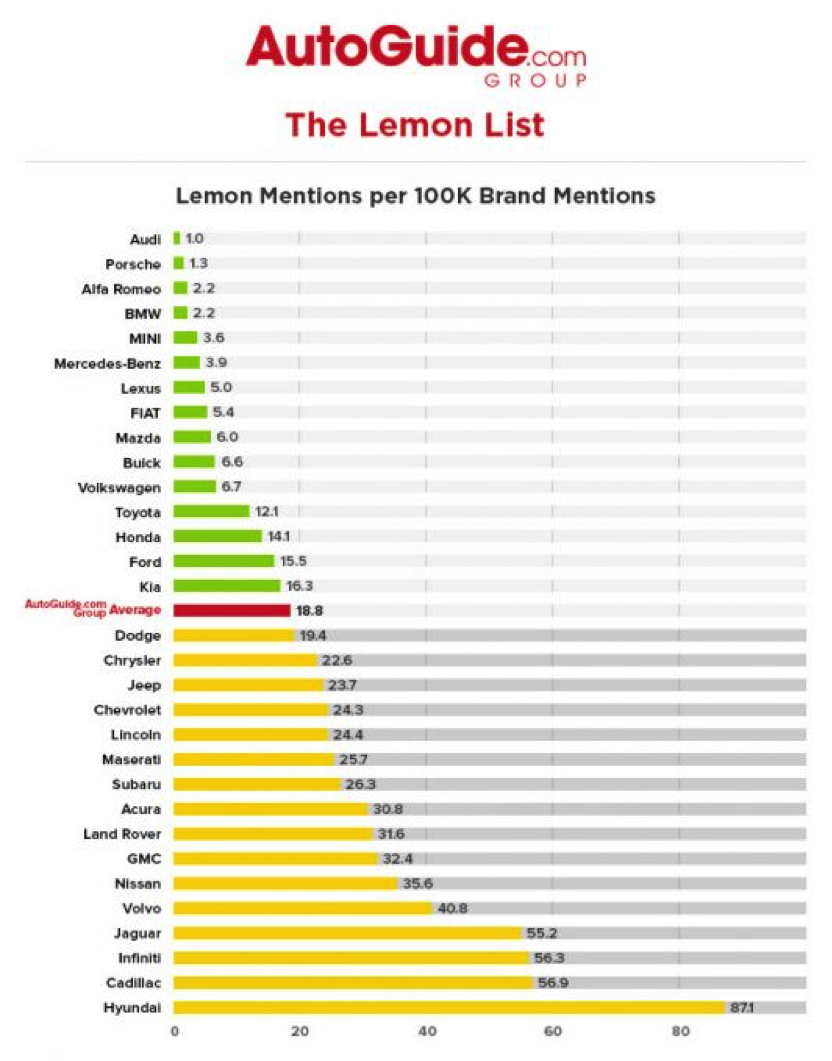
There's no way a modern Kia or Hyundai would appear anywhere near the same level as on that list (and definitely not below any American car company or Fiat or Volkswagon).
“Price, quality, manufacturing at scale. Pick two.”
Ok, that’s a little flippant. But the underlying truth is that quality for software and manufactured goods is one of many variables that can be dialled up or down at the expense of other variables.