(1) The Earth has been cooler with CO₂ levels 10 times higher. We currently have some of the lowest levels in the history of the planet.
(2) CO₂ increases and decreases also usually seem to trail temperature changes.
(3) Warmer temperatures are not necessarily negative. We've been in an ice age for 2 million years, but life thrived at higher temps.
(4) You have to balance negative effects with positive effects, like increased greening.
It might be a good thing to increase CO2. It might be bad. It might be the case that increasing carbon dioxide causes counter balancing effects and therefore increasing CO2 does not increase temperature (I remain skeptical of this but I’m not a climate scientist). But what is beyond dispute is that massively increasing CO2 will cause climatic disruptions while the weather system reaches a new equilibrium.
The reasonable pushback against this is per se isn't a realistic assumption in a system as dynamic as our biosphere.
Note that there are many seemingly obvious things that are false so I could be wrong.
The word "may" is doing a lot of work here. Lots of things may cause massive disruptions to human society. One thing we can say with certainty: the mitigation efforts being proposed to reduce CO2 levels will cause massive disruptions to human society.
On average it’s in a random direction, so some goes out into space eventually. But some goes straight toward the Earth’s surface, which also absorbs and then re-emits it.
The result is that some IR energy is trapped bouncing back and forth between the surface and atmospheric greenhouse gases (there are a few, not just CO2). This is the so-called “greenhouse effect” that keeps the surface habitable.
As you increase the amount of greenhouse gases, there are more molecules available to absorb and re-emit IR energy. So the total amount of energy that can be trapped bouncing back and forth goes up. More heat is trapped.
CO2 is particularly worrisome because the carbon cycle is slow. Water vapor has a larger effect, but it varies on the order of weeks (when it rains, for example). CO2 can take hundreds of years to get fixed again once it is in the atmosphere.
The next time I teach correlation/causation I’m using this as my goto example.
Wednesday, May 6th, 2009
at
http://books.google.com/books?id=DgqLplWtGPgC&pg=PA76&lpg=PA...
(but not now, no longer)
from page 76 of
Susan Milbrath, Star Gods of the Maya: Astronomy in Art, Folklore, and Calendars (The Linda Schele Series in Maya and Pre-Columbian Studies), ISBN-13 978-0292752269, University of Texas Press, 2000.
with
"Indeed, blood sacrifice is required for the sun to move, according to Aztec cosmology (Durian 1971:179; Sahaguin 1950 - 1982, 7:8)."
2) In the global historical record the peak of CO2 has usually trailed the peak of temperature. Again this reflects changes in insolation: as more sunlight makes the climate get hotter, more CO2 is released. Then as sunlight declines, the climate cools but the CO2 lingers for a while. This is actually really concerning because it implies that we should expect a natural spike of CO2 on top of our anthropogenic spike of CO2, meaning it will get much worse than it even looks now.
3) Yes, “life” can thrive at higher temps, but our bodies, culture, and infrastructure are adapted for these temps. And it’s not just temperature; sea level rise (primarily driven by the metric expansion of water as it is heated) will inundate large amounts of livable land including some of the most productive and populated. Maybe good for neritic life, but bad for us.
4) The negative and positive effects don’t necessarily balance. Again, losing dry land to the sea is not balanced by increased ocean algal growth. “I destroyed your house, but gave you more fertilizer for your lawn”—does that seem like a fair trade?
https://en.wikipedia.org/wiki/Paleocene%E2%80%93Eocene_Therm...
CO2 absorbs photons in three narrow wavelength bands, one for each of bending, stretching, and twisting of the molecule, out in the infrared. The absorption spectrum is shown at the Web site of the US NIST.
That absorption makes CO2 a greenhouse gas.
The usual claim is that the infrared does not come from "sunlight" but from Planck black body radiation from the surface of the earth.
The broad, intuitive idea that the CO2 acts like a thick insulating blanket over all the earth and trapping all heat is not very close to reality.
Then there is the question of, how much warming does CO2 cause? Some dozens of studies, with computer models, etc. were done. Results varied. A summary of the results is in a graph at
http://www.energyadvocate.com/gc1.jpg
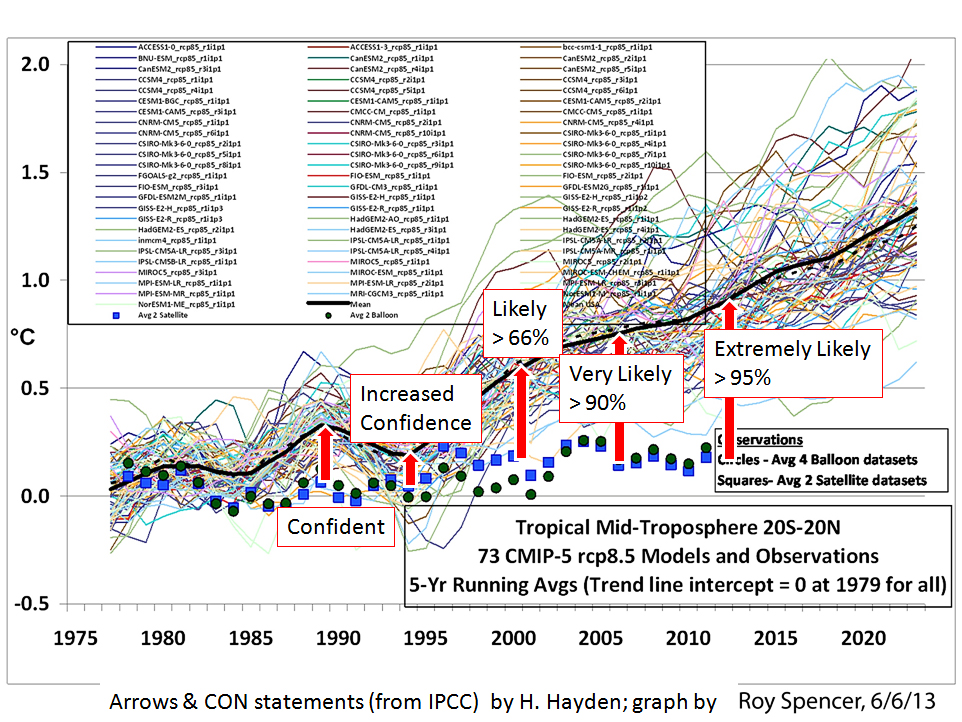
Also it appears that the names of the studies are in small print in a box in the upper left of the image.
Some results predicted significant warming, but the times of the predicted warming came and went years ago without the predicted warming.
Al Gore's movie showed a graph of data from ice cores from Vostok station in Antarctica. The ice cores went back 800,000 years of so. Gore graphed both temperature and CO2 concentration and observed that the two went up and down together.
As I read the graphs:
(1) When temperature started to rise, CO2 concentration was low, not high. So, something made temperature rise, but it was not high CO2.
(2) About 800 years after temperature rose, CO2 concentration rose, and the usual explanation is that the extra CO2 was from more biological activity from the higher temperature.
(3) Some thousands of years later, temperature fell. Then CO2 concentration was high, not low. So, something made temperature fall, but it wasn't low CO2 concentration.
(4) We had some CO2 from WWII and the post war economic boom, but from 1945 to 1970 we had some significant cooling.
For one more, not from Gore's graph, recently I heard a claim that the three highest temperatures on record happened in just the last few years or some such. There is some issue about the relevance of extreme values: E.g., in any stochastic process, of course the highest values observed so far never go down, and in real processes, say, the fastest 100 yard dash, we can expect the highest values to go up.