This is why we joked NTSC meant Never The Same Color.
The last thing you wanted to see in NTSC was bright red because you'd continue to see it smear for at least 1/4 of the screen to the right. NTSC "Safe" red wasn't really red. Run a broadcast safe filter on 255,0,0 and see how far off it goes. Should be somewhere around 180,0,0 IIRC. The days of looking at vectorscope to see the red point shoot off while everything else was much closer. When it became easier to get digital images to tape, we'd have to adjust the chroma down on the TBC to bring it back into legal limits which would mean the rest of the other colors would get squashed when the client didn't work in NTSC safe color palletes.
SECAM = System Essentially Contrary to the American Method
PAL = Perfection At Last
I want a time machine to go back and prevent the US decision makers to not fret about keeping a color system backwards compatible with B&W. I don't care to use the time machine to prevent war, making stock picks or sports bets. I just want to make my future career a little less insane by stopping this idiotic (in hindsight) decision. If there's enough time, I'd try to convince them to keep working on progressive scan and avoid more complications to my future career by not needing to deal with interlacing issues.
Weren't NTSC somewhat also grainier with more pronounced horizontal gaps between each scanline? Certainly seemed so.
Refresh rate is linked to mains frequency.
It doesn't have to be. Japan has a split power grid with 50Hz in the east and 60Hz in the west, but television frequency is 60Hz on both sides.
https://en.wikipedia.org/wiki/Electricity_sector_in_Japan#/m...

The AC power line frequency was used for the vertical refresh rate for two reasons. The first reason was that the television's vacuum tube was susceptible to interference from the unit's power supply, including residual ripple. This could cause drifting horizontal bars (hum bars). Using the same frequency reduced this, and made interference static on the screen and therefore less obtrusive. The second reason was that television studios would use AC lamps, filming at a different frequency would cause strobing.
It is similar to the effect that could be seen when using native lighting in a 50Hz mains country while recording video in NTSC. Not everyone would notice, but when you sit in an edit bay working with that footage all day, you notice everything.
Then again, some people don't notice the stuttering that is the result from 24->29.97 either. The modern 4th frame repeat drives me up the wall. </rant>
I've personally never seen the ability to switch from mains frequency. That's a switch on the back of the PSU that typical goes from 240v or 120v.
The turbo button and mains frequency are 2 totally different things.
Though UK developers new what they were doing an optimised properly for pal. Goldeneye looks better on pal for example.
Australia is PAL too. I remembered waiting for this game and being so disappointed. It was $135 also which was a lot. Modern games are like $70.
Europe had RGB so I wonder if that was part of the reason the Mega Drive (Genesis) was so popular. The SNES doesn't look (much?) better than the Genesis when both in RGB, but SNES composite is much much better than Genesis.
I think they pretty often need to be recapped in modern times. More so than contemporary nintendo systems tend to need to, I think.
In the end most of this wasn't really super obvious on an 80s/early 90s consumer CRT though, and I don't think people were really comparison shopping on it.
* The power of that sticker was amazing! ;P
Before colour TVs, Brazil used the American 60Hz System M (B&W predecessor of NTSC), so when it came time to adopt colour they couldn't choose the European PAL because it would not be compatible with current B&W TV sets, and they didn't want to adopt NTSC* because by then it was clear it was an inferior colour encoding, so they slapped a PAL colour encoding on top of a SystemM B&W signal, resulting in a 525 lines 60Hz without NTSC colour distortions (kinda best of both worlds).
* Also they didn't want to adopt NTSC because they wanted to prop the national electronics industry, so a home made standard meant local TV makers didn't have to compete with imported TV sets.
In fact, if you had a composite device (with the yellow, red and black plugs), you could just get one of those cheap passive adapters to hook it up to SCART: https://media.s-bol.com/mwVL1yR45z6E/1144x1200.jpg
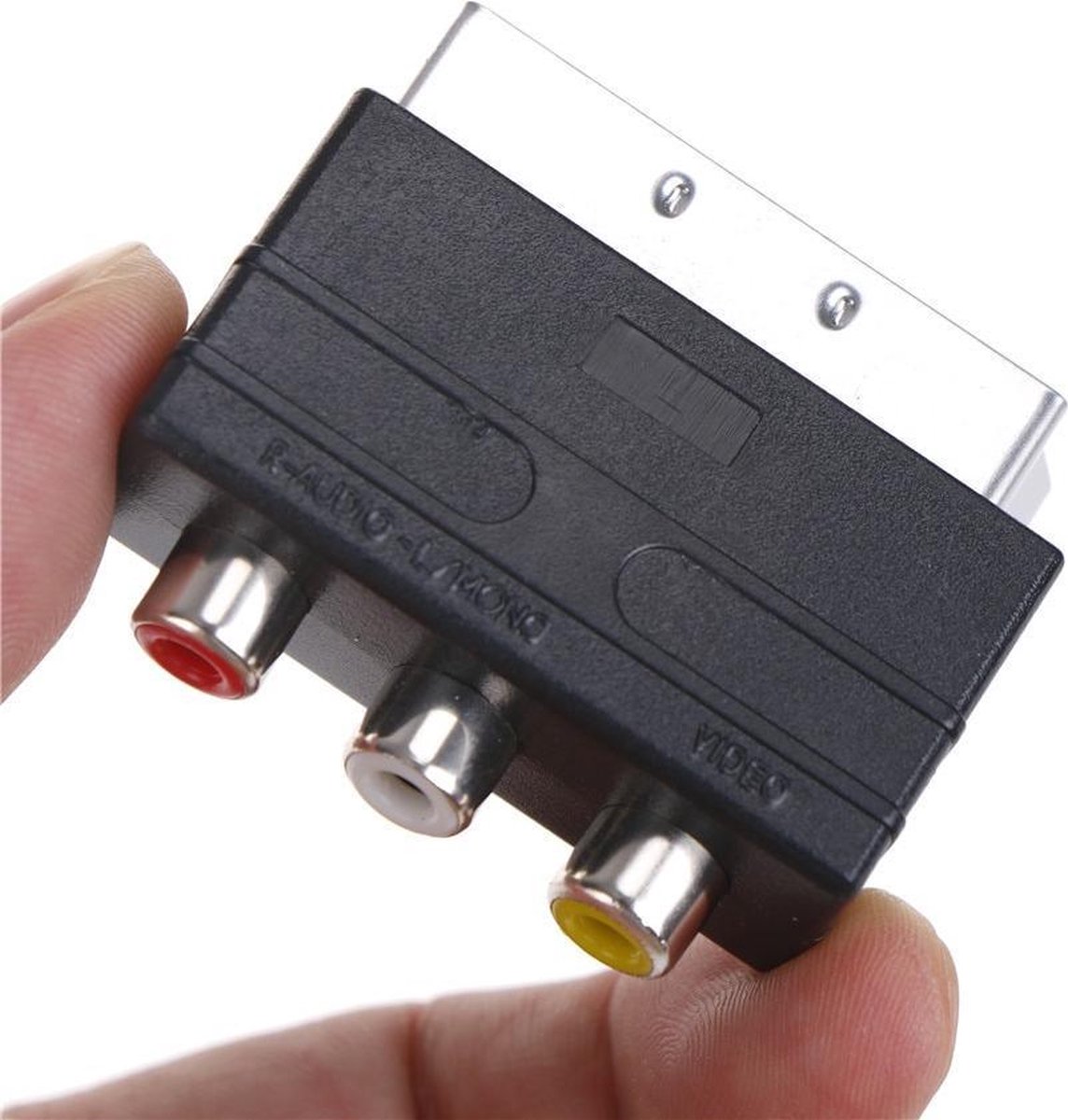
IIRC our childhood (Philips) TV had two SCART inputs: one supported both RGB and CVBS, the other only CVBS.
Take the analog path from NES to TV in that common situation, then the second analog path inside the TV generating the color, then NTSC color/lum separation limitations, and "crisp" or "accurate" is something that couldn't describe the results.
On nesdev.com there's at least one thread where quite a few people are discussing about the best way to capture the color palette from video sources, and argument that there really isn't a "golden palette" because each TV was different and NTSC quirks: a pixel sent to a CRT TV could have different colors depending on its position and the colors/luminance before and after.
So CRT/NTSC fuzziness is part of the memory and nostalgia. I like the NTSC emulation options in FCEUX which do a really good job of the color fringing and smearing that was on CRT TVs and really make it "look" like how it was when I was young.
My thinking is that there was certainly an RGB palette that the designers — probably working on something like an Amiga — chose when creating the pixel art for the games; and that Nintendo likely has institutional memory, if not hard records, of what that design-time palette was; and so later palettes in RGB-based emulators were likely chosen to closely resemble those design-time palettes.
* As evidenced by the fact that the (RGB-based) Nintendo VS. System has a different palette than later emulation releases, even at the time Nintendo wasn't sure of the "correct" RGB palette (or has since come around and changed their mind about what that should be).
* There wasn't really any sort of standard devkit. Different developers, different games, different artists used different hardware and software tools to draw their graphics. Nintendo was notoriously crappy to third-party developers during the Famicom years, and Western developers in particular had little institutional support from them. Even if you had the correct palette that Nintendo was using between 1988 and 1991, that's not necessarily what Rare was using in 1990, or what Square was using in 1987, or...
* The Famicom was released in 1983, and development on it began in 1982. There was no Amiga, no Atari ST, no X68000, no VGA, no mainstream computers really capable of general purpose graphics editing. Developers often had to come up with bespoke systems for editing graphics at the time, including bespoke hardware - and it's entirely possible these bespoke systems used a similar non-RGB design as the Famicom, or even the same PPU, or were even just editing programs on a Famicom with some kind of serial-out hacked in.
* Philosophically speaking, the artists were aware that they were producing graphics for the Famicom/NES. That is, they weren't looking at whatever RGB output they had as the definitive version, but just as a rough guideline for how the image would appear on TVs. Given that, whatever RGB the devkit might've been spitting out isn't "definitive" in the sense of how the artist intended anyone to see it.
* I don't really trust Nintendo to make any extra effort to provide an "authentic" experience in their re-releases: witness, for instance, the low quality of the N64 emulation in the Switch Online Expansion Pack they just put out. The actual people who did the art may be gone or uninvolved in the re-releases; just because they own the copyright I don't think whatever Nintendo slaps together really represents the intent of the artists themselves, in the same way that I don't think, say, the release of Go Set a Watchman says anything about the intent of Harper Lee.
Sure, but that's not what I meant.
Back when images were being bit-banged into computers, you didn't really care what the results looked like on the screen of your workstation, if your workstation wasn't the target system. You designed on paper — usually grid paper — and then iterated from there by flashing an EEPROM and checking the results on the machine.
When I say "the design colors", I mean the marker-pen colors used to color the grid paper. You might also call these the "pre-color-grading" palette.
Certainly, the artist would get a different idea about what they wanted a thing to look like, once the image had been passed through the "color grading" of the NES palette; and so would then iterate toward a design that most-closely lined up the vision in their head with what the NES could actually produce.
But the artist's original intent wasn't to achieve that iteratatively-color-graded final result image; it was to achieve the original colors they had put down on the grid paper. That original intent was just stymied by the system; and so they had to settle for the colors the system could do.
(I realize that modern designers working with retro art styles often design from scratch under palette constraints; but video games were much newer then, and so most of the professional art-and-design people working in the industry had never done digital art before, and had been trained / previously worked only in traditional art. The closest their designers would have got to the kind of constraints imposed by the NES would be in designing neon signs.)
We have seen photos featuring people using nice, pro or broadcast grade CRT displays. Given the lack of an RGB authority, and the limited number of colors, it is likely each group just used whatever references that made sense to them.
And regions. PAL, SECAM, other variants all added noise.
I'll bet a standard consumer grade TV with RF was a small part of many dev processes too. Just a check on effects and or particularly troublesome color combinations. The pro or broadcast grade displays would often render those better than one might expect, but your average TV would likely display a hopefully interesting blur...
RGB images suggest this check on a basic RF TV because some of the pixel art choices may have been different, given better display signals were an option.
For me personally, viewing an NES on a better quality composite display works best for me. Personal preference, and that is due to having composite capable displays early on. I used composite more than anything else. But all that said, the NES RF modulator was respectable. Worked better than many did.
Often, the design choice was a long cable to the TV.
I had a few systems that parked the modulator right next to the signal input on the TV. TI Home computer had a huge one, but it really was great. I used it for many different systems. There was a modulator for PS1 that you could use with a very short connection. And the NES.
RF done that way worked well enough.
I don't think it's necessarily even very likely that they were looking at rgb from a devkit. These days people associate PVMs and other pro monitors with RGB but they aren't synonymous. Take a look through ebay listing for PVMs and you'll find plenty of composite or s-video-ish pro monitors from the 80s kicking around.
And even some microcomputer monitors were composite. If the dev tooling they used was based on a C64 or Apple IIe (which also used 6502 cpus), that'd be composite out for eg., even with a designed-for-c64/appleIIe monitor. And I'm pretty sure I've seen photos of people using Apple IIe or similar for NES dev.
To add to that, the emulation of old games is handled by the NERD group at Nintendo, based in France (https://en.wikipedia.org/wiki/Nintendo_European_Research_%26...). Nintendo is not a monolithic block, and internal groups will have vastly different opinions on how things should look.
While I still feel the original quality was shameful, I recently upgraded my subscription and I have been enjoying it with no issues.
https://community.amd.com/t5/gaming/amd-fidelityfx-super-res...
What made the NES so interesting? It was the games, pure and simple! I've got probably 20 versions of classic arcade Q*Bert. But the iteration with the "purest" design? My goto to actually play when I want to go for a personal high score? Hands down, it's the NES.
And yeah, I also got a modded nes to use with an ossc but now there are good retro-console upscalers that'll take composite (notably the retrotink5x, which incidentally does have a deblur filter for the n64 iirc) and it just doesn't seem worth it anymore. I'll still mod my consoles (or get them modded by someone better at it than me) if they actually have a better video signal to steal, but I just don't see the point in faking one in the console instead of outside it.
I've been poking at trying to mod famicoms/NESs just for the purposes of getting a cleaner composite signal out of them, but it's tricky and I'm not that good at this stuff.
This is something that a lot of even very plugged into retrogaming people don't really get about the NES and RGB mods. I think it's very counterintuitive for people now that there is no part of the system that operates in actual 'color' information. The NES' video output is composite from start to finish[1], with palette entries corresponding to approximate output frequencies for the color subcarrier.
So there is no canonical palette for the NES - the colors produced by games varied by region, a little bit by unit, and especially because NTSC had trouble with stable color even by TV.
So people imagine that RGB or HDMI mods of the NES are somehow tapping into a missing layer of raw color information, but what it's actually doing is intercepting communications with the PPU and modelling (on an fpga) an extra PPU that does operate in RGB, and then constructing a new video signal from that.
And then you have to pick a palette, because there isn't just one.
I have an RGB modded NES (a US toploader) but I doubt I will ever buy or make another one. At this point I think it's better to just use an upscaler, which will produce no less authentic a picture. The main benefit imo of the rgb mod is that there's less interference so the picture is clearer, even if you just output reconstructed composite from it.
[1] There is actually a model of NES PPU that outputs RGB, it was used in the PlayChoice arcade machines (which generally used RGB monitors, not composite) and it has a palette that most people agree is ugly as sin.