I read the link and while I learned more about Tor, the article seems to describe how to secure Tor traffic that is forwarded to regular Internet hosts, for example if someone using a Tor client visited ycombinator.com. My question is, if you use a Tor client to visit twitterhpgjerufcvrmzerg2novpipy42rk3anvb5b7np4zggm4rwaqd.onion, why is part of the route through regular Internet hosts (afaict) and what are the implications of that? The article shows what I am describing in this screenshot; the blacked out parts next to "Portugal", "Germany", and "United States" are IP addresses:
https://www.jamieweb.net/blog/forwarding-tor-hidden-services...
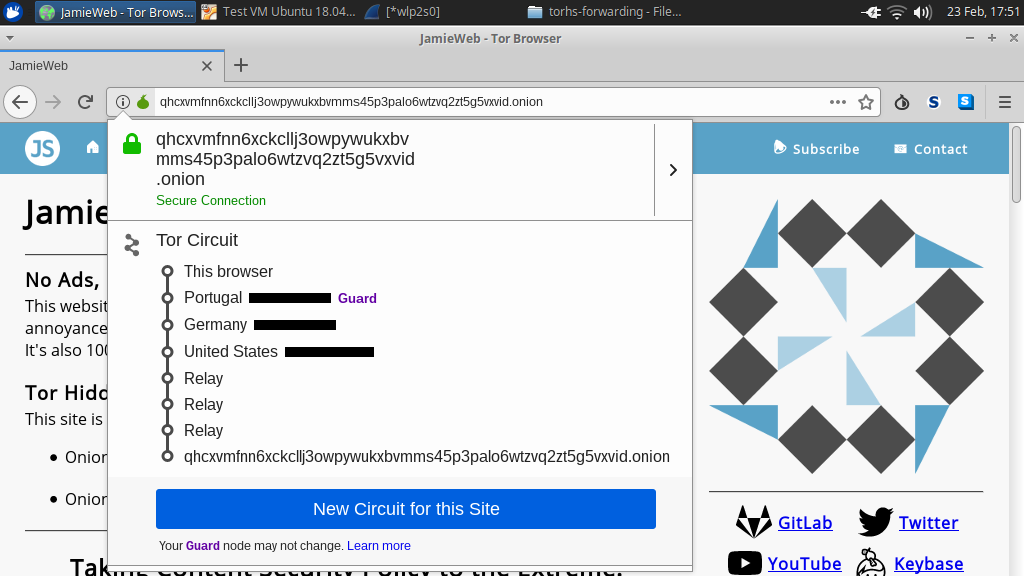
(Also, my original post had it backward: the traffic goes through regular Internet hosts and then through Tor relays, not vice versa)
Again, maybe I am just missing the implications of what you are saying.
I like your initial explanation sp332, I thought it was good so I elaborated on it.
Clear internet is for when someone is using tor and goes to a clearnet site like blah.com. This is what exit relays are for.
EDIT: See this screenshot from an article elsewhere in this discussion. The blacked out bits next to "Portugal", "Germany", and "United States" are publicly routable IP addresses (IIRC):
https://www.jamieweb.net/blog/forwarding-tor-hidden-services...
This screenshot, from an article linked below, shows what I'm talking about. The blacked out parts next to "Portugal", "Germany", and "United States" cover publicly routable IP addresses (afaik):
https://www.jamieweb.net/blog/forwarding-tor-hidden-services...
Also, note that I had it backward in the parent: The traffic first goes through publicly routable IPs, then through Tor relays.
Tor works by ensuring that there is three Tor relays between the Tor client (the software that connects to the Tor network) and the destination the Tor client is connecting to.
However, what happens when you want to establish a connection between two hosts who are both using Tor through the Tor network? Well, in that case both Tor programs establish a path through three Tor relays and link the last Tor relays in each of their separate chains together (if you are interested in learning about how each Tor program knows the others end point look up "Tor hidden service directory"). Now with both ends of their Tor relay chains linked, both hosts can communicate with each other securely and anonymously over the Tor network. (For example: you are using Tor browser to connect to a hidden service. Both Tor browser and the hidden service make a chain of three Tor relays each and connect the chains together through the last node of each chain. The Tor browser only knows the relays that it uses for its chain + the end of the hidden services chain. The hidden service only knows the relays in its chain + the last relay in your chain. Thus keeping you both anonymous.)
I hope this helps!
Why the 'regular' Internet relays? It wasn't a hijack of some sort, this diagram was from the Tor Project. It wasn't an exception AFAICT, I saw it for multiple .onion hosts.
I assume the traffic is encrypted over the Internet relays, but it seems to add a bunch of potential vectors of attack, not to mention potential performance issues.
EDIT: 'clear' -> 'regular'