Ukraine gets the Donbas back in return for international recognition of Crimea as Russian territory.
Fanciful, I know. And questionable whether Article 8 would hold up. But advantages:
1. End to the conflict 2. Security guarantees for all of Europe 3. Repurposing of NATO from anti Russia alliance to anti China alliance, ie pivot to Asia
Not to mention that this current war would look like a sibling fight relative to what China would do if it saw a risk of NATO first-strike capabilities coming anywhere near its borders.
Russia recognised the ukrainian borders in 1994 in exchange for them giving up their nukes.
It's hotly debated but alleged that the US gave verbal assurances NATO wouldn't expand east in discussions about German reunification.
[1]: https://en.wikipedia.org/wiki/Enlargement_of_NATO#Adriatic_C...
It sure looks like it's more a fault of Russia than NATO.
Let me put it another way: what is the alternative? We're clearly not going to put boots on the ground. NATO does not want a member country directly on the Russian border, particularly a large border as Ukraine and Russia have. The US (and the rest of NATO for that matter) simply does not want to get dragged into a conflict on Russia's borders. That's it.
The US would never accept a military alliance between Russia or China with Mexico and Canada that allows Russia or China to build military bases along the US border. So why should we be surprised that the "F** the USSR" military alliance may end up building bases on Russia's borders?
There are already two NATO countries directly on the Russian border. Four if you count Kaliningrad. Five if Finland joins.
Edit:
I’ve looked at the map and it turns out Norway also borders Russia, so +1 to all the calculations :)
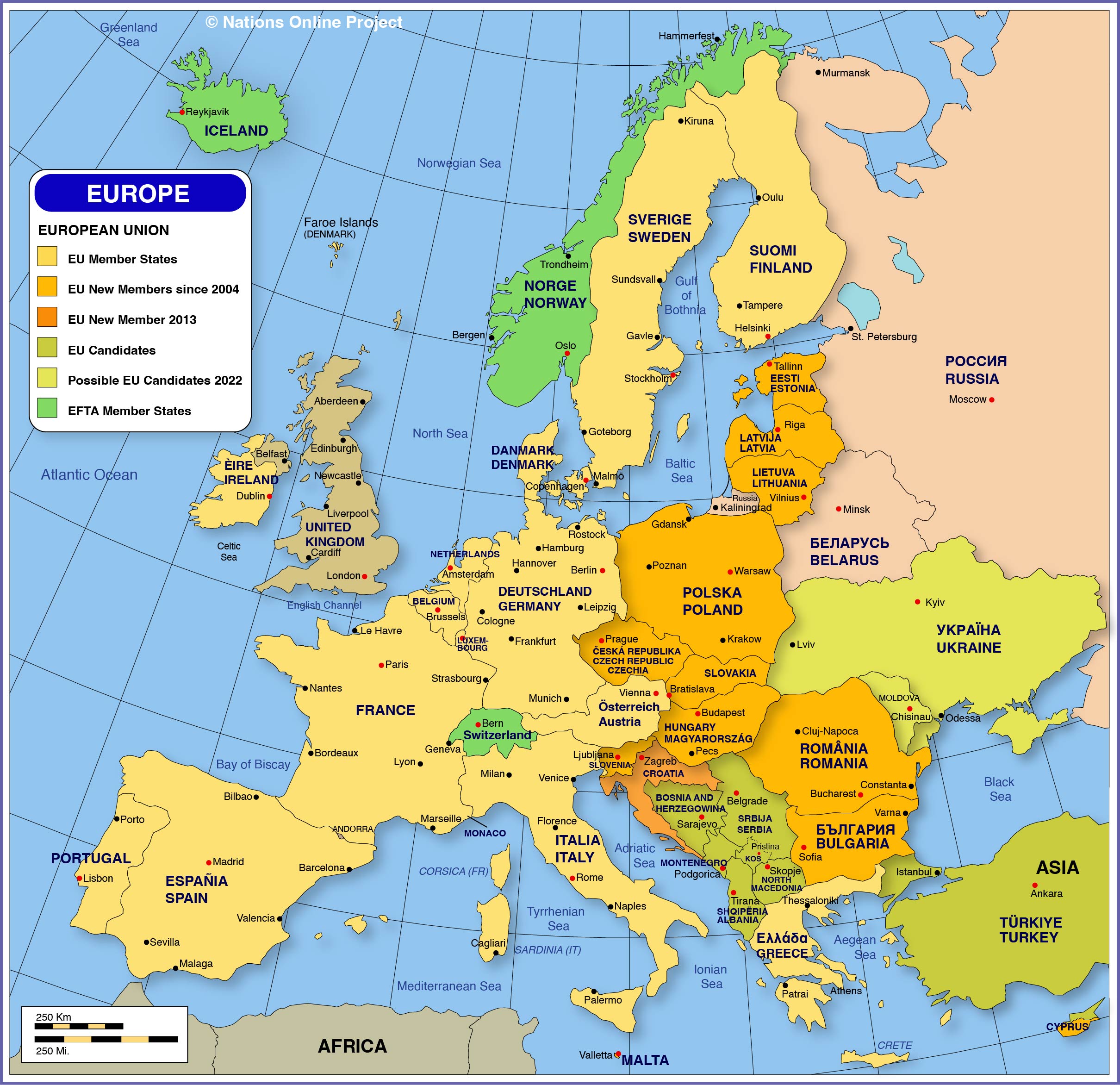
This map [1] puts the size of the borders in perspective and also why Russia has made Belarus effectively a client state. And also why Georgia is in a similar position as a buffer between Russia and Turkey.
But Ukraine is of particular strategic importance to Russia not only because of the expansive border but because Ukraine is relatively flat. Here's a map of the Operation Barbarossa invasion route [2]. It was largely through what is now Belarus to the north and Ukraine to the south.
I can't find a similar map but I believe Napoleon followed a similar route.
While niether of these two campaigns were successful, quite famously, it's merely a function of geography.
Additionally, Ukraine's position is even more significant because it potentially threaten's Russia's access to the Black Sea and the occupited territory of Crimea.
[1]: https://www.nationsonline.org/maps/countries_europe_map-L.jp...
[2]: https://upload.wikimedia.org/wikipedia/commons/1/11/Marcks_P...

Wrong. It's fairly flat, mostly tundra and swampland.
"Additionally, Ukraine's position is even more significant because it potentially threaten's Russia's access to the Black Sea and the occupited territory of Crimea."
Wrong. Just look at a map.
Given this is already a pivot to sharing a "significant" border with NATO, perhaps you should be a bit more discerning with your statements.
If you count EEZ's, Russia's and Turkey's EEZ border each other in the Black Sea, as would Romania's if you believe Crimea (and hence its associated EEZ) to be part of Russia.
Ukraine never joined NATO and never joined the EU.
They still got invaded.
You've written a lot of words justifying the invasion despite saying there was no justification.
What that actually shows you is there is literally no downside to diplomacy because at worst it doesn't matter. To assume that your opponent isn't at least a semi-rational actor that wants something they're prepared to negotiate for is just throwing your hands in the air and saying "I've tried nothing but I'm all out of ideas".
And the fact that Russia made very little effort to justify its invasion to other countries (internal agitprop is very different, by the way!) tells you all you need to know about the effectiveness of diplomacy that is not backed by real and credible threat of force in this case.
There are no other means when dealing with a nuclear superpower. Diplomacy is precisely necessary because the US is never going to get into direct conflict with Russia either directly or through NATO. Not for Ukraine. The US is happy to dangle the carrot and throw some token "lethal aid" across the border but that's it. Sanctions will never work. They never have, not in forcing regime change or capitulation. So what other options are there?
> by the time you get to other means, it can be too late because the victim is already dead.
There are no other means and we've been talking about the Russian military "exercises" for literal months. How much time do you need? Since there aren't any other options what are you losing?
> And the fact that Russia made very little effort to justify its invasion to other countries
Russia has almost certainly sought and gained China's asurances of staying out of it. In the Security Council vote 3 nations abstained: China, India and the UAE. In fact Putin visited China during the Olympics. In hindsight it seems that Ukraine was a discussion point and may well have been the reason for the trip.
All of these pro-Western Imperialist drones (often Americans) who want to "be tough on Russia" are just virtue signaling or parroting someone who is. They like to throw around words like "appeasement" and don't offer any solutions of how to deal with a nuclear superpower that we will never fight a direct war with.
What you call "diplomacy" seems to be a double-speak for appeasement. Your claim, in essence, is that with nukes in the picture, appeasement is the only option left. To that my question is: where do you plan to stop? If the West continues to back down in the face of direct military confrontation, because it might escalate into nuclear, but Russia doesn't harbor the same sentiments, it will take a while before it might cross your personal red line. But by that time, you might find that others aren't willing to fight for you, just as you weren't willing to fight for them.
Oh, and I'm Russian.
That being said, we need to look at how we got here, maybe what should've happened instead and what can be done to hopefully defuse and resolve this situation.
First, dangling the carrot of NATO membership, which because with George W Bush's swansong in a NATO summit in Bucharest in 2008 (and hasn't been changed by any subsequent administration) was dangerous and deliberately antagonistic to Russia. This was compounded by successive waves of expansion after the collapse of the Soviet Union, the entity NATO was supposedly created to defend against.
Second, Zelensky seems out of his depth here (geopolitically) and should've realized this. The annexation of Crimea in 2014 should've raised the alarm bells here both that embracing to the West was dangerous and because of the threat of Russia unlikely to ever happen. This means another route needs to be paved.
Third, outright refusing to take NATO membership off the negotiating table by the US (which, as noted, was never going to happen) was downright irresponsible and clueless, particularly when the US would never put troops into Ukraine and directly get into a military conflict with Russia. That alone should prompt a less hardline approach.
This brings me to the substance of the article and a model that should've been pursued by the Ukrainian government. And that is one of neutrality, probably most similar to the Swiss model. This would include:
1. A consitutional amendment against joining any military alliance;
2. A consitutional amendment for military neutrality that might include, for example, not allowing passage by any foreign military without, say, the approval of both Russia and NATO;
3. National service, say 12 months.
4. A policy of building a defensive army. That means fixed military installations, particularly on entry points into Ukraine. It also means tactical rather than strategic weapons;
5. Equipping and training armed services in insurgency. Hardened communications, access to caches of small arms in the vent of invasion and access to weapons that have shown to be devastating against an occupying force (eg portable SAMs).
6. Exercises and planning for defending Ukraine against large outside military forces. The idea here isn't necessarily to win in such a conflict but to make the cost of victory and occupation so high as to deter it from happening.
You would probably need additional steps to protect legitimate Russian economic interests, most specifically pipelines of oil and gas to the EU and deepwater port access to the Black Sea.
As for disputed regions, you may need to adopt a model similar to, say, Nortern Ireland of joint control and semi-autonomy while still being with the borders of Ukraine.