This was the default assumption for plenty of people when they first hear about real flat earthers, but unfortunately it appears to quickly devolve into actual, very firm beliefs for many people.
This whole phenomenon of "LARPing" your way into a conspiracy (I'm going to start posting about the Jewish cabal controlling the world because it's "edgy," it triggers people online, and it's a fun intellectual exercise to see if I can gather as many pieces of evidence as possible) and then actually believing it seems to honestly explain how a lot of these conspiracy theories end up gaining so much momentum.
After a while, they just grow tired of keeping up appearances, or maybe a famous person talks about conspiracy X, so they are no longer embarrassed by their belief, etc.
Is it possible to quantify "many people"? Like, what percentage of people that are ostensibly flat earthers are actually genuine flat earthers vs. trolls? I would guess trolls make up the majority of internet flat earthers.
There are without question plenty of "real" flat earthers our there. People willing to spend actual money on experiments doomed to fail. People cutting ties with their families because they don't agree with them.
When we read people espousing flat earth views on YouTube or Reddit or wherever, out natural assumption is to think that they must be trolling, because nobody could be that stupid, but in fact there really is a subculture that does.
Was her point grounded in reality? Hell no. But the exact point being made above is highlighted by your comment.
Her original post: https://politizoom.com/wp-content/uploads/2021/01/Greene-las....
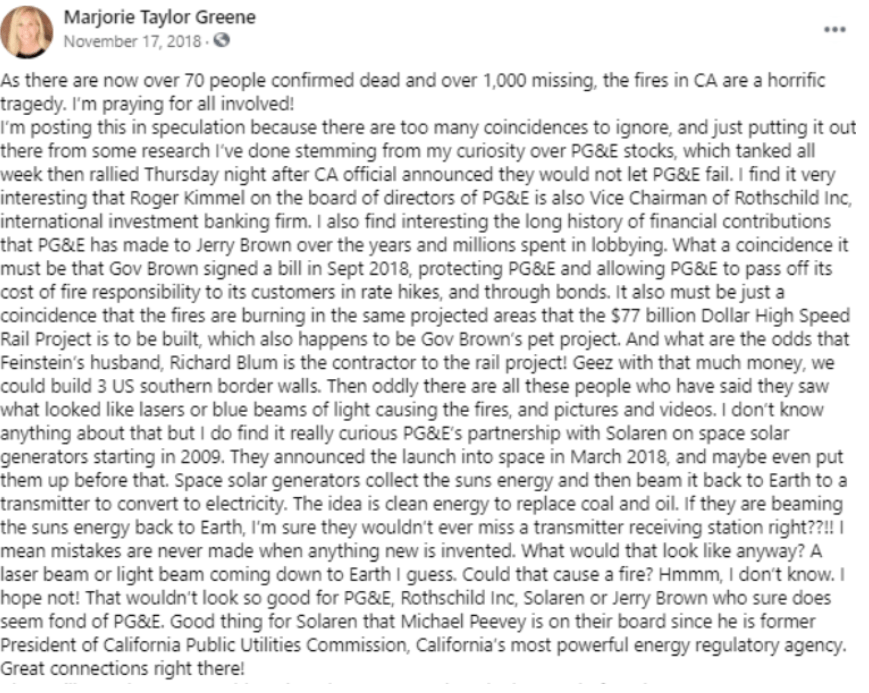
There's a perfectly reasonable point to be made in each case, but many of the people making it feel the need to overstate the case and make it even more absurd.
I think it's because mockery spreads faster on the internet than a simple debunking. And so the thing being debunked is turned into its most extreme form. Perhaps even a step or two beyond a valid interpretation of what's being asserted by the subject.
So with the Mockery Maximization Principle, you get a meme that can spread very quickly and discredit the target at the same time.
The problem with this technique is that it can backfire if people start repeating it as what was actually being asserted. For example, the horse paste meme has backfired when it came to Rogan and the CNN doctor. When this happens, now the debunkers are on the defensive and they don't have a great way out of it since they're no longer on the side of accuracy and truth.
That's a great term.
This is the problem with tribal audiences. CNN can say to its audience (mainly older liberals) that ivermection is horse paste, and face no repercussions. Conformity is so valued by society as a whole, that no one is going to stand up for the truth on CNN itself. But then in those brief moments when the outside world comes in, their bluff is called.
The right does it as well, and your mockery maximization principle (great name BTW) mandates that the meme is produced solely for their primary audience to sell clicks.
That one could write that she did not quite say that, instead of the sane universe’s version that she did not say anything remotely like it truly is shocking. And horrifying.
She put enough of her thoughts and 'research' into her post that it was a 'dog whistle' for like-minded-thinkers.
You do not always have to explicitly say something, to actually say something...
And rather than stating the incorrect belief explicitly, she was using dog-whistle rhetoric techniques.
The lie is pretending that someones' written words are not actually enough evidence to show their intent.
The lie is pretending that statements exist completely isolated from any cultural or historical context. Marjorie Taylor Green has a well documented history of making very controversial statements.
The lie is ignoring the fact that time and time again conspiracy theorists keep bringing up the same scapegoats. Perhaps you are simply unaware that historically, attempting to link things with "Rothschild" is a very long-standing anti-semetic conspiracy and a known dog whistle.
Assumption.
> The lie is pretending that someones' written words are not actually enough evidence to show their intent.
Assumption.
> The lie is pretending that statements exist completely isolated from any cultural or historical context. Marjorie Taylor Green has a well documented history of making very controversial statements.
Assumption.
> The lie is ignoring the fact that time and time again conspiracy theorists keep bringing up the same scapegoats.
Generalization.
---
You're desperate to align reality with your opinion and offering nothing but characters attacks and assumptions as argumentation.
This isn't a strawman intellectual exercise. If we're in the car and talking about charging it, she will excitedly bring up how electricity will be free soon and laugh when we suggest that's a load of bull. She chose to not get vaccinated because she believes the vaccine was engineered to make you more susceptible to the "next virus" that the CCP is planning to release.
I don't really understand how she can possibly believe so much drivel, but she tunes in for her update every day, and this is the only "news" she cares about.
edit: just to be clear, the "free energy" thing isn't about government subsidizing electricity, it's about a device that nikola tesla invented that creates electricity from nothing but was suppressed for generations by the rich and powerful vested interests of the fossil fuel industry.
I like the idea of intellectual exercise, and I enjoyed reading the sub when it was just fun and games. I stopped reading it when they started to seriously support his election. But people for sure lose themselves in the delusions, especially if some part of it connects to them. It's like some sort of cheat code into their minds. I have friends who fell to the QAnon situation. If you told them 5 years ago that our government officials were satanic ritualistic baby eaters, they'd laugh you out of the room and tell you to have another beer. It doesn't really work that way. No way in any serious debate could you ever convince them of this. But now, after they've fell down the rabbit hole some of them seriously unironically believe these things could actually be true.
It's like they saying goes: If you open up your mind too much, your brains will fall out.
What's surprising is the speed at which this happens. In Berger's conceptualization is that this happens over the course of lifetimes, while in the social media space, this happens over the course of months.
My final point is that this is the reason why "jokes"[2] are insidious. They will attract people who earnestly believe they aren't just jokes which normalizes harassment.
[1] The Social Construction of Reality. Berger, Peter http://perflensburg.se/Berger%20social-construction-of-reali...
[2] A specific kind of harassment designed to habituate abuse while also taking advantage of plausible deniability by ostensibly also being a "joke".
They literally cannot see beyond their own senses, e.g., want to see for themselves the curvature of the earth, yet they believe that it is the case that every one of the billions of photos of the earth from space or high altitude is faked, but won't believe that people can go to space.
The psychological research that seems to best explain it is that these people prefer to believe that the world is full of and controlled by an evil secret cabal than live in the reality of a world that is deeply random and uncertain.
Someone seeing periodicity or even symmetry, fractal self simlarity, or isomorphic structure in something noisy could just as easily be accused of apophenia until they produce proof. That there is structure in the noise matters to the theorist, but to the hegemon it's unimportant, if not subversive and dangerous.
I prefer to look at it as having to do with how people relate to power and truth and how they perecieve it.
I'm not sure it conflicts, and likely even correlates well with your view of how people relate to power and truth.
Whatever the root cause is relatively unimportant, until an aspiring authoritarian starts herding those who have trouble with objective reality - creates support for a regime that will constrain the rest of us.
On several key points, the conspiracy subreddit has been correct. For example, in March 2020, they accurately predicted the course of covid, namely that vaccines would be developed, that there would be large-scale hesitancy, and that this would be used to justify the keeping of covid lockdowns / masking requirements / eviction moratoria far beyond the stated 15 days. Regardless of your belief in whether this was justified or not, this happened.
Similarly, the subreddit was correct about things later revealed by edward snowden.
Of course the next post will be about lizard people, but frankly, that doesn't mean we ought to discount the well thought out, presented, and reasonable 'conspiracies' that get trotted out there. Some of them actually happen.
It's just a bad place to trust, because they do no moderation. On the other hand, the places that do moderate are always behind on the things that end up being true.
Why do we need that? I find this type of control suffocating and it is just a patch for deeper seated problems, mistrust of authority for example.
The grammar was very poor. I meant the "look at all the nuts out there, we need to control what people can read" as the false conclusion that might be drawn by someone who believes conspiracy theories are rampant.
You need to find out why that happened and fix that.
I imagine a lot of these people just want/need something to cling to , because even the conspiracy theory sometimes seems more real then reality.
A friend of a relative is an apparent flat earther - my relative is always saying things like "oh you wouldn't believe what this guy thinks, he says the world is actually shaped like a UN map, what a goof". In this situation, which of the two is actually the more gullible? From the situations I hear described, it's pretty clear the guy just likes to tease, and enjoys the "intellectual exercise" - for some value of intellectual - of tearing down commonly held truths by providing alternatives, even if they are silly. I've seen the same thing with moon landing and 9/11. People like to use these as strawmen about look at all the nuts out there, we need to control what people can read, but this is just an excuse for shutting down opinions they don't like.