Instead, draughtsmen will simply recreate it according to the instructions of the artist, as given in the diagram, at a new location.
See for example https://www.tate.org.uk/art/artworks/lewitt-wall-drawing-113...:
"Wall Drawing #1136 can be installed, removed, and then reinstalled in another location, as many times as required for exhibition purposes. As such, there can also be periods of time in which the work does not exist in physical form."
For starters, let's take the Autoglyphs (https://www.larvalabs.com/autoglyphs): the smart contract gives a list of instructions for each piece that you can use to draw the final output.
Cool concept or scam?
How is the mode of ownership of this wall drawing different? The physical piece can change or disappear. What matters is who is recognised as the owner of the artwork an immaterial sense, as evidenced by the certificate.
The owner cares about the piece of paper but not because the typography is so sweet. The piece of paper is not the artwork. The piece of paper is a token.
"A glyph can be created by anyone who is willing to donate the creation fee of 0.20Ξ ($769) to our chosen charity, 350.org."
No, the glyph can be created by anyone who runs the code. And the code is publicly available. The "donation" is completely unrelated to the glyph, yet they try to trick you into thinking that both are connected.
The certificate will still be valuable even if the copyright on the work expires. If the artist would work with say WeWork to reproduce this work across their offices, the certificate still has value. The Tate is still able to resell that certificate.
It's actually not clear to me that Sol Le Witts estate could enforce a copyright claim on an "unauthorized reproduction", since describing a drawing in words is not the same thing as actually drawing it. But regardless, the copyright question is entirely incidental.
There is a reason why the guy didn't just drew the damn lines himself, and why his such an influential figure in art history. It's precisely because he intended to interrogate some of these ideas.
Note that even if we suppose your way of thinking about this, in terms of a license grant that will move over to any would-be buyer of this certificate, is the correct one, that means this certificate shown above either a) grants such a license implicitly, or b) a separate license grant is communicated somehow. In both cases, this is still exactly like an NFT, where artists often communicate licenses to buyers of NFT certificates.
https://images.ctfassets.net/662nae7q8cm6/38DaHNDnz0epPreBMr...
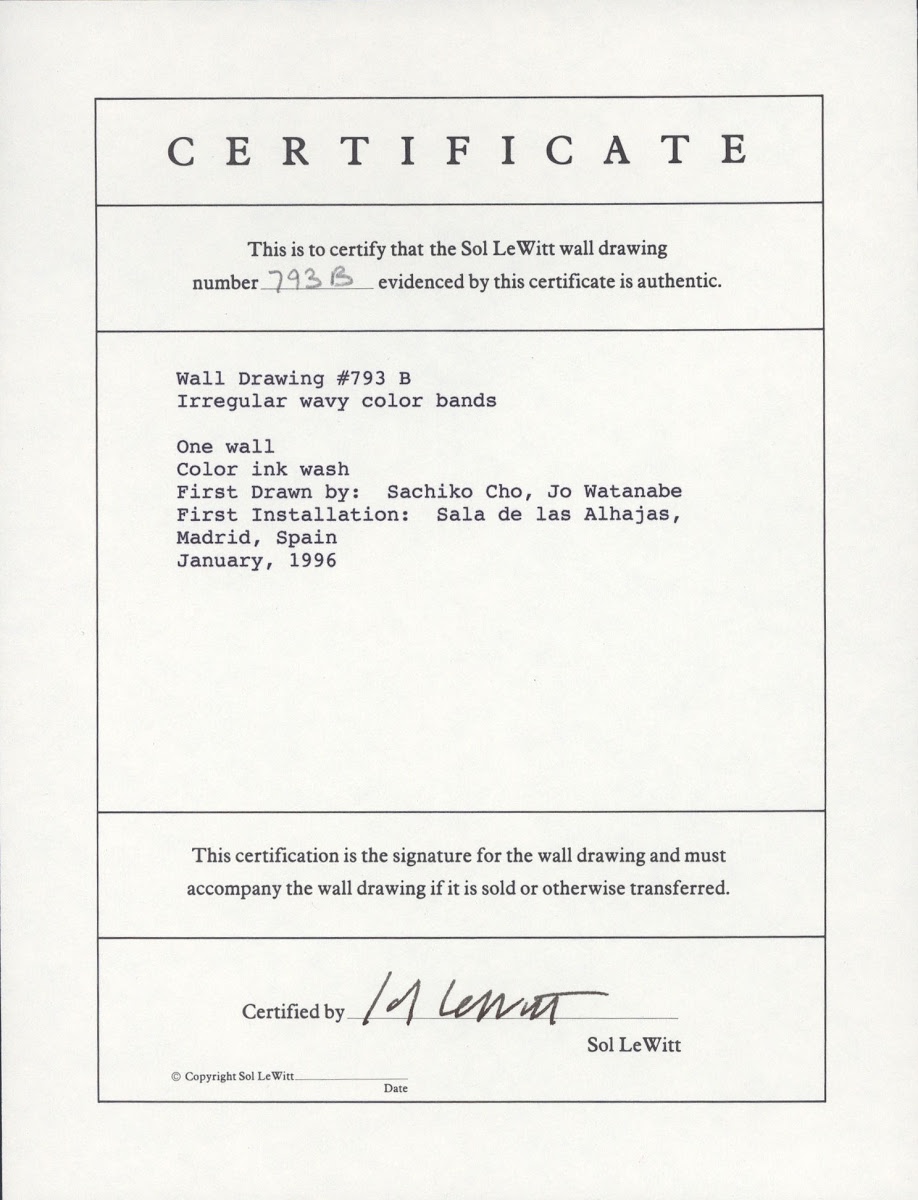
That's a signed statement, from the artist, stating that the drawing in question was created in accordance with the instructions.
Does such a certificate have value of its own? It depends on whether somebody is willing to pay for a certificate stating that a particular drawing (which may no longer exist) was created according to the instructions. So, maybe yes, maybe no. I don't know why you think this is important though.
Does a certificate of authenticity make sense in the case of a digital image? No, because we can verify the authenticity ourselves by calculating the MD5 sum of the copy and comparing it to the MD5 sum of the original. We don't need to pay a trusted third party to do that for us, we can do it ourselves for free.
You misinterpret the practical workings there a little bit. The Tate will not need to buy another certificate if they choose to exhibit the drawing once again, by hiring draughtsman to paint it on a wall once more. It doesn't refer to a specific installation. The number of the wall drawing on the certificate refers to the design, not the physical object.
Nevertheless, even with your interpretation, you could ask why a museum would want to pay for an artist to provide this kind of certification.
I'm writing this from Frieze Art Fair. There are a number of video pieces here which you can buy. They'll give you a USB drive. They will pinky swear to only sell one of those, to you. And they'll give you a certificate of authenticity. Its supposed to certify that this isn't just a copy of the video that you made. Which isn't to say that you can't make a copy and give it to your friend. She will own the same bits. But only yours is authentic, because you have that certificate. That is what is meant by authenticity.
It's a system the art world has experimented with for a while. These kinds of certificate-based works don't sell that easily either. Much easier to sell a painting. But it's the same system as an NFT and not more or less scammy than that.
A certificate of authenticity does make absolute sense in the case of physical art (provided that it actually certifies the authenticity of the work, of course), because physical copies are all slightly different. Therefore people may want to tell those that are original, i.e. made by the artist or under their supervision, apart from those that are not. By contrast, there is no such thing as an original copy of some digital information, because a piece of digital information isn't put together by any individual that could claim to be the author of the copy. Even if they could (which they definitely cannot), all copies are identical and impossible to tell apart one from another. Then, what would a certificate of authenticity be certifying exactly? Nothing. It's just a ploy.
A ploy that all actors willingly are signing on to - artists, galleries, and collectors. No one is misunderstanding what is going on. People are selling the certificate on the artificial assumption that it represents the art somehow, but you are buying the piece of paper.
W
> The way The Currency works is that collectors will not be buying the physical artwork immediately. Instead, they will pay $2,000 for the NFT and then have a year to decide whether they want the digital or the physical version. Once the collector selects one, the other will be destroyed.
https://www.fastcompany.com/90657113/damien-hirsts-the-curre...
The Tate is the owner of the following certificate of ownership by Sol Le Witt:
https://www.tate.org.uk/art/artworks/lewitt-a-wall-divided-v...
Are they the victim of a scam?