>You need a PD charger and not a QC charger...
Impossible, all USB-C QC chargers are also USB PD chargers.
>into the correct usb port to charge the laptop
The port is either marked (everything but MacBooks) or doesn't matter (MacBooks, pretty sweet).
>buy an original charger for your laptop
Good! Now you have a USB PD charger that covers your laptop and also every device you own that's lighter in wattage. Less chargers to pack when travelling :)
>you're back at where we were 20 years ago
No, not at all. 20 to 10 years ago all charging ports (including on cameras, phones, everything) were barrel plugs of slightly different diameter; everybody's cranking out their own boxy black chargers putting out maddening variations on the same ~20V for laptops and 3-5V for smaller devices, you can't share chargers between devices, can't always find the replacement, especially if the device is on the older side. Buying a device with a different connector - bam, old charger goes to e-waste (or e-bay).
>but it won't charge. You need a fast charger...
EU makes it mandatory to say on the packaging what wattage the device needs, and what wattage the chager can provide. Granted, the laptops are not covered by the EU proposition in question yet, but have patience, we don't now have those 240W chargers for nothing :)
Some of them had the same diameter, so accidentally plugging 12V to 5V port could fry your device.
At least I'm not afraid that the 65W USB PD charger will fry my phone lol
Many years ago I had two Linksys devices. A router and an access point. They were both that blue and gray chassis style. (Like the original WRT54G, except these both predated that model).
They had the same size barrel connector. I was fumbling around under my desk getting everything connected when I let the magic smoke out of one of them. Turns out I gave the 9V unit 18V from the other’s wall wart.
That may also have been the day I learned the phrase “magic smoke”
Never were much into electrical engineering, to my own chagrin.
I can one up you. Verilux sells a "happy light" SAD lamp thing, still sold at Costco, which uses a mini-USB plug, running on 19V 300mA or something.
Yeah. How the FUCK does the USB Forum not shut that down?
> The port is either marked (everything but MacBooks) or doesn't matter (MacBooks, pretty sweet).
From https://apple.stackexchange.com/questions/363337/how-to-find...:
> TLDR; If your MacBook Pro runs hot or shows a high % CPU for the kernel task, try charging on the right and not on the left.
IMO if it's to be optional to implement the 'receive' side of USB-PD (or QC? Whatever it is) then it should use an extra pin, so a PD cable physically can't fit in a non-PD port. And the ends opposite, so that the PD-pin-having transformer plug won't fit a non-PD cable.
(I don't really want that though, I'd rather it was just required to support it. So it's all the same and we can properly live the one-connector dream.)
> The port is either marked (everything but MacBooks) or doesn't matter (MacBooks, pretty sweet).
Except that even when there shouldn't be a right choice, there still is:
https://www.extremetech.com/computing/309802-charging-a-macb...
Some MacBook Pros get very hot when you use the USB-C ports on the left side for charging.
Two clicks to opt-out of everything¹ compared to tens, some of which include needing to visit the parter separately to opt-out there, and even then it is not complete because some simply marked “this partner does not provide an opt-out”. ExtremeTech: welcome to my DNS blacklist.
[¹] assuming you trust it to actually opt you out properly, of course
Except this is an issue with a specific Apple product, not the USB spec as this thread implies.
Have you every used an Apple product? Because if you did you'd know that it doesn't matter which direction you plug it in.
https://en.wikipedia.org/wiki/Lightning_(connector)
"The male Lightning connector is symmetrical (same pins on either side), so it can be inserted into a female Lightning port in either orientation."
https://www.techinsights.com/blog/systems-analysis-apple-lig...
"I have some USB C chargers that only charge in 1 orientation"
Are there any example of barrel-style connectors with >2 pins, i.e. coaxial barrels? Similar is the 'jack' (3.5mm and such) but with split regions along a single pin rather than concentric rings of course. I wonder why such designs aren't more popular/explored (that I'm aware of anyway) for multi-pin data connections?
eg lenovo, two charger generations ago:
https://i.imgur.com/Wn4EM33.png

But usually the inner one was only connected via a resistor, to tell the device the wattage of the charger (but could be used by a bunch of 1 wire protocols instead.
But the reverse is not true: All USB PD chargers are not QC chargers. Some are, but not all. I admit this is not a huge problem because QC is fading away and it merely means that some older equipment won't charge with a newer charger, but the issue does exist.
You have a lot of USB-A QC chargers, and you just take a usb A -> C cable. [0]
> The port is either marked (everything but MacBooks) or doesn't matter (MacBooks, pretty sweet).
https://p3-ofp.static.pub/fes/cms/2021/07/01/5q6w49cnwh2ka55...
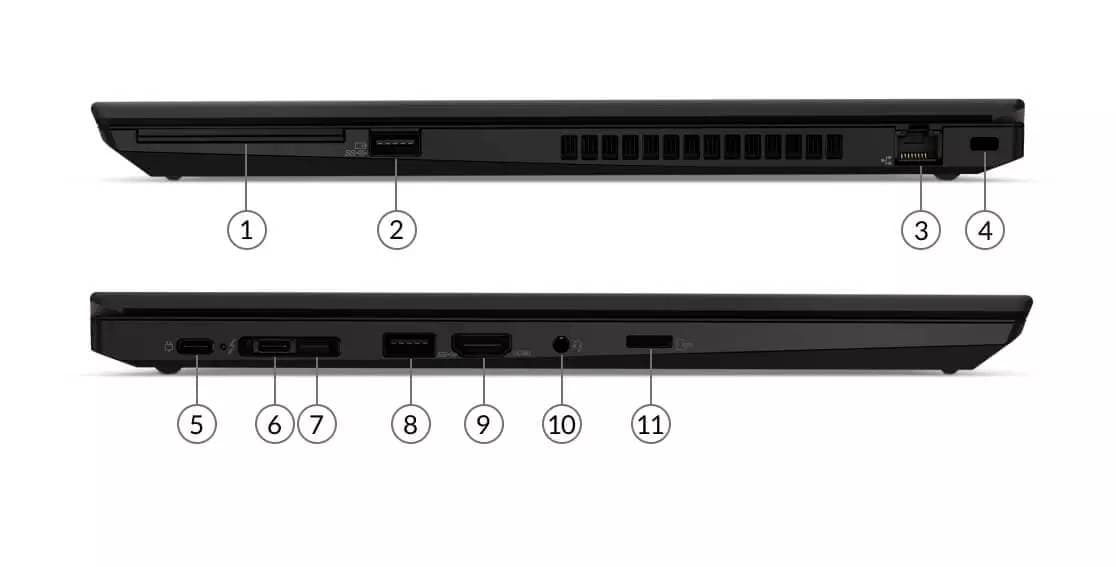
So... do I tell my grandma to plug it into the "weird robot"-symbol port (5), or the "danger, high voltage" one (6)? It fits into both.
> No, not at all. 20 to 10 years ago all charging ports (including on cameras, phones, everything) were barrel plugs of slightly different diameter; everybody's cranking out their own boxy black chargers putting out maddening variations on the same ~20V for laptops and 3-5V for smaller devices, you can't share chargers between devices, can't always find the replacement, especially if the device is on the older side. Buying a device with a different connector - bam, old charger goes to e-waste (or e-bay).
This is not really true... Some laptops maybe... Lenovo had a square one ( https://www.amazon.com/Converter-Charger-Adapter-ThinkPad-Un... ) for example. Phones had all the custom ones...
ericsson examples:
https://www.amazon.com/Charger-Cable-Ericsson-C510i-C702i/dp...
https://www.navigation-accessoires.com/en/sony-ericsson/p-se...
Either way, you brought one device + one cable, and you know where to plug it.
Yes, from an average tech nerd perspective, this might be better, because people know and remember what to use where, which protocol their devices use, and which port they have to plug it in. Normal users don't.. and if it fits, they use it like that. If they buy a custom charger for their laptop, they won't use it to charge their phone, because they know their phone charger won't charge their laptop, even though everything fits.
I'm not saying it's all bad, but dealing with several older relatives, and stuff that fits and doesn't work is making it a pain in the ass, especially with stores selling stuff (eg ikeas https://www.ikea.com/us/en/p/askstorm-40w-usb-charger-dark-g... ) that works but doesn't charge if under heavy use.
[0] https://www.amazon.com/Charge-Charger-Portable-Adapter-Folda...
The exact shape of the port is clearly not the point of their statement. It is that you had specific, one use, variations of chargers that only worked for one laptop and were trashed when you got something new and were very difficult to get a replacement or additional charger for. Whether they were barrel or square isn’t the point.
> If they buy a custom charger for their laptop, they won't use it to charge their phone, because they know their phone charger won't charge their laptop, even though everything fits.
But most people handled it fine if they had a tablet, phone, and a few other random devices with micro USB. For the average person, moving to the semi standard micro USB was a net win, even though some people would try trickle charging their phones with old, low power usb chargers. Just because grandma can’t figure out what she is doing, doesn’t mean the actual average user won’t quickly figure out that their USB-C charger will work for anything less what the charger was rated for. Your laptop charger will charge your tablet, phone, and extras like headphones. Your tablet charger will charge your phone and headphones, etc. that is a good enough solution for most people, and simple enough most people will be fine. Knowing you can travel with 4-5 USB-C devices and only bring your laptop charger to charge everything is much better.
Why would you assume it would work? Just because the connectors fit together? Both my computer monitor and my TV have two HDMI input ports. Should I fault the HDMI protocol (and any connector standard where server and client sides are physically identical) that I can't daisy-chain them?
My grandma has a microUSB Android tablet and a microUSB feature phone. I set up for her a dual USB-A charger and two identical microUSB cables that are always plugged in, so she can use either one or both. I don't quite see the problem with the USB-C setup either: get several high-powered chargers for her so that she can use whichever one.
But I get it. The times really did have changed; one piece of information - the wattage of the charger - that was hidden from the consumer is now reified: all chargers fit, but only some of them are powerful enough. Fortunately, it's mostly a question of comparing integer numbers: my phone's 25W, and the charger is 30W - it fits! My laptop is 45W though, bummer. I should get a >=45W charger for it.
But for that nuisance we traded away the obnoxious burden of distinguishing between Pump Express and QuickCharge and Adaptive Fast Charge and Adaptive Super Fast Charge, between Lenovo thick or thin barrel plugs or yellow rectangle plug, between multiple generations of Apple laptop plugs, of insane proprietary connectors like Nikon's UC-E6, of having to power hubs externally (thank god for 15W minimum), of the anticonsumer pricing of the vendors' proprietary tech, and (fingers crossed) of the ridiculous mix and match approach Apple has to its iPhone and iPad lines.
It seems to be a good deal.
By the way, I fondly remember a Sony Ericsson K510i I had in high school :) That toothy connector was finicky as hell (something I'm reminded of by lower quality USB-C hubs).
> things were simple
I think USB accomplished its goal by standardizing a lot of communication protocols for a lot of (type of) devices. I lived through the 80's and 90's as a kid. I still feel the pain of plugging a new mouse or joystick and try to make it work. Then USB came and it was 'magic'.
Edit: still, if I have a serial port outputting data from a device I'm debugging and I turn on my PC, sometimes Windows would think it has a Trackball mouse connected to the serial port and will move the cursor around until I reboot my computer... I say this as a reminder on how things were back in the day (regarding communication protocols for devices).
Thunderbolt screwed a few things up, but a few users use tunderbolt devices without actually knowing what they're doing, and where to plug them.
(I never had as much trouble with connecting displays as I do today)
Edit: Ahh I didn't realize DVI was first, that makes more sense. I just remembered getting a DVI motherboard, and an HDMI TV around the same time.
I was trying to help a lawyer out and trying to explain why the $5.00 USB-C cable he'd bought from Amazon wasn't delivering 4K video to his expensive monitor AND powering his laptop too.
Me: OK: so its a USB-C cable, but its not a high data rate USB-C cable.
Him: But, its a USB-C Cable.
Me: but, no, not all USB-C cables are high speed cables. And some of them can't do high speed and power delivery
Him: but... its a USB-C cable: it plugs into the port.
Me: Um... just because it plugs in, doesn't mean its going to work. You can have USB-C cables that are actually slower than the old USB ports.
Him: but.... shouldn't it just work?
And so on. For... 15? more minutes? maybe 30? I finally got him to buy a "proper" belkin USB-C cable . Which was bought from a company that should be anonymous, but lets just say that a "refurbished" cable was shipped, which, surprise, surprise ,didn't work, for ANYTHING.
This basically sums up everything that is wrong with Tech thinking vs User Thinking.
When I was a young kid just getting into computers and didn't know what the hell I was doing, I would try and connect the parts solely based on what wire fit into which hole. And amazingly, it just worked.
Today, I'm still replicating that clumsy behavior, albeit in different ways.
Luckily, it seems QC is finally fading away. Last gen it was a subset of PD anyways, and I've not seen many devices advertising QC5 as a selling point.
There are other more niche chargers and cables - look no further than Oppo and Xiaomi and their proprietary things. I suspect this was mainly because USB spec fell behind, leaving companies to go it alone. I imagine these too will go away as the specs now cover their intended charging speeds.
In the past, I'd always wished these cables were color coded for quick identification. Like probably many people, I have a box full of unlabeled usb cables that I have no idea the specs on. These new logos will certainly help in that regard, at least. Once I get a few, I fully intend on getting rid of this box of random cables.
> And now? You buy a new laptop... usb-c charging, great. You need another charger, you go to the store, find a usb charger, buy it, plugi it in - everything fits - but it won't charge. You need a fast charger... back to the store, bring it home, doesn't charge. You need a PD charger and not a QC charger...
All the chargers I've gotten are multi-mode.
And yes buying a tiny charger is a problem. Yes it sucks, but back in the bad old days I had an android phone that came with a charger that could barely charge it if I was streaming video on the phone while it was plugged in. Oops!
I've also had laptops that came with such a weedy charger that it had similar issues.
FWIW my el-cheapo USB-C hub, charges almost everything.
(In part I propose this to validate whether this is the correct mental model for what a cable is and what it is expected to do.)
• Cables that can transmit lots of data have to have more / better / shorter wires.
Rumours suggest Apple will go back to Magsafe ( hooray ) and offer USB-C as additional functionality. That way the mental model is simple. You want, fast, full speed usage of your Laptop you use the original charger. If you use USB-C to charge, dont expect it to keep you full voltage given it depends on both cables and charger.
I have also wanted USB-C cable to simplify into two model instead of giving 6 options.( if I remember correctly, may be more in the newer 2.1 specification ) Just 2, thinner cable = (may be 30W), and thicker cable is Full USB4 + 240W capability.
Right now you can even have USB-C cable without data lane. Although no longer possible with USB-C spec 2.1, but that doesn't solve the problem as there are no mandatory requirement to force the usage of newer spec.
It really is a bag of hurt. USB should now stands for Universally Silly Branding.
But in the end it was Yet Another Laptop Charger, and it made travelling a pain for anyone with multiple laptops of different make. The current status quo is not perfect but it is much better than it was.
No, it still remains (arguably) the best laptop charging connector ever. USB C was a step backward in that regard.
The removal Magsafe from apple laptops was the final straw that got me to switch to Linux.
You also had to buy a new motherboard every time some new peripheral port got adopted.
Will it support higher wattages? Maybe not: the cables have to advertise their supported wattages. But maybe that's preferable to years gone by with shady USB cables that would happily cook your phone due to bad wiring.
QC is a red herring here, as it was never a USB standard. Some vendors decided to piggyback on a standard connector with a goofy protocol: as if some motherboard / switch vendor decided that the PS2 connector should also be used for a high-end network connector as well.
"Back in the days", it was a bunch of different ports of different sizes and shapes, and each thing had its own cable that fit into that thing only, and into only port only on the back of the pc. Yes, you needed 20 cables, but things were simple.
Then came the USB... one cable, one protocol for all.... except video (firewire) and storage (esata). Then even those got replaced by USB, as new usb standards made it faster.
And now? You buy a new laptop... usb-c charging, great. You need another charger, you go to the store, find a usb charger, buy it, plugi it in - everything fits - but it won't charge. You need a fast charger... back to the store, bring it home, doesn't charge. You need a PD charger and not a QC charger... store again, new charger... plug it in, doesn't charge. You need a PD charger, that goes up in voltage enough (20V) to charge. Store again, a new one... you plug it in... still nothing. Even though it fits in the hole, not all holes are equal, and you need to plug it into the correct usb port to charge the laptop. Yaay, everthing works! Start a game, play, nice framerate, and bam, battery low warning. Yes, it charges, but your charger is only 45W, and that's not enough, you need a correct wattage one (eg 65W).
And then you go to the store and buy an original charger for your laptop, and you're back at where we were 20 years ago, just with a higher chance of plugging the charger in a wrong port, because it fits in more than one hole.