Quote: “If the top 5 percent of polluters lowered their emission intensity to the global average for fossil fuel plants, the world’s CO2 emissions could drop by 25 percent, the study found.”
So while these plants emit a lot due to their size, they are also much worse (28%-75% per the article) on a co2/kw generated basis as well. (At least according to this article)
That's impossible, as the total power-generation related emissions count for less than 25 % of the total emissions [1].
[1] https://www.epa.gov/sites/default/files/2016-05/global_emiss...
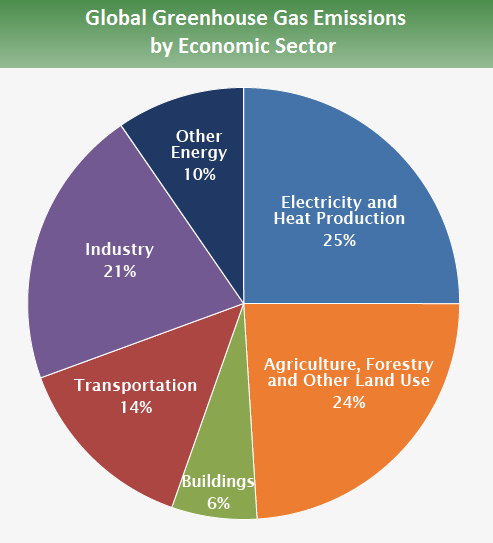
It's repeated several times through the article, though it may not be super clear. I think they just wanted to avoid repeating themselves all the time
0: https://iopscience.iop.org/article/10.1088/1748-9326/ac13f1/...
"If coal and oil plants in the top 5 percent of polluters switched to natural gas, global emissions would drop by 29.5 percent."
So, if top 5% just switch to natural gas of the same electrical generation capacity, the global emission still drops by ~30%.
Reading the actual study, it does seem their rank for "top 5% polluting" is total emissions. They do calculate relative intensity, as you say. But the ranking for plants with greatest emissions was done without regard for capacity.
Also, the "73%" reduction would only be for GHG's from electricity-generation, not all sources.
I mean, obviously coal is a pretty awful fuel from an environmental standpoint and it's good to quantify these things. Just reading these are hard when the authors didn't necessarily make 100% clear the last few tables.
Sadly, I doubt that will happen.
A gentler approach would be a well designed cross border emission tax. This could make operation of these plants economically impractical.
Merely adding a new tax would be the most regressive solution available, as it disproportionately hurts the poorest- the consequences would take longer but could end up just as severe. Maybe they dont have access to plentiful natural gas, or grid storage for renewables. Maybe they simply dont have an economy healthy or government free enough of corruption to invest in the capital required to transition.
A more reasonable approach would be to set up a program that fronts the necessary investments while letting the locals retain control... effectively a free loan. It would certainly meet the criterion of "gentler", at least, and probably cheaper than fuelling the planes and the bombs as well- those things are crazy expensive.
Germany in particular made the stupid decision of shutting down nuclear plants (Fukushima overreaction) and it is pushing this narrative of being a green energy country… to me it sounds like an easy problem to solve once there is enough political attention.
Most likely you fell victim to American newspapers lying to you that Germany is pushing a green narrative. After all they lied about Germany moving back to coal. What happened is that Germany willingly delayed reductions in CO2 emissions. It clearly cared about the nuclear shutdown more than the coal shutdown. However, the articles are always about how emissions went up "because more coal" when that never happened. It's lies upon lies.
Germany is a country that is standing still, neither getting better nor worse and likes it that way. It's not green and nobody pretended that it is green.
What should have happened 20-60 years ago is modular LFTR reactors, they had them at Oak Ridge. Closet sized reactors could probably scale quickly.
> “Another major reason is that many high-carbon production chains were outsourced from developed nations to Chinese cities, thus increasing the export-related emissions of the latter.”
The solution possibly is something more radical than what you're thinking, because the PRC forcing emissions reductions and driving up manufacturing costs could just cause these industries to jump to the next exploitable developing region. I'm thinking more along the lines of strategies to reduce consumerism in general, or match global product prices to their "true" cost considering environmental damage - ideas most pro-infinite-growth capitalists find untenable.
Kind of insane the article and the linked discussion don't include HOW MUCH POWER these places make. I've been reading through those two and I can't find that simple fact.
> Reducing CO2 emissions by targeting the world’s hyper-polluting power plants
https://iopscience.iop.org/article/10.1088/1748-9326/ac13f1/...
https://en.wikipedia.org/wiki/List_of_largest_power_stations
I would love to know about how efficiency varies with plant size (are bigger plants more efficient?) but this study is _mostly_ just stating that bigger power plants produce more emissions in absolute terms, which should be obvious to pretty much anyone.