All quite a sorry state for one of the largest car companies out there.
At this point, they’re doing more harm then good and I’d call them a dirty company and would avoid buying any of their products. They are wasting all their good will that they gained due to them pushing hybrids.
It's unfair to blame all Japanese car makers, but it is definitely fair to blame all American brands of Japanese car makers (as the weird, highly profitable step-children that they are).
It's not like there's a good source of hydrogen that doesn't come from electricity generation anyway. It's "just" a different take on the battery, one that appears to be mostly worse other than charge times.
> And yet, Toyota had no great BEV follow-up
Prius sales trends since debut in 1997 reflect this sentiment in that they were first, executed well, and thus had most of the market. Current Prius sales are dropping off very steadily by year, though.
But to your point on the trade ins, current Tesla Model 3 sales are getting close to Prius' best all time sales of +200K units/year.
https://www.goodcarbadcar.net/total-toyota-prius-sales-figur...
https://www.goodcarbadcar.net/tesla-model-3-sales-figures-us...
Those arguments are true in some part but meaningless or misinformation in some part. I agree that LCA CO2 regulation is win for EU/China and lose for Japan car industry, and now EU car manufacturer become able to make BEV in clean energy so EU pushes the regulation, but decarbonization is now obviously justice so blaming it is nonsense. We're stuck in small land/grid and against nuclear for now.
They also hype about hydrogen cars. Hydrogen seems to good to investigate for truck or other industry vehicle, or dedicated storage, but they overly hype about car with fuel cell or even ICE burning hydrogen. Maybe because who read such article loves ICE.
I think Toyota and Honda did well for decarbonization until the solution become making BEV that needs massive amount of Li-ion (material and power intensive battery).
The tech works, refuels 10x faster than any battery based car, but so far no adoption outside of europe and asian countries.
That's a phenomenal achievement. They chose wrong maybe, but they chose, and chose a path they though most viable.
To claim they aren't in the game is beyond unfair.
https://electrek.co/wp-content/uploads/sites/3/2016/04/hybri...
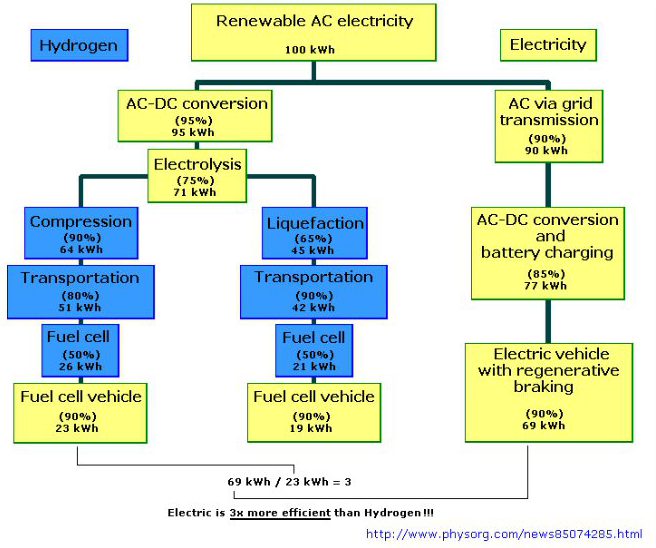
The primary advantage is faster refueling. The price is no in-home refueling -- a big win for BEVs, as most trips will not require refueling on the road. There are also real safety concerns about storing and transporting H2 at very high pressure.
Complete nonsense. Most Hydrogen is produced with natural gas. And the conversion makes and end to end efficiency makes it actually far worse both economically and environmentally.
Maybe in some imaginary future that will not actually happen it is as green.
> refuels 10x faster than any battery based car
Waste overestimation and in reality even if that was true, you are gone spend 100x more times refueling then in an EV. Because EV you simply charge at home and 99% you not gone use any fuel-station.
And Hydrogen charging station still have many problems if you actually attempted to have a high volume of cars using them.
> They chose wrong maybe, but they chose, and chose a path they though most viable.
The path that would give them the most government subsidies and allow them to delay EVs as long as possible.
> To claim they aren't in the game is beyond unfair.
Go look at how many actually FCV have been sold.
https://www.hyundai.news/eu/articles/press-releases/hyundai-...
I give Toyota big props for the Prius, which was the original Green Vehicle 15-20 years ago, and still is a HUGE player in the efficiency space. IIRC, The number one vehicle trade-in for TSLA has been Priuses. Was there even a car before the Prius that used regenerative braking? In many ways, Prius "primed" the market for greener vehicles.
And yet, Toyota had no great BEV follow-up. In a high-tech educated country like Japan, an island nation with extremely large amounts of coastline, I'd assume Toyota and Honda would wise up to climate change earlier.